Vertical Wood Pellet Machine: How It Works & Why It Matters
Kingwood · May 26, 2026
What a Vertical Wood Pellet Machine Actually Does
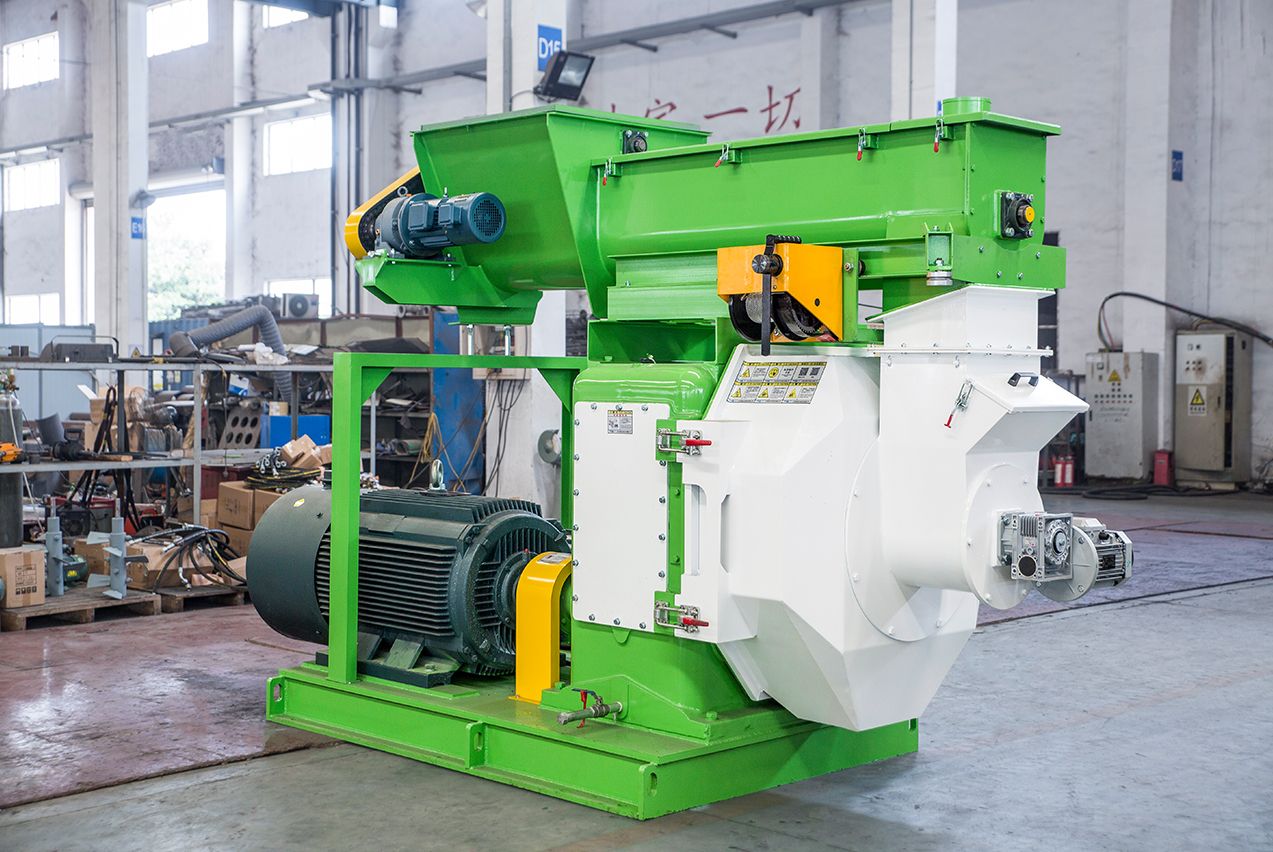
A vertical wood pellet machine — more precisely, a vertical ring die pellet mill — compresses raw biomass into cylindrical pellets of controlled diameter and density. Feedstock enters the compression chamber from above, where a pair of rollers forces it through a perforated ring die. The extruded material is cut to length by an adjustable knife, producing pellets of consistent geometry suitable for automated combustion systems and international commodity trading.
The vertical axis orientation distinguishes this design from horizontal configurations. With the die rotating on a vertical plane, gravitational feed assists material distribution across the die surface, which simplifies feeding mechanics and reduces the risk of uneven roller wear. For plant operators managing tight floor layouts, the vertical format also reduces the machine’s overall footprint — a practical advantage when integrating multiple pelletizing units into a single production hall.
Kingwood’s JWZL series represents this category across five capacity tiers:
| Model | Capacity |
|---|---|
| JWZL-420 | 1–1.5 t/h |
| JWZL-688 | 2–2.3 t/h |
| JWZL-688D | 3–3.5 t/h |
| JWZL-928 | 4–5 t/h |
| JWZL-1068 | Contact sales |
For operations requiring horizontal ring die architecture, Kingwood also manufactures the JZWH-860 horizontal pellet mill, rated at 4–5 t/h.
Feedstock Versatility and Pellet Quality Standards
The industrial appeal of a vertical wood pellet machine lies partly in feedstock flexibility. Kingwood’s JWZL series processes wood chips, sawdust, bark, rice husk, corn stover, straw, and palm shell — essentially any lignocellulosic material with appropriate pre-treatment. Feedstock moisture, particle size distribution, and bulk density each influence die selection, roller gap, and throughput settings. Kingwood’s engineering team assesses these parameters during line design to ensure stable output from the first shift.
Pellet quality on Kingwood production lines consistently reaches:
- Calorific value: 4,800 kcal/kg
- Moisture content: <15% (meets EU EN 14961 and ISO 17225 standards)
- Sulfur content: <0.3% (within Japan’s ≤0.5% threshold)
- Ash content: <18% (below ISO standard ceiling of <20%)
- Dioxin emissions: <0.5 ng TEQ (well below China GB standard of ≤1.0 ng TEQ)
All emission performance from Kingwood-equipped boiler installations falls below the limits defined in GB13271-2001, China’s national Emission Standard of Air Pollutants for Boilers. For buyers targeting export markets in Europe, Japan, or South Korea, these specifications align with the primary certification frameworks those markets require.
The economic argument is direct: biomass pellets produced on Kingwood lines reduce fuel expenditure by 40–50% compared to coal or heavy fuel oil. A 12 t/h wood pellet production line installed in Vietnam in 2024 recovered its full capital cost in 23 months under standard operating conditions.
Complete Line Design vs. Stand-Alone Machine Supply
A pellet mill is the compression core of a production process, not a standalone solution. Raw biomass arrives at a pelletizing facility with variable moisture levels — often 40–55% in freshly chipped wood — far above the <15% threshold the die requires. Without upstream drying and particle size control, die wear accelerates, output drops, and pellet density falls short of specification.
Kingwood addresses this through its wet-feed biomass pellet production line architecture, which sequences:
- Drum chipper — reduces log or branch material to chip dimensions
- Hammer mill (coarse grinding) — reduces chips to fibrous particles
- Drum dryer — reduces moisture to process-target levels
- Hammer mill (fine grinding) — achieves final particle size for die entry
- Vertical pellet mill (JWZL series) — compression and pellet formation
- Counter-flow cooler — reduces pellet temperature and hardens surface
- Pellet packaging machine — bags finished product for storage or shipment
The entire sequence operates under Kingwood’s Three-Standardization Framework: Integrated production lines, Dust-Free production lines, and Automated production lines. Dust-free enclosure is not cosmetic — it directly addresses fire risk, occupational health compliance, and regulatory requirements that affect operating licenses in China, the EU, and Southeast Asia. Kingwood’s Guizhou dust-free biomass pellet workshop (2024) demonstrates this implementation in a live industrial setting.
Maximum designed line capacity reaches 200,000 metric tons per year. Kingwood has planned and engineered over 2,000 production line projects for clients across 30 countries since its founding in 1999.
Selecting the Right Vertical Pellet Mill Configuration
Equipment selection requires matching machine capacity to annual production targets, available feedstock volume, and site infrastructure. Key variables include:
- Feedstock type and moisture range — determines dryer sizing and hammer mill screen selection
- Target pellet diameter — typically 6 mm or 8 mm for industrial fuel applications; die bore configuration differs accordingly
- Operating hours per year — affects both machine sizing and wear part replacement scheduling
- Regulatory environment — dust control requirements vary by jurisdiction and determine enclosure specification
Kingwood’s application engineers conduct feedstock assessments and layout feasibility reviews before equipment specification is finalized. This process draws on 27 years of R&D in biomass pelleting and a 20-person technical team based at Kingwood’s 25,000 m² production facility in Liyang Zhongguancun Industrial Park, Jiangsu Province.
For procurement teams evaluating vertical biomass pellet mills, the relevant starting point is matching the JWZL model tier to verified throughput requirements, then determining whether a stand-alone machine or a complete integrated line better fits the project scope. Kingwood supplies both, with full after-sales support covering installation, commissioning, operator training, and spare parts logistics.
FAQ
What is a vertical wood pellet machine and how does it differ from a horizontal pellet mill?
A vertical pellet mill orients the die and roller assembly along a vertical axis, which reduces the machine's floor footprint compared to a horizontal ring die configuration. This layout suits plants where floor space is constrained without sacrificing throughput. Kingwood produces both types: vertical models (JWZL series) and the horizontal JZWH-860, all based on ring die compression technology.
What biomass materials can Kingwood's vertical pellet mills process?
Kingwood's JWZL series handles wood chips, sawdust, bark, rice husk, straw, palm shell, and other agricultural or forestry residues. Material suitability depends on moisture content, fiber structure, and bulk density — parameters Kingwood engineers assess during line design.
What capacities are available in Kingwood's vertical pellet mill range?
The JWZL-420 produces 1–1.5 t/h; the JWZL-688 produces 2–2.3 t/h; the JWZL-688D reaches 3–3.5 t/h; and the JWZL-928 delivers 4–5 t/h. The JWZL-1068 capacity is project-specific — contact Kingwood sales for sizing.
What fuel quality do biomass pellets produced by these machines achieve?
Pellets produced on Kingwood lines achieve a calorific value of 4,800 kcal/kg, moisture content below 15%, sulfur content below 0.3%, and ash content below 18%. All emission indicators comply with China's GB13271-2001 boiler air pollutant standard.
How much can switching to biomass pellets reduce fuel costs?
Based on Kingwood project data, biomass pellets reduce fuel costs by 40–50% compared to fossil fuels such as coal or heavy oil, with documented payback periods as short as 23 months on a 12 t/h Vietnam installation completed in 2024.
Does Kingwood supply only the pellet mill, or complete production lines?
Kingwood designs and supplies complete wet-feed biomass pellet production lines covering crushing, coarse grinding, drying, fine grinding, pelletizing, cooling, and packaging — fully automated, enclosed, with integrated dust removal. Line capacity reaches up to 200,000 metric tons per year.
What certifications and standards does Kingwood's equipment carry?
Kingwood holds ISO 9001, ISO 14001, and CE certifications, along with designations as a Jiangsu Provincial High-Tech Enterprise and Jiangsu Provincial Specialized & Innovative Niche Leader. The company is listed on China's NEEQ exchange under stock code 871765.
- Global industrial wood pellet demand reached approximately 33 million metric tons in 2023, driven by coal-to-biomass conversions across Europe and East Asia. (2023, IEA Renewables 2023 Report (International Energy Agency))
- Biomass accounted for roughly 55% of total renewable energy consumption in the EU in 2022, with solid biomass (including wood pellets) representing the largest share. (2022, Eurostat Energy Statistics 2022 (European Commission))