Wood Pellet Machine: Uses, Characteristics & Selection Guide
Kingwood · May 26, 2026
pubDate: “2026-05-26” origin_url: “https://www.kingwood-china.com/new/industry-news/the-use-and-characteristics-of-wood-pellet-machine.html” heroImage: “/img/01320a6650a4.jpg” lang: “en” author: “Kingwood” tags:
- “The use and characteristics of wood pellet machine”
What a Wood Pellet Machine Actually Does — and Why It Matters Industrially
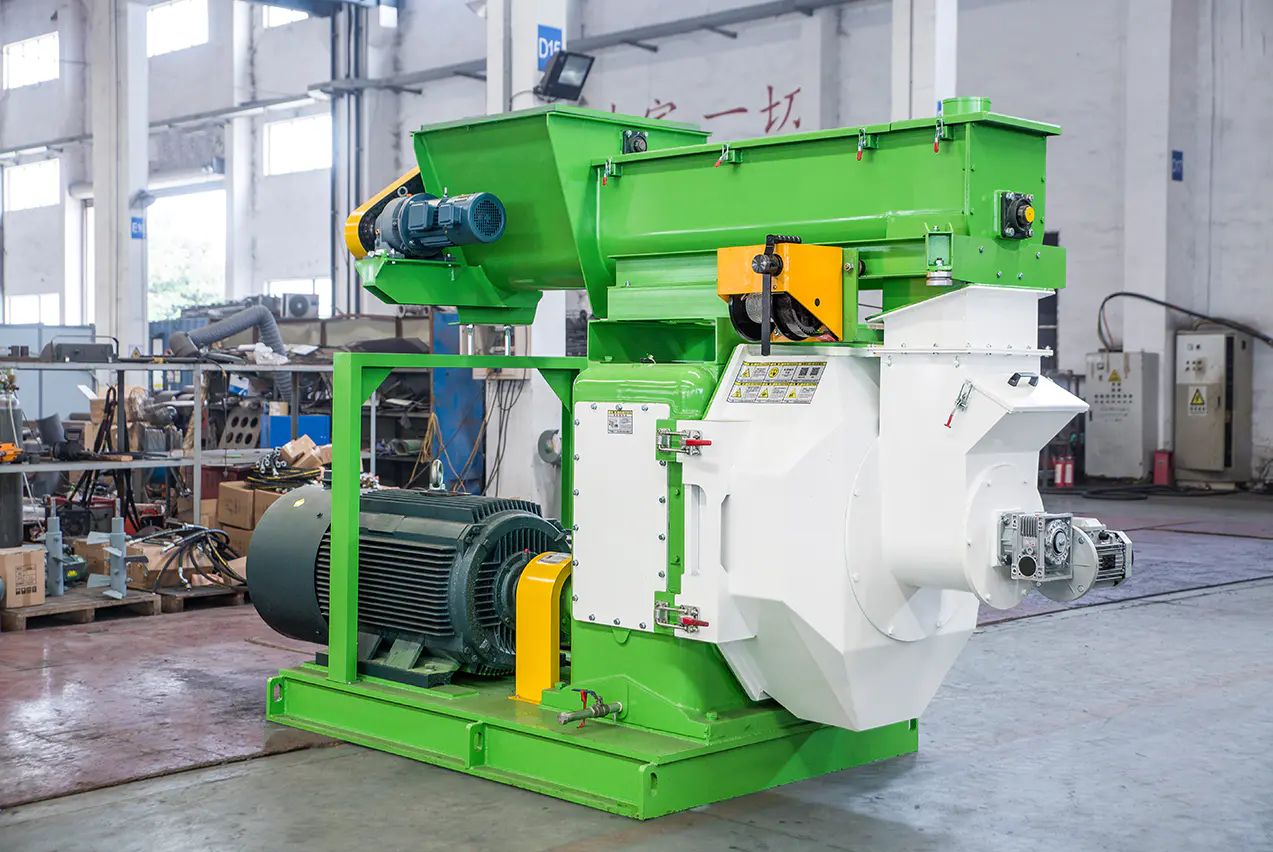
A wood pellet machine — more precisely, a biomass pellet mill — applies mechanical compression to conditioned feedstock, forcing material through calibrated die holes under controlled pressure and temperature to produce uniform, high-density cylindrical pellets. The output is dimensionally consistent, low-moisture, and energy-dense: a direct result of the compression process rather than any added binder.
This matters industrially for two distinct reasons. First, dense pellets are logistically efficient: they store without spoilage, resist moisture uptake, and transport at significantly higher energy density per cubic meter than loose biomass or powder. Second, the pelletizing process itself — particularly the gelatinization of starches under pressure and heat — improves the nutritional availability and palatability of feed-grade material, reducing waste in livestock feeding operations.
Demand for wood pellet machines peaks seasonally in autumn across agricultural markets. Post-harvest volumes of crop straw, corn stalks, and rice husks are at their highest, and operators preparing biomass fuel inventory for winter heating applications place equipment orders during this window. Understanding the technical characteristics of the pellet mill, and how production line configuration affects output quality, is essential before committing capital.
Core Technical Characteristics of Industrial Pellet Mills
Die and Roller Configuration
The ring die is the defining component of an industrial pellet mill. Kingwood’s vertical ring die design — used across the JWZL series — positions the die vertically, allowing gravity to assist feedstock distribution and making the configuration well-suited to the high-moisture, variable-density biomass feedstocks common in agricultural and forestry waste streams. Die hole diameter determines pellet diameter (typically 6–10 mm for fuel pellets, 4–8 mm for feed pellets); die compression ratio — the ratio of effective length to hole diameter — determines pellet hardness and density.
Pressure rollers must maintain consistent gap geometry relative to the die inner surface. Inconsistent gap produces fines, increases energy draw, and accelerates die wear. Kingwood manufactures dies and rollers from alloy steel with controlled heat treatment, subject to dimensional inspection at each production stage.
Feedstock Conditioning Requirements
Raw biomass rarely enters a pellet mill in optimal condition. A complete wet-feed production line addresses this systematically:
- Chipping: Oversized wood waste processed through a drum chipper to 30–50 mm particle size
- Coarse grinding: Hammer mill reduces chip size to ≤5 mm
- Drying: Drum dryer brings moisture content to the 12–15% range required for pelletizing
- Fine grinding: Secondary hammer mill or similar equipment achieves the fine, uniform particle distribution that maximizes die fill and pellet density
- Pelletizing: Ring die pellet mill under controlled throughput
- Cooling: Counter-flow cooler brings pellet temperature down from 70–90 °C at die exit to ambient +5 °C, hardening the pellet structure
- Packaging or bulk handling: Final product handling to specification
Each stage affects pellet quality. Operators who skip or undersize intermediate processing steps — particularly drying and fine grinding — see elevated fines, reduced durability index, and increased die failure rates.
Output Quality Parameters
Biomass fuel pellets produced on Kingwood lines consistently achieve:
| Parameter | Kingwood Specification | Reference Standard |
|---|---|---|
| Calorific value | 4,800 kcal/kg | ISO 18125 |
| Moisture content | <15% | EU / ISO |
| Sulfur content | <0.3% | Japan ≤0.5% |
| Ash content | <18% | ISO <20% |
| Dioxin emissions | <0.5 ng TEQ | China GB ≤1.0 ng TEQ |
Boiler emission performance meets all indicators under China’s GB13271-2001 standard.
Kingwood Pellet Mill Product Range and Installed Capacity
Kingwood — operating as Jiangsu Kingwood Industrial Co., Ltd., listed on NEEQ (stock code: 871765) — has been engineering biomass pellet equipment since 1999. The current product range covers the following vertical ring die configurations:
| Model | Capacity |
|---|---|
| JWZL-420 | 1–1.5 t/h |
| JWZL-688 | 2–2.3 t/h |
| JWZL-688D | 3–3.5 t/h |
| JWZL-928 | 4–5 t/h |
| JWZL-1068 | Contact sales |
The JZWH-860 horizontal pellet mill extends the range to 4–5 t/h in a horizontal ring die configuration for operators with specific process or spatial requirements.
Multi-unit installations scale these capacities substantially. The 24 t/h wood chip pellet production line in Vietnam (2023) illustrates how parallel pellet mill configurations, integrated with full upstream and downstream processing, support commercial-scale biomass fuel production. A separate 12 t/h installation in Vietnam (2024) demonstrated a 23-month capital payback under verified operating conditions.
Complete production lines can be engineered to annual output capacities up to 200,000 metric tons per year, all designed under Kingwood’s Three-Standardization Framework: Integrated process flow, Dust-Free enclosed handling, and Automated PLC control throughout.
Selecting the Right Configuration for Your Operation
The question buyers most frequently misjudge is feedstock heterogeneity. A single-species, consistent-moisture sawdust operation from a furniture manufacturer runs very differently from a multi-feedstock agricultural waste aggregator handling straw, husks, and prunings at variable moisture. The pellet mill specification — die compression ratio, roller surface profile, motor sizing — must match the anticipated feedstock range, not just the target throughput.
For operations new to biomass pellet production, Kingwood’s engineering team conducts feedstock analysis and recommends line configuration based on 27 years of production line design experience across more than 30 countries and over 2,000 planned and designed production line projects. The Guizhou Dust-Free biomass pellet workshop (2024) and Beijing’s first biomass pellet demonstration project (2024) are recent examples of turnkey implementations addressing specific regulatory and environmental requirements.
Kingwood’s facility at #568 Hongsheng Road, Liyang City, Jiangsu Province operates across 31,200 m² of production and office space, with 25,000 m² of manufacturing capacity supporting component fabrication, assembly, and pre-shipment testing. All equipment is certified to ISO 9001, ISO 14001, and CE standards.
For throughput requirements, feedstock assessments, or line configuration consultations, contact Kingwood’s sales engineering team directly.
FAQ
What feedstocks can a wood pellet machine process?
Industrial wood pellet machines handle a broad range of biomass feedstocks including sawdust, wood chips, crop straw, rice husks, corn stalks, and other agricultural or forestry residues. Moisture content and particle size must be conditioned prior to pelletizing for consistent pellet quality.
What are the primary uses of a wood pellet machine in industrial settings?
In B2B contexts, wood pellet machines serve two main applications: producing biomass fuel pellets for industrial boilers and power generation, and producing high-density feed pellets for livestock and poultry operations. Fuel pellets from biomass can reduce energy costs by 40–50% compared to fossil fuel alternatives.
What distinguishes a vertical ring die pellet mill from a horizontal configuration?
Vertical ring die pellet mills are better suited to higher-moisture, lower-density biomass feedstocks and are the standard configuration in Kingwood's JWZL series. Horizontal ring die mills such as the JZWH-860 are designed for specific throughput requirements. Both types compress conditioned material through precision-machined die holes to form uniform pellets.
What pellet quality standards do Kingwood biomass pellets meet?
Kingwood biomass pellets achieve a calorific value of 4,800 kcal/kg, moisture content below 15%, sulfur content below 0.3%, and ash content below 18%. Emission performance meets all indicators specified in China's GB13271-2001 boiler air pollutant standard. These parameters also conform to EU, US, and Japanese import specifications.
What production line capacities does Kingwood offer for wood pellet processing?
Kingwood designs and supplies complete wet-feed biomass pellet production lines from small-scale units up to 200,000 metric tons per year. Individual pellet mill models range from 1 t/h (JWZL-420) to 4–5 t/h per unit (JWZL-928, JZWH-860), with multi-machine configurations supporting higher aggregate throughputs such as the 24 t/h line deployed in Vietnam in 2023.
What does Kingwood's Three-Standardization Framework mean for pellet line buyers?
Kingwood's Three-Standardization Framework mandates that every production line is Integrated (end-to-end process continuity), Dust-Free (enclosed processing with integrated dust removal), and Automated (PLC-controlled with minimal manual intervention). This directly reduces operational labor costs, improves workplace safety compliance, and produces more consistent pellet output at scale.
How long is the typical payback period for a Kingwood wood pellet production line?
Payback periods vary by feedstock cost, output volume, and local energy pricing. A documented 12 t/h Kingwood installation in Vietnam (2024) achieved full capital recovery in 23 months under local market conditions.
- Global industrial wood pellet demand reached approximately 36 million metric tons in 2023, driven by co-firing mandates and renewable heat obligations across the EU, Japan, and South Korea. (2023, IEA Bioenergy Task 40 — Sustainable Biomass Supply Chains, 2024 Annual Report)
- Biomass pellets can reduce fuel costs by 40–50% versus coal and heavy fuel oil in industrial boiler applications, based on verified plant-level comparisons. (2024, Kingwood Engineering — Verified Customer ROI Data (Vietnam 12 t/h Installation, 2024))