How to Choose Pellet Production Equipment for Your Business
Kingwood · May 26, 2026
Selecting pellet production equipment is a capital-intensive decision with long-term operational consequences. The wrong choice—undersized capacity, incompatible feedstock handling, or poor build quality—creates production bottlenecks, elevated maintenance costs, and delayed ROI. This guide outlines the technical and commercial criteria that industrial buyers must evaluate before committing to a pellet production system.
Define Throughput Requirements Before Evaluating Equipment
The starting point is not equipment specifications—it is your production target. Calculate your required annual output, then work backward to the necessary hourly throughput, accounting for planned operating hours, scheduled downtime, and a realistic utilization rate (typically 75–85% for continuous industrial lines).
For biomass fuel production, Kingwood’s vertical pellet mill lineup covers a range of industrial throughput tiers:
| Model | Rated Capacity |
|---|---|
| JWZL-420 | 1–1.5 t/h |
| JWZL-688 | 2–2.3 t/h |
| JWZL-688D | 3–3.5 t/h |
| JWZL-928 | 4–5 t/h |
| JZWH-860 (horizontal) | 4–5 t/h |
For operations requiring output beyond a single machine’s rated capacity, parallel pellet mill configurations or fully integrated production lines—scalable up to 200,000 metric tons per year—are the appropriate architecture.
Never size equipment to current demand alone. If your business case projects volume growth within 36 months, either select a model with headroom or specify a modular line layout that can accommodate additional pellet mills without major civil engineering changes.
Assess Raw Material Characteristics and Line Configuration
Feedstock properties—species, moisture content, particle size, and bulk density—directly determine which equipment configuration is required. This is where many buyers make costly errors by treating a pellet mill as a standalone purchase rather than one stage in an integrated process.
High-moisture biomass (freshly chipped wood, agricultural residue, sawmill byproduct) requires a wet-feed production line. This configuration processes material through sequential stages: drum chipping → coarse hammer milling → drum drying → fine hammer milling → ring die pelletizing → counter-flow cooling → packaging. Each stage must be matched in throughput to prevent upstream accumulation or downstream starvation.
Kingwood’s wet-feed lines are fully automated and enclosed, meaning material moves through the entire sequence under controlled conditions without manual transfer steps. This is not a convenience feature—it is a dust and moisture management necessity. Uncontrolled moisture variation entering the pellet mill die directly affects pellet density, durability, and calorific value.
Target pellet specification also constrains equipment selection. If output is destined for EU, Japanese, or US markets, the finished pellets must meet regional standards. Kingwood’s biomass fuel specification—4,800 kcal/kg calorific value, moisture below 15%, sulfur below 0.3%, and ash below 18%—is engineered to satisfy the EU’s <15% moisture threshold, Japan’s ≤0.5% sulfur limit, and the ISO <20% ash standard simultaneously. Equipment that cannot reliably produce to those tolerances is not suitable for export-oriented operations regardless of its price point.
Evaluate Build Quality, Automation, and Dust Management
Construction Standards
Ring die pellet mills operate under continuous mechanical stress. The die and roller assembly—where biomass is compressed into pellet form—must be manufactured to tight tolerances and from appropriate wear-resistant alloys. Evaluate the manufacturer’s machining capabilities, heat treatment processes, and quality control procedures from raw material intake through finished assembly. Kingwood holds ISO 9001 and ISO 14001 certifications and subjects components to documented quality control at each production stage, from forging through final assembly and pre-shipment testing.
Automation Architecture
Manual or semi-manual pellet lines introduce two problems: labor cost at scale, and process variability. Automated control systems maintain consistent feed rate, die temperature, and pellet discharge, which directly stabilizes output quality. Kingwood’s Three-Standardization Framework—comprising Integrated, Dust-Free, and Automated production line standards—represents a systematic approach to eliminating the variability that plagues manually operated biomass lines.
For high-throughput operations, automation is not optional. A 24 t/h line—such as the Kingwood installation commissioned in Vietnam in 2023—cannot be practically operated at consistent quality without automated feed, monitoring, and discharge systems.
Dust Control
Biomass dust is a combustion hazard and a regulatory liability. Enclosed processing with integrated dust extraction at the grinding, pelletizing, and cooling stages is a minimum requirement for any compliant industrial facility. Kingwood’s Dust-Free line standard, implemented at a 2024 Guizhou facility, demonstrates how fully enclosed material handling eliminates fugitive dust across the entire production sequence—not just at individual emission points.
Total Cost of Ownership: Beyond the Purchase Price
Acquisition cost is one variable in a multi-year ownership equation. Factor in:
- Energy consumption per ton of output — motor efficiency and control system design determine this; it compounds over thousands of operating hours.
- Die and roller wear life — replacement frequency and part availability directly affect uptime and maintenance budgeting.
- Feedstock cost versus output revenue — Kingwood-equipped lines producing biomass fuel report 40–50% cost savings versus equivalent fossil fuel inputs, which is the economic foundation of most project business cases.
- Payback period — a documented Kingwood 12 t/h Vietnam installation achieved full capital recovery in 23 months, a benchmark that reflects both equipment performance and project economics.
Request documented case references from any manufacturer you evaluate. Operational data from comparable projects—throughput achieved, uptime rates, maintenance intervals—is more reliable than specification sheets alone.
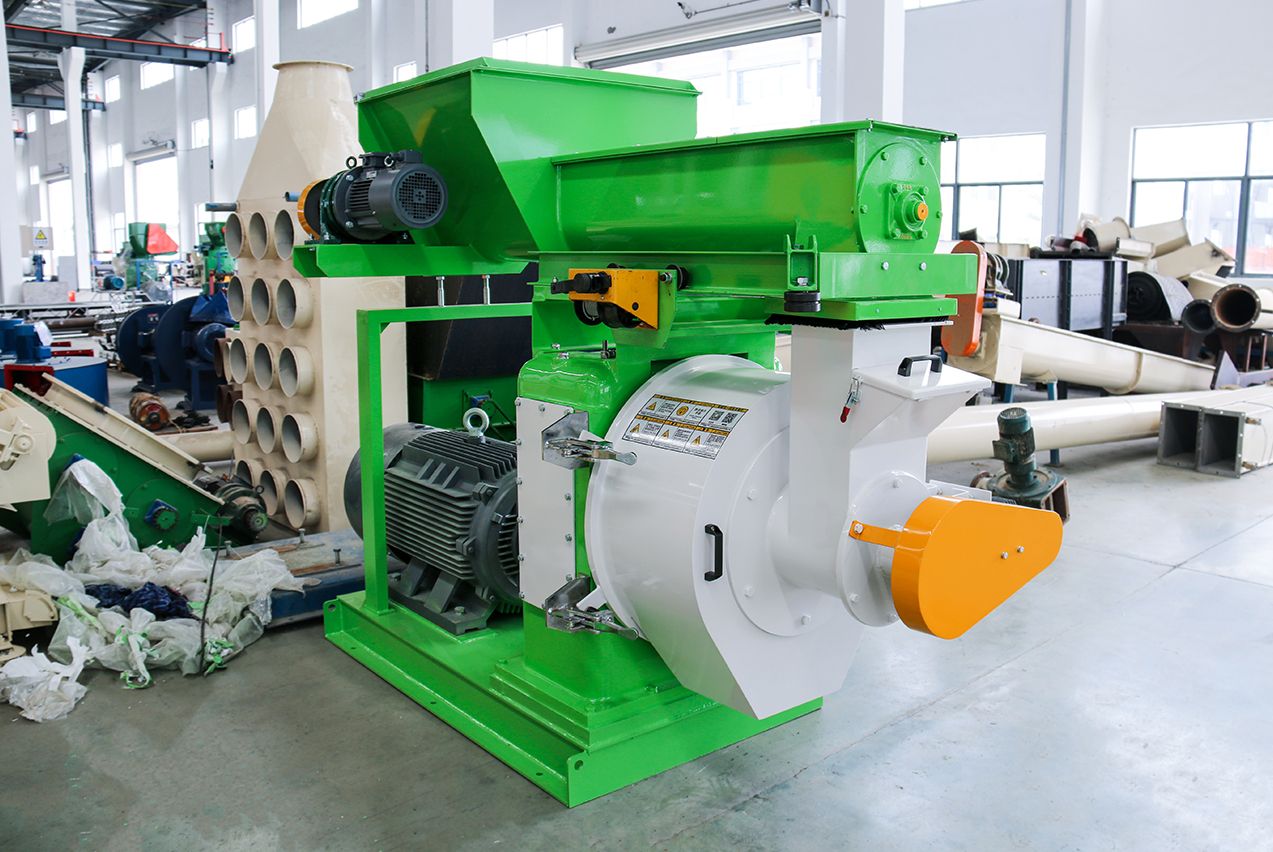
Pictured: Kingwood JWZL-420 vertical biomass pellet mill, rated at 1–1.5 t/h, suitable for small-to-mid-scale biomass fuel operations.
Jiangsu Kingwood Industrial Co., Ltd. (NEEQ: 871765) is headquartered at #568 Hongsheng Road, Liyang City, Jiangsu Province, China. Founded in 1999, Kingwood has planned and designed more than 2,000 production line projects across 30+ countries. For technical consultation or project scoping, contact the Kingwood sales team directly.
FAQ
What types of pellet production equipment should I evaluate for a new biomass facility?
A complete biomass pellet production line typically includes a drum chipper for size reduction, a hammer mill for fine grinding, a drum dryer for moisture control, a ring die pellet mill for densification, a counter-flow cooler for pellet stabilization, and a pellet packaging machine. Evaluating each stage as an integrated system—rather than individual units—reduces bottlenecks and improves overall line efficiency.
What production capacity range do industrial biomass pellet mills cover?
Kingwood's vertical pellet mill models range from 1–1.5 t/h (JWZL-420) up to 4–5 t/h (JWZL-928), with the horizontal JZWH-860 also rated at 4–5 t/h. Complete integrated production lines designed by Kingwood can reach up to 200,000 metric tons per year.
How does raw material moisture content affect equipment selection?
High-moisture biomass feedstocks require a wet-feed production line configuration that incorporates drum drying upstream of pelletizing. Skipping or undersizing the drying stage leads to poor pellet density, die wear, and inconsistent output. Kingwood's wet-feed lines handle the full process—crushing, coarse grinding, drying, fine grinding, pelletizing, and packaging—in an automated, enclosed sequence.
What quality standards should biomass pellets meet for export markets?
Key benchmarks vary by region: the EU requires moisture content below 15%; US standards require calorific value above 2,500 kcal/kg; Japan limits sulfur content to ≤0.5%; ISO standards cap ash content below 20%. Kingwood's biomass fuel specification—4,800 kcal/kg calorific value, <15% moisture, <0.3% sulfur, <18% ash—meets or exceeds all four regional standards.
Why does dust control matter in pellet mill selection?
Biomass dust is a fire and explosion hazard, and also a regulatory compliance issue in most jurisdictions. Kingwood's Dust-Free production line pillar—part of its Three-Standardization Framework—uses fully enclosed processing and integrated dust removal systems to eliminate fugitive dust at every stage, as demonstrated in the 2024 Guizhou facility implementation.
What certifications should a pellet equipment manufacturer hold?
At minimum, look for ISO 9001 (quality management), ISO 14001 (environmental management), and CE marking for export-market compliance. Kingwood holds all three, along with designation as a Jiangsu Provincial High-Tech Enterprise and recognition by the China Biomass Energy Industry Alliance.
How quickly can a biomass pellet production line reach payback?
Payback period depends on feedstock cost, output price, and line utilization. A documented Kingwood 12 t/h line installed in Vietnam in 2024 achieved full investment payback within 23 months. Biomass fuel produced by Kingwood-equipped lines typically delivers 40–50% cost savings versus equivalent fossil fuel inputs.
- A Kingwood-equipped 12 t/h biomass pellet production line in Vietnam (2024) reached full capital payback within 23 months of commissioning. (2024, Kingwood project case: vietnam-wood-pellet-line-12-tph-kingwood-payback)
- Kingwood has planned and designed over 2,000 production line projects serving customers in more than 30 countries since its founding in 1999. (2025, Jiangsu Kingwood Industrial Co., Ltd. — company profile data)