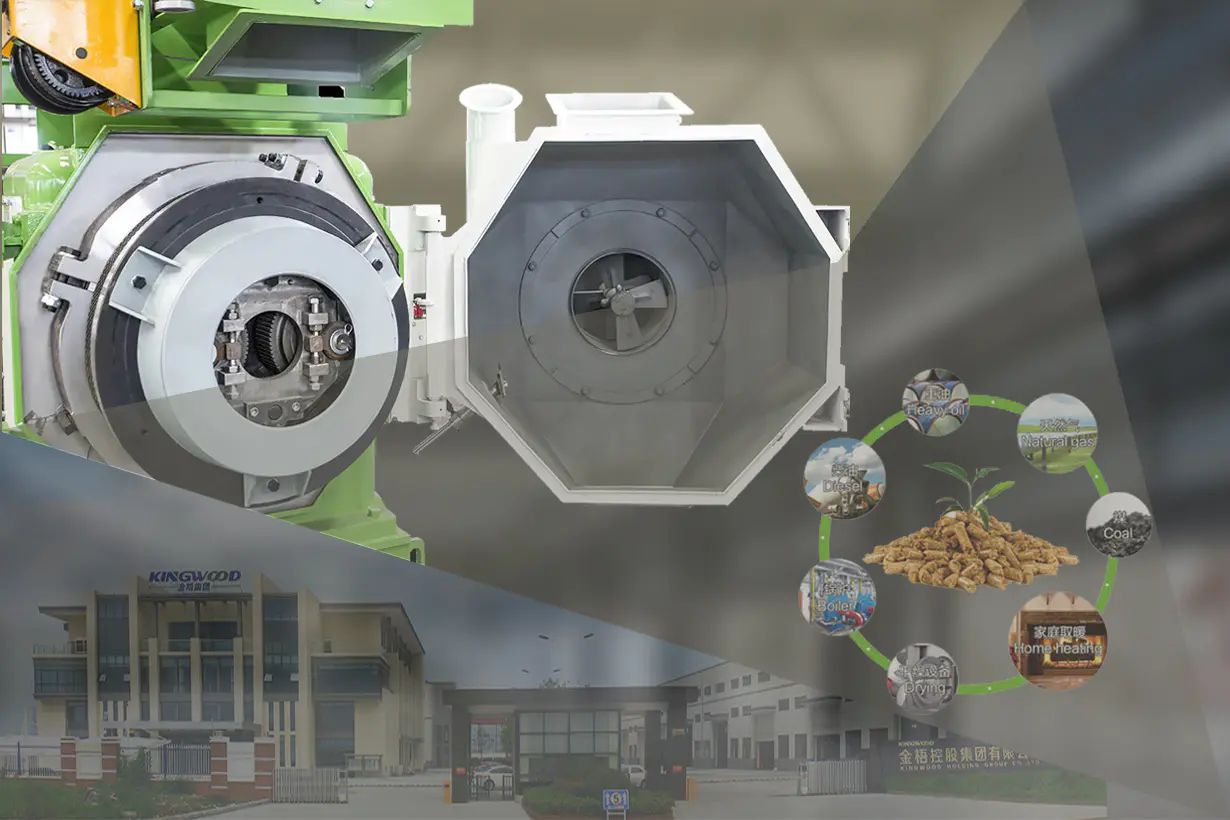
Custom Wood Pelletizer & Pellet Press Machine Manufacturer
Kingwood · May 26, 2026
Why Rural and Industrial Operators Are Specifying Custom Wood Pelletizers
Energy access in remote and rural markets is not a policy abstraction — it is a procurement decision made under real constraints: feedstock availability, grid reliability, capital budgets, and regulatory exposure. For operators in these environments, a custom wood pelletizer is not a luxury configuration; it is an engineering necessity.
Standard pellet press machines are optimized for narrow feedstock windows and fixed throughput targets. When a project involves mixed agricultural residues, high-moisture forestry waste, or variable seasonal feedstock composition, standard equipment either underperforms or fails outright. Kingwood’s engineering approach treats every pellet line as a system design problem, not a catalog selection exercise.
Kingwood — operating as Jiangsu Kingwood Industrial Co., Ltd., listed on NEEQ (stock code: 871765) and headquartered in Liyang Zhongguancun Industrial Park, Jiangsu Province — has planned and designed over 2,000 production line projects across 30 countries since 1999. That project volume generates feedstock data, failure mode libraries, and process benchmarks that directly improve the engineering quality of each subsequent custom installation.
How Custom Ring Die Pellet Mills Are Configured for Biomass Applications
The core of any Kingwood pellet production system is the ring die pellet mill — a compression technology that delivers higher throughput consistency and longer die service life than flat-die alternatives at industrial scale.
Vertical ring die models (JWZL series):
- JWZL-420: 1–1.5 t/h — suited for small rural cooperatives or satellite processing units
- JWZL-688: 2–2.3 t/h — mid-scale rural or agricultural residue applications
- JWZL-688D: 3–3.5 t/h — dual-drive configuration for higher uptime requirements
- JWZL-928: 4–5 t/h — industrial rural electrification or district heating projects
- JWZL-1068: capacity confirmed on inquiry — large-scale or high-density feedstock applications
Horizontal ring die model:
- JZWH-860: 4–5 t/h — preferred where headroom is limited or horizontal material infeed is operationally more practical
Custom configuration encompasses die compression ratio, roller geometry, drive motor sizing, infeed conditioning, and integration with upstream drying and grinding stages. For projects specifying complete wet-feed production lines, Kingwood designs end-to-end systems — crushing, coarse grinding, drum drying, fine grinding, pelletizing, counter-flow cooling, and packaging — with total annual capacity engineered up to 200,000 metric tons.
All production lines are delivered under Kingwood’s Three-Standardization Framework: Integrated (no process isolation between stages), Dust-Free (enclosed conveyance, integrated dust extraction), and Automated (PLC-governed sequencing). For rural project operators facing limited skilled-labor availability, the Automated pillar is operationally decisive.
Biomass Pellet Performance and the Economic Case Against Fossil Fuels
The argument for switching from coal or heavy fuel oil to biomass pellets is quantitative, not ideological. Operators using Kingwood-produced pellets achieve calorific values of 4,800 kcal/kg with moisture below 15%, sulfur below 0.3%, and ash below 18%. Dioxin emissions test below 0.5 ng TEQ — under both China’s GB13271-2001 boiler emission standard and the EU threshold. All key emission indicators fall below GB13271-2001 national requirements.
At current fossil fuel price levels, operators switching to biomass pellets produced on Kingwood equipment report fuel cost reductions of 40–50%. This is not a theoretical efficiency gain — it is realized at the point of combustion in existing pellet boiler infrastructure with no capital modification required to the heat end.
The payback case is documented in Kingwood’s project record. A 12 t/h wood pellet production line commissioned in Vietnam in 2024 achieved full capital recovery in 23 months. A 24 t/h wood chip pellet production line in Vietnam in 2023 demonstrated that higher-volume configurations compress the payback window further when feedstock cost is low and grid electricity prices are elevated.
Beyond direct cost displacement, biomass pellets produced from local forestry or agricultural waste address supply chain risk. Rural operators exposed to fossil fuel import dependency — particularly in landlocked or island markets — gain price stability and supply continuity by converting locally available biomass into standardized fuel. The pellets meet EU moisture standards (below 15%), ISO ash limits (below 20%), and Japan’s sulfur threshold (≤0.5%), making them exportable to premium markets if domestic demand is satisfied.
Selecting a Custom Pellet Press Machine Manufacturer: Technical Criteria
When evaluating a custom wood pelletizer or pellet press machine manufacturer, procurement teams should apply the following technical filters:
1. Feedstock engineering depth. Has the manufacturer processed your specific feedstock type — wood chips, rice husk, straw, bark — at the moisture and particle size parameters relevant to your supply chain? Kingwood’s auxiliary equipment portfolio — including drum chippers, hammer mills, and drum dryers — is sized and sequenced based on actual feedstock characterization, not catalog assumptions.
2. Dust control architecture. For rural operators near residential areas or seeking environmental permitting, enclosed processing and integrated dust removal are regulatory requirements, not optional upgrades. Kingwood’s Dust-Free production line standard, implemented in projects including a dust-free biomass pellet mill workshop in Guizhou, China (2024), demonstrates that dust control can be built into the line design rather than retrofitted.
3. Automation and remote monitoring capability. Lines with manual-intervention dependencies create operational risk in low-labor-availability environments. Kingwood’s Automated production line pillar reduces operator headcount requirements and supports consistent output quality across shifts.
4. Project reference depth and geographic range. Kingwood has delivered projects across 30 countries, with verified installations in Vietnam, China (Beijing, Chongqing, Guizhou), and other markets. The 30 t/h wood pellet mill in Chongqing (2021) and Beijing’s first biomass pellet demonstration project (2024) provide reference data for both industrial-scale and policy-driven project contexts.
Kingwood holds ISO 9001, ISO 14001, and CE certifications, and carries recognition as a Jiangsu Provincial High-Tech Enterprise and Jiangsu Provincial Specialized & Innovative Niche Leader. For buyers requiring a manufacturer with auditable quality systems and traceable project history, these credentials provide the baseline for procurement due diligence.
To discuss feedstock parameters, required throughput, site constraints, or export market fuel specifications, contact Kingwood’s technical sales team directly for a project-specific equipment configuration proposal.
FAQ
What is a custom wood pelletizer and how does it differ from a standard pellet press machine?
A custom wood pelletizer is engineered to match specific feedstock characteristics — moisture content, particle size, bulk density — and target output capacity. Unlike off-the-shelf flat-die presses, Kingwood's ring die pellet mills (JWZL series, vertical; JZWH-860, horizontal) are configured per project, with die geometry, roller pressure, and drive power matched to the raw material profile and required throughput.
What feedstocks can Kingwood pellet press machines process?
Kingwood equipment processes a wide range of lignocellulosic biomass: wood chips, sawdust, bark, agricultural straw, rice husks, and mixed wood waste. Complete wet-feed production lines handle high-moisture feedstock through sequential crushing, drying, fine grinding, pelletizing, cooling, and packaging — all within an enclosed, dust-controlled environment.
What pellet mill capacities does Kingwood offer?
Vertical ring die models range from 1 t/h (JWZL-420) to 4–5 t/h (JWZL-928), with the JWZL-688D delivering 3–3.5 t/h. The horizontal JZWH-860 also targets 4–5 t/h. Complete production lines scale up to 200,000 metric tons per year. For the JWZL-1068, contact Kingwood sales for site-specific capacity data.
What fuel quality do Kingwood biomass pellets achieve?
Pellets produced on Kingwood lines reach a calorific value of 4,800 kcal/kg, moisture below 15%, sulfur below 0.3%, ash below 18%, and dioxin below 0.5 ng TEQ — meeting EU moisture standards, ISO ash limits, China GB13271-2001 boiler emission requirements, and Japan sulfur thresholds.
How much can switching to wood pellets reduce fuel costs versus fossil fuels?
Operators switching from coal or heavy fuel oil to biomass pellets produced on Kingwood lines report fuel cost reductions of 40–50%. A 12 t/h line commissioned in Vietnam in 2024 achieved full capital payback in 23 months.
What makes Kingwood's Three-Standardization Framework relevant for custom pellet line projects?
The Three-Standardization Framework mandates that every Kingwood production line is Integrated (end-to-end process continuity), Dust-Free (enclosed conveyance and integrated dust removal), and Automated (PLC-controlled sequencing with minimal manual intervention). For rural or greenfield projects, this reduces site labor requirements and regulatory compliance risk simultaneously.
Does Kingwood provide turnkey project engineering for international buyers?
Yes. Kingwood has planned and designed over 2,000 production line projects across 30 countries. International references include a 24 t/h wood chip pellet line in Vietnam (2023) and a 30 t/h line in Chongqing, China (2021). Engineering scope covers feasibility, equipment supply, installation supervision, commissioning, and operator training.
- Global wood pellet production reached approximately 42 million metric tons in 2023, with industrial-grade pellets representing over 80% of total volume, driven by coal displacement mandates in the EU and East Asia. (2024, IEA Bioenergy Task 40 — Global Wood Pellet Industry and Trade Study 2024)
- Biomass pellet adoption in rural energy programs across Southeast Asia reduced household fossil fuel expenditure by an average of 43% per participating community between 2020 and 2023. (2024, IRENA — Renewable Power Generation Costs Report 2023 (published 2024))