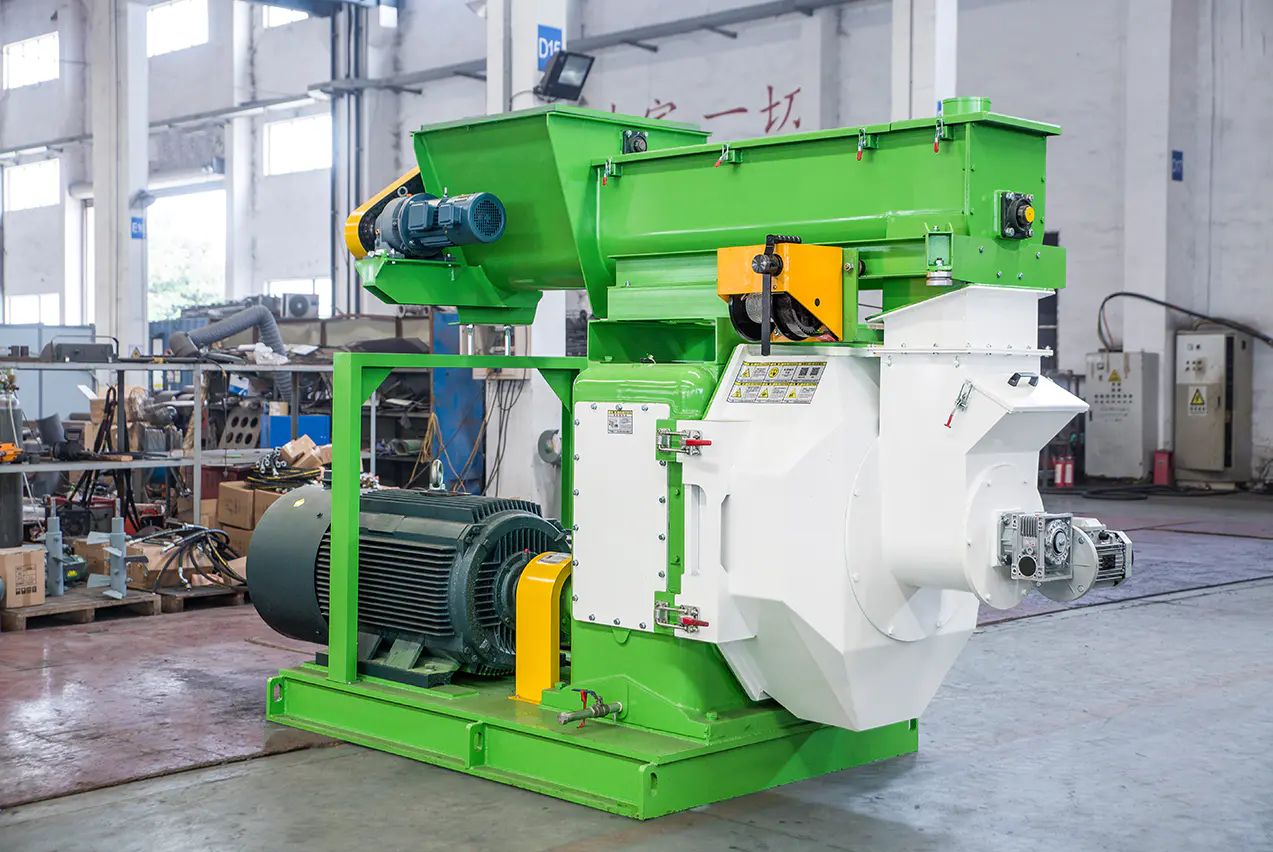
Ring Die Pellet Mills in Biomass Energy Production
Kingwood · May 26, 2026
How Ring Die Pellet Mills Work in Industrial Biomass Processing
A ring die pellet mill is the mechanical core of any high-throughput biomass densification line. The ring die itself is a rotating perforated cylinder; as the die turns, counter-rotating rollers press feedstock against the inner die surface. Material is forced radially outward through precisely dimensioned holes, emerging as dense, cylindrical pellets that are cut to length by stationary knives. The result is a consistent pellet geometry — critical for predictable combustion behavior in industrial boilers and co-firing applications.
The mechanical advantage of the ring die configuration over flat die alternatives lies in its die surface area. A larger active compression zone means higher throughput at equivalent specific energy consumption, and wear is distributed more evenly across the die face. For industrial buyers specifying equipment at 2 t/h and above, the ring die architecture is the standard precisely because it scales without compromising pellet density or durability ratings.
Kingwood’s vertical biomass pellet mill range spans five models — JWZL-420, JWZL-688, JWZL-688D, JWZL-928, and JWZL-1068 — covering output from 1 t/h to multi-tonne-per-hour configurations engineered to individual project requirements. The horizontal JZWH-860 delivers 4–5 t/h for facilities where vertical installation footprint is constrained.
Pre-Processing Equipment: Why Feedstock Preparation Defines Pellet Quality
Ring die pellet mills do not operate in isolation. Pellet quality, energy consumption per tonne, and die service life are all determined substantially upstream of the pelletizing stage. Two pre-processing equipment categories are most consequential for wood-based feedstocks.
Drum chippers reduce oversized wood waste — logs, slabs, timber offcuts — to uniform chip sizes compatible with downstream grinders. Consistent chip geometry prevents bridging in conveyors and ensures even feed distribution at the hammer mill inlet.
Hammer mills provide the fine grinding stage that establishes particle size distribution entering the die. For most ring die applications processing wood feedstock, a geometric mean particle diameter of 0.8–1.2 mm is the target range. Particles that are too coarse produce pellets with visible cracks and low mechanical durability; particles that are too fine increase compression resistance and raise specific energy consumption.
Where feedstock arrives at elevated moisture content — as is common with freshly chipped green wood or agricultural residues — a drum dryer reduces moisture to the sub-15% threshold required for efficient pelletization and for meeting EN ISO 17225-2 and EU fuel quality specifications.
This integrated sequence — drum chipper → hammer mill → drum dryer → ring die pellet mill → counter-flow cooler → packaging — is the architecture Kingwood engineers into complete wet-feed production lines, designed for annual outputs up to 200,000 metric tons. For a documented example at industrial scale, see the 24 t/h wood chip pellet production line project in Vietnam (2023).
OEM Sourcing and Engineering Scope for Ring Die Pellet Equipment
Buyers sourcing ring die pellet mills through OEM or direct-supply channels face several specification decisions that cannot be resolved by catalog data alone. Die hole diameter, compression ratio, die material grade, and roller configuration all interact with feedstock density, moisture profile, and target pellet diameter. Errors in specification translate directly into poor pellet durability, elevated fines generation, or premature die failure.
Kingwood’s engineering team comprises 20 R&D specialists and draws on 27 years of process development across biomass densification. To date, over 2,000 production line projects have been planned and designed, with equipment operating in 30 countries. This project history — spanning wood waste, agricultural straw, rice husk, and mixed biomass streams — provides the empirical basis for feedstock-specific die and roller recommendations that catalog suppliers cannot replicate.
For OEM buyers, Kingwood’s scope extends beyond the pellet mill unit to full production line integration under the Three-Standardization Framework: Integrated, Dust-Free, and Automated production line design. The Dust-Free pillar is particularly relevant for facilities operating under tightening occupational health or environmental permit requirements — a growing constraint across Southeast Asia, Europe, and increasingly in domestic Chinese projects such as the Guizhou dust-free biomass pellet mill workshop (2024).
Pellets produced on correctly specified Kingwood lines meet the following verified performance parameters:
| Parameter | Kingwood Value | Reference Standard |
|---|---|---|
| Calorific value | 4,800 kcal/kg | EU: >4,600 kcal/kg |
| Moisture content | <15% | EN ISO 17225-2 |
| Sulfur content | <0.3% | Japan: ≤0.5% |
| Ash content | <18% | ISO: <20% |
| Dioxin | <0.5 ng TEQ | China GB: ≤1.0 ng TEQ |
These specifications position Kingwood-produced biomass pellets as a commercially viable substitute for coal and heavy fuel oil across industrial boiler applications, with documented fuel cost reductions of 40–50% versus fossil fuel equivalents — the basis of the 12 t/h Vietnam project’s 23-month investment payback.
Jiangsu Kingwood Industrial Co., Ltd. (NEEQ: 871765) operates from a 31,200 m² facility at #568 Hongsheng Road, Liyang City, Jiangsu Province, China, and holds ISO 9001, ISO 14001, and CE certifications alongside recognition as a Jiangsu Provincial High-Tech Enterprise.
FAQ
What is a ring die pellet mill and how does it differ from a flat die design?
A ring die pellet mill uses a rotating perforated cylinder (the ring die) against which rollers press biomass feedstock. Material is forced radially through the die holes, producing dense, uniformly dimensioned pellets. Compared with flat die designs, ring die configurations handle higher throughput, generate more consistent compression across the die face, and are better suited to continuous industrial-scale operation.
What biomass feedstocks can Kingwood's ring die equipment process?
Kingwood's ring die pellet mills and associated pre-processing equipment handle wood chips, sawdust, bark, straw, rice husks, cotton stalks, and other agricultural residues. Complete wet-feed production lines include crushing, coarse grinding, drying, fine grinding, and pelletizing stages to accommodate high-moisture or variable-particle-size feedstocks.
What pellet quality standards do Kingwood production lines meet?
Biomass pellets produced on Kingwood lines achieve a calorific value of 4,800 kcal/kg, moisture content below 15% (EU standard), sulfur content below 0.3% (≤0.5% Japan standard), ash content below 18% (<20% ISO standard), and dioxin content below 0.5 ng TEQ (<1.0 ng TEQ China GB standard). All combustion emission indicators comply with GB13271-2001.
What production capacities are available for ring die pellet mill configurations?
Kingwood's vertical ring die pellet mills range from the JWZL-420 (1–1.5 t/h) through the JWZL-688 (2–2.3 t/h), JWZL-688D (3–3.5 t/h), and JWZL-928 (4–5 t/h) to the JWZL-1068 (capacity on request). The horizontal JZWH-860 also delivers 4–5 t/h. Complete integrated production lines are engineered for up to 200,000 metric tons per year.
What does OEM or custom engineering support look like with Kingwood?
Kingwood's engineering team — 20 dedicated R&D experts with 27 years of accumulated process knowledge — provides full OEM support including feedstock-specific die specification, throughput engineering, dust-free workshop design, and automation integration. Over 2,000 production line projects have been planned and designed globally across 30 countries.
How does ring die pellet production reduce fuel costs compared to fossil fuels?
Biomass pellets produced on ring die lines consistently deliver fuel cost savings of 40–50% versus coal or heavy fuel oil equivalents, based on equivalent calorific output. The high energy density (4,800 kcal/kg) and low sulfur content also reduce flue gas treatment costs and carbon tax exposure.
What auxiliary equipment integrates with a ring die pellet mill production line?
A complete Kingwood wet-feed line integrates a drum chipper for primary size reduction, a hammer mill for fine grinding, a drum dryer for moisture control, ring die pellet mills for densification, a counter-flow cooler for pellet conditioning, and automated pellet packaging equipment — all within an enclosed, dust-free processing envelope.
- Global biomass pellet production capacity exceeded 50 million metric tons in 2023, with industrial-grade wood pellets representing the largest segment by volume. (2023, IEA Bioenergy Task 40 — Sustainable International Bioenergy Trade, 2023 Status Report)
- Biomass pellets meeting EN ISO 17225-2 A1 grade specifications require ash content below 0.7% for premium residential grade and below 2% for industrial grade, with calorific values above 4,600 kcal/kg — thresholds Kingwood production lines are engineered to consistently achieve. (2022, ISO 17225-2:2021 — Solid Biofuels: Fuel Specifications and Classes for Wood Pellets)