How a Drum Wood Crusher Works: Operation & Industrial Uses
Kingwood · May 26, 2026
What Is a Drum Wood Crusher and How Does It Work?
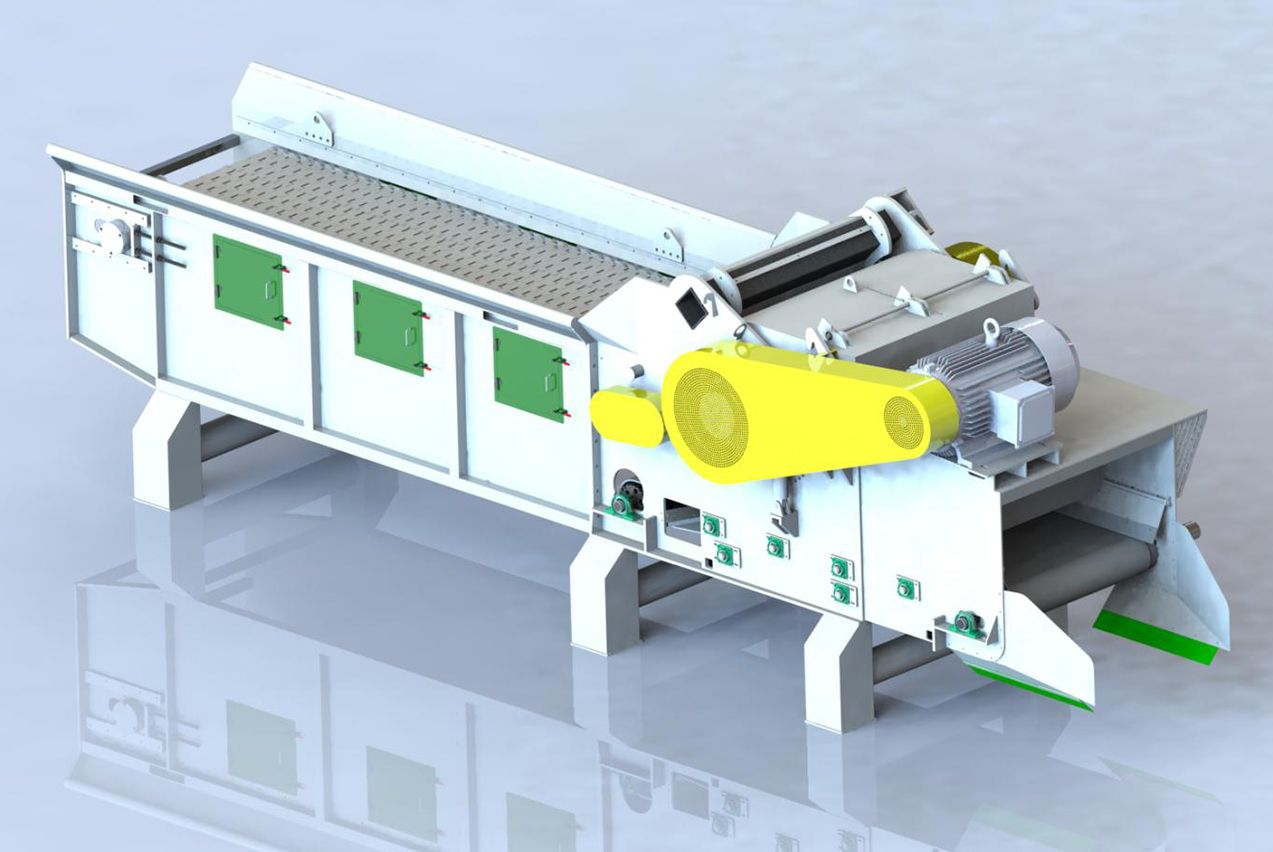
A drum wood crusher — more precisely called a drum chipper — is a primary size-reduction machine designed to convert logs, branches, slabs, and woody residues into uniform chips or coarse sawdust. It is a standard front-end unit in industrial-scale biomass pellet production lines, paper pulp operations, and particleboard manufacturing plants.
The operating principle is mechanically straightforward. A large cylindrical drum, fitted with hardened blades arranged along its outer surface, rotates at high speed inside a reinforced housing. Feedstock — logs, branches, or bulky woody offcuts — is introduced through the infeed opening, typically from the top or via a conveyor. As material contacts the rotating drum, the blades shear it into chips in a continuous, controlled action. A screen beneath the drum governs output particle size: chips that meet the aperture specification pass through; oversized material is retained and re-processed until it reaches specification.
The result is a chip stream with consistent geometry — a critical requirement for any downstream process that depends on uniform feedstock, whether that is a ring die pellet mill, a pulping digester, or a drying system.
Role of the Drum Chipper in a Biomass Pellet Production Line
In a wet-feed biomass pellet production line — the configuration Kingwood designs for clients handling high-moisture raw wood — the drum chipper occupies the first processing stage. Understanding its position clarifies why chip geometry matters so much to overall line performance.
Stage 1 — Primary chipping (drum chipper): Whole logs, branches, and bulky residues are reduced to chips typically 20–50 mm in length, depending on feedstock species and moisture level. This step collapses the bulk density of the infeed and makes subsequent handling, drying, and grinding mechanically feasible.
Stage 2 — Coarse grinding (hammer mill): Chips pass through a Kingwood hammer mill for secondary particle reduction, bringing material to the particle size range required for efficient drying and pelletizing.
Stage 3 — Drying (drum dryer): Ground material enters a drum dryer to reduce moisture content to the sub-15% level required by pellet mill dies and international fuel standards.
Stage 4 — Fine grinding: A second hammer mill pass may be used to achieve the fine, homogenous particle distribution that maximizes pellet density and mechanical durability.
Stage 5 — Pelletizing (ring die pellet mill): Conditioned material is pressed through ring dies in a Kingwood vertical pellet mill — such as the JWZL-928 at 4–5 t/h or the JWZL-688D at 3–3.5 t/h — or the horizontal JZWH-860 for equivalent throughput.
Stage 6 — Cooling and packaging: A counter-flow cooler reduces pellet temperature and hardens the surface, after which a packaging machine completes the line.
Complete Kingwood-designed production lines operate at up to 200,000 metric tons per year capacity, are fully automated and enclosed, and incorporate integrated dust removal — the Dust-Free pillar of Kingwood’s Three-Standardization Framework.
Why Uniform Chip Quality Determines Downstream Efficiency
The drum chipper’s output quality is not simply a pre-processing convenience — it directly governs energy consumption, die wear, and pellet quality in every subsequent stage.
Drying efficiency: A chip stream with consistent thickness dries evenly in a drum dryer. Mixed chip dimensions — the result of a poorly maintained or under-specified chipper — produce a moisture gradient in the dried output. Wet zones in the material entering the pellet mill cause die blockages, reduce throughput, and accelerate wear on ring dies.
Hammer mill throughput: Uniform chips enter hammer mill screens predictably. Oversized pieces overload hammers, generate heat, and increase specific energy consumption per tonne processed.
Pellet density and durability: Fine grinding of consistent chips produces a homogenous particle distribution. Inconsistent particle size distribution before pelletizing creates density variation in the pellet bed, reducing mechanical durability index (MDI) scores — a key commercial specification for industrial biomass fuel buyers.
Kingwood’s biomass pellets, produced through fully integrated lines starting from quality chipping, achieve 4,800 kcal/kg calorific value, below 15% moisture, below 0.3% sulfur, and dioxin emissions below 0.5 ng TEQ. These figures comply with EU moisture standards, US calorific value thresholds, Japanese sulfur limits, and China’s GB national standards simultaneously — a requirement for producers supplying multiple export markets.
For a real-world example of what a complete, high-throughput line delivers, see the Kingwood 24 t/h wood chip pellet production line case study from Vietnam, 2023.
Operational and Commercial Case for Drum Chipping
From a plant economics perspective, integrating a drum chipper at the front of a biomass line produces measurable cost impacts across the full value chain:
- Logistics cost reduction: Chipping at source or at the mill gate dramatically reduces the bulk volume of woody feedstock. Whole logs and branches have very low bulk density; uniform chips load efficiently into conveyors, silos, and transport vehicles, cutting inbound logistics cost per tonne of dry fiber.
- Labor reduction: A drum chipper operating at industrial scale replaces high volumes of manual size-reduction labor. Automated infeed conveyors and discharge systems minimize operator intervention, consistent with Kingwood’s Automated production line standard.
- Feedstock flexibility: Drum chippers process a wide range of species, moisture levels, and log diameters without die changeover. This flexibility is commercially significant for producers who source feedstock from multiple supply streams — mixed hardwood, softwood, agricultural woody residues — as is common in Southeast Asian and European biomass markets.
- Biomass fuel economics: Kingwood data indicates that biomass fuel produced through properly integrated lines, beginning with correct chipping, delivers 40–50% cost savings versus fossil fuel alternatives for industrial heat and power users.
Kingwood has planned and designed over 2,000 production line projects across 30 countries since its founding in 1999. The engineering judgment embedded in those projects — including drum chipper selection, sizing, and integration — is applied to every new line design the Liyang engineering team undertakes.
Jiangsu Kingwood Industrial Co., Ltd. (NEEQ: 871765) is headquartered at #568 Hongsheng Road, Liyang Zhongguancun Industrial Park, Jiangsu Province, China. For drum chipper specifications, line design consultation, or project quotations, contact the Kingwood sales team directly.
FAQ
What is a drum wood crusher and how does it differ from a hammer mill?
A drum wood crusher (also called a drum chipper) uses rotating blades mounted on a cylindrical drum to slice logs and branches into uniform chips. A hammer mill, by contrast, uses impact force from swinging hammers to grind material into finer particles. Drum chippers are preferred for primary size reduction of large-diameter feedstock, while hammer mills handle secondary grinding for pellet-ready particle sizes.
What materials can a drum wood crusher process?
Drum wood crushers are designed to handle logs, branches, slabs, offcuts, and woody agricultural residues. They can process both green (high-moisture) and dry wood, making them suitable as the first stage in a wet-feed biomass pellet production line.
What chip size does a drum wood crusher produce?
Output chip dimensions are controlled by the screen aperture and blade configuration. Typical chip lengths range from 10 mm to 50 mm depending on downstream process requirements — finer for pellet lines, coarser for direct combustion or board manufacturing.
How does a drum chipper fit into a complete biomass pellet production line?
In a wet-feed pellet production line, the drum chipper is the primary size-reduction step. Oversized logs and branches are chipped first, then conveyed to a hammer mill for fine grinding, passed through a drum dryer to reduce moisture, and finally pelletized in a ring die pellet mill such as the Kingwood JWZL or JZWH-860 series.
What are the main operational advantages of a drum wood crusher?
Key advantages include high throughput with low operator intervention, consistent chip geometry that improves downstream processing uniformity, reduced transportation and storage volume versus whole logs, and compatibility with a wide range of wood species and moisture levels.
Is drum chipper output suitable for biomass fuel production?
Yes. Wood chips produced by a drum chipper serve as the primary feedstock for biomass pellet lines. Kingwood's biomass pellets produced from this feedstock achieve a calorific value of 4,800 kcal/kg, moisture content below 15%, sulfur content below 0.3%, and dioxin emissions below 0.5 ng TEQ — meeting EU, US, Japanese, and Chinese national standards.
What certifications and standards govern Kingwood drum chipper equipment?
Kingwood drum chippers are manufactured under ISO 9001 and ISO 14001 quality and environmental management systems and carry CE certification. All equipment produced at Kingwood's 25,000 m² manufacturing facility in Liyang, Jiangsu undergoes strict quality control from raw material procurement through finished product shipment.
- Global wood pellet production reached approximately 42 million metric tons in 2023, with industrial-grade chipping equipment at the core of every major production line. (2024, IEA Bioenergy Task 40 — Sustainable Biomass Supply Chains, 2024 Annual Report)
- Biomass energy accounted for roughly 55% of total renewable energy consumption in the EU in 2022, sustaining strong demand for upstream wood chipping and size-reduction equipment. (2023, Eurostat — Renewable Energy Statistics, 2023 edition)