How Advanced Pellet Mill Design Drives Higher Production Rates
Kingwood · May 26, 2026
Why Pellet Mill Engineering Determines Line Profitability
In industrial biomass fuel production, the pellet mill is the rate-limiting machine in the entire process chain. Every upstream step—chipping, drying, grinding—exists to deliver conditioned feedstock to the pelletizer at the right particle size and moisture level. Every downstream step—cooling, screening, packaging—depends on the mill producing consistent pellet geometry and density. This means that engineering decisions made at the pellet mill level propagate directly into throughput figures, energy consumption per ton, and ultimately, the return on capital for the entire facility.
The market context makes this consequential. Industrial demand for biomass pellets has expanded steadily across power generation, industrial steam, and district heating sectors in Europe, Japan, South Korea, and Southeast Asia. Producers competing for long-term off-take contracts must demonstrate not only pellet quality compliance—moisture <15%, calorific value ≥4,800 kcal/kg, sulfur <0.3%, ash <18%—but also the production reliability to fulfill contracted volumes consistently across seasons and feedstock variations.
The engineering of the pellet mill itself is where these commitments are either supported or undermined.
Precision Ring Die Engineering and Throughput Efficiency
The ring die is the core productive component of any industrial pellet mill. Its geometry—hole diameter, compression length, and the ratio between them—determines both the mechanical energy required to form each pellet and the structural density of the finished product. Poorly specified or worn dies increase resistance, raise specific energy consumption, and generate pellet fines that must be recirculated or discarded.
Modern ring die design incorporates metallurgical advances that extend operational lifespan and maintain consistent compression geometry across hundreds of operating hours. High-alloy steel with controlled surface hardness resists the abrasive wear patterns that degrade die performance and shift pellet quality out of specification. Precision-machined roller assemblies maintain uniform gap geometry across the full width of the die face, preventing the uneven compression that produces mixed-density pellet batches.
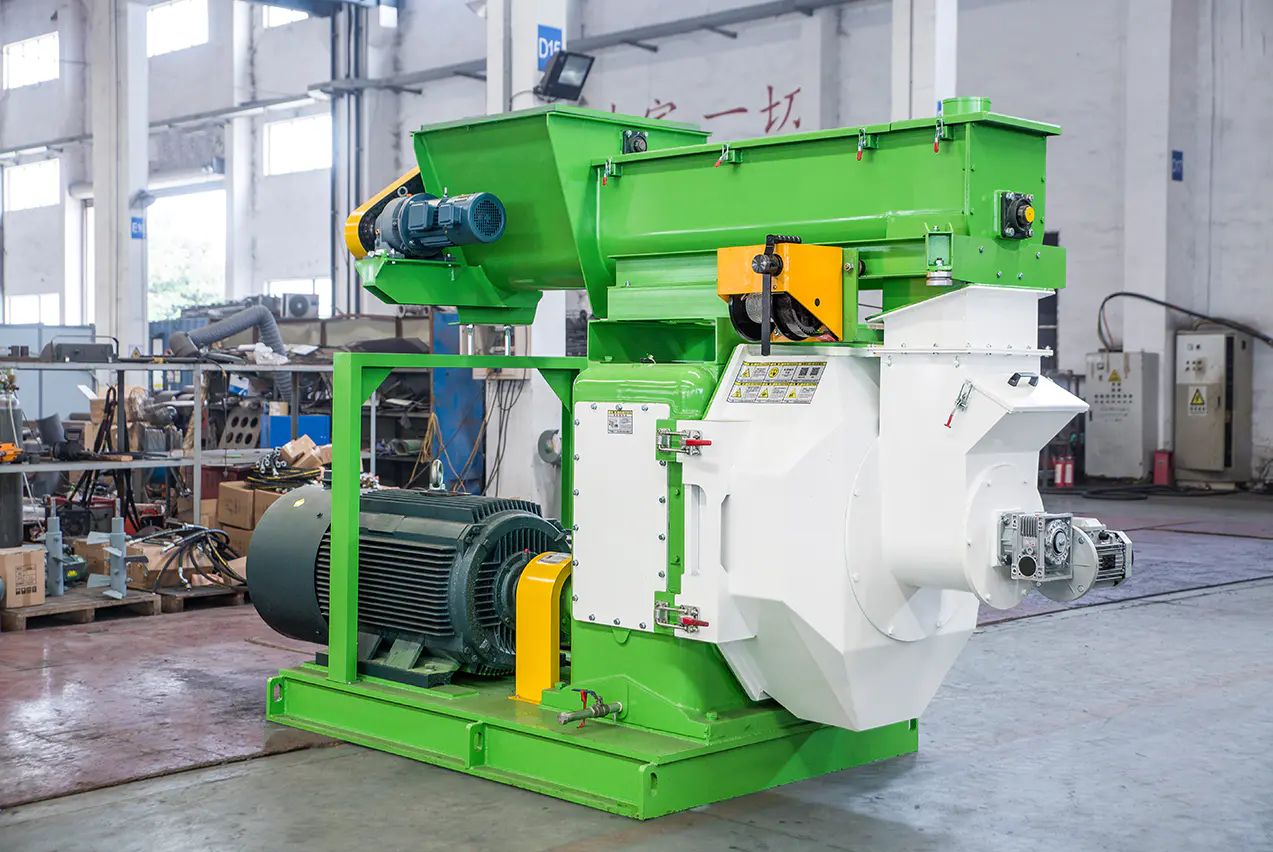
The throughput impact is direct. Kingwood’s JWZL-928 vertical biomass pellet mill, for example, achieves 4–5 t/h under design conditions. The JWZL-688D delivers 3–3.5 t/h, and the JZWH-860 horizontal configuration matches the JWZL-928 at 4–5 t/h. Across a production line with multiple mills operating in parallel, the cumulative effect of die efficiency on annual output is substantial. See Kingwood’s full pellet mill product range for detailed specifications across all models.
Self-lubricating bearing housings and modular die-change systems reduce maintenance windows. Where traditional configurations required extended shutdowns to replace worn dies, modular designs allow component exchange within a single shift, keeping annualized availability figures high.
Automation, Process Control, and Consistent Pellet Quality
Throughput figures are only meaningful if the pellets being produced meet specification consistently. Batch-to-batch variation in pellet density, length, or moisture content creates downstream problems: inconsistent combustion performance, increased fines generation during transport, and the risk of quality rejection at the point of delivery.
Closed-loop process control addresses this directly. Modern pellet mill control systems monitor feed rate, die temperature, motor load, and pellet discharge characteristics in real time, adjusting operating parameters continuously to maintain the compression conditions that produce on-specification pellets. When feedstock moisture shifts—as it does naturally with seasonal variation in biomass supply—automated systems compensate before the shift propagates into product quality problems.
Kingwood integrates this control architecture into complete wet-feed production lines designed for high-moisture biomass inputs. The full process sequence—drum chipping, coarse grinding via hammer mill, drum drying, fine grinding, pelletizing via ring die mill, counter-flow cooling, and automated packaging—operates as a coordinated system rather than a collection of independent machines. This integration is a core element of Kingwood’s Three-Standardization Framework: Integrated, Dust-Free, and Automated production lines that meet the operational standards required for bankable industrial biomass projects.
The dust-free enclosed processing specification matters beyond regulatory compliance. Dust accumulation in pellet facilities is a fire and explosion hazard that creates both safety liability and unplanned production interruptions. Kingwood’s dust-free biomass pellet mill workshop implementation in Guizhou (2024) demonstrates how enclosed processing architecture integrates with production design from the facility level down.
Feedstock Flexibility and Complete Line Capacity
Industrial biomass producers rarely operate with a single, invariant feedstock. Wood residue composition varies by species and processing origin. Agricultural residue availability is seasonal. Energy crop characteristics differ from forestry byproducts. A production line that can only process one feedstock efficiently is a line with constrained utilization rates.
Kingwood’s complete wet-feed line design accommodates this reality. The line handles high-moisture biomass inputs across a range of material types, with the drum dryer stage reducing moisture to pelletizing-compatible levels before fine grinding and ring die compression. Adjustable operating parameters allow operators to tune compression conditions for different feedstock densities and fiber structures without requiring capital modifications to the line.
At scale, Kingwood designs complete lines up to 200,000 metric tons per year capacity. The 2023 Vietnam installation at 24 t/h and the 2024 Vietnam 12 t/h installation with a documented 23-month payback period demonstrate how this line architecture performs under commercial operating conditions in export-oriented biomass fuel markets.
Biomass fuel produced on these lines consistently achieves the cost structure that drives buyer interest: operational cost 40–50% below equivalent fossil fuel energy, with emission performance across all indicators below China’s GB13271-2001 boiler emission standard—and well within EU, US, and Japanese import specifications.
For producers evaluating pellet mill configurations for new or expanded facilities, the engineering decisions at the mill level are the decisions that determine whether production targets, quality specifications, and investment returns are achievable over the facility’s operating life.
FAQ
What design features in a modern biomass pellet mill most directly increase production throughput?
High-performance ring die and roller assemblies reduce internal friction and improve compression efficiency, allowing more material to be processed per hour. Combined with automated feed-rate control and optimized drive systems, these features raise throughput without sacrificing pellet density or calorific value.
How does automation improve pellet mill production rates?
Closed-loop control systems continuously monitor and adjust temperature, pressure, and feed rates in real time. This eliminates manual variability, maintains optimal pelletizing conditions, and prevents the micro-stoppages that accumulate into significant lost output across a production shift.
What maintenance design features reduce unplanned downtime in industrial pellet mills?
Self-lubricating bearing assemblies, modular wear components, and quick-change ring die configurations reduce both scheduled maintenance windows and unplanned breakdowns. Kingwood's vertical pellet mill models are engineered with accessible component layouts to minimize service time.
Can a single pellet mill handle multiple biomass feedstocks without retooling delays?
Yes. Modern pellet mills with adjustable die gap settings and variable feed systems can transition between feedstocks—wood chips, agricultural straw, energy crops—with minimal adjustment time. Kingwood complete wet-feed production lines are designed to handle high-moisture biomass across a range of species and moisture levels.
What pellet quality specifications should industrial buyers target for fuel-grade biomass pellets?
For industrial biomass fuel applications, target calorific value ≥4,800 kcal/kg, moisture content <15%, sulfur content <0.3%, and ash content <18%. These specifications align with EU moisture standards and exceed the US calorific minimum of 2,500 kcal/kg.
How large a production line can Kingwood design and supply?
Kingwood engineers complete wet-feed biomass pellet production lines up to 200,000 metric tons per year capacity, covering the full process chain: drum chipping, coarse grinding via hammer mill, drum drying, fine grinding, pelletizing, and automated packaging.
What is the typical investment payback period for an industrial biomass pellet production line?
Based on a documented 12 t/h Kingwood installation in Vietnam (2024), the investment payback period was 23 months. Biomass fuel produced on Kingwood lines typically costs 40–50% less than equivalent fossil fuel energy, which is the primary driver of rapid payback.
- Global industrial wood pellet demand reached approximately 28 million metric tons in 2023, with Asia-Pacific import volumes growing at over 10% year-on-year. (2023, IEA Bioenergy Task 40 — Sustainable International Bioenergy Trade, 2023 Annual Report)
- Biomass pellets complying with ISO 17225-2 grade A1 specifications achieve calorific values of 4,600–5,000 kcal/kg, making pellet mill die and roller precision a direct determinant of fuel product value. (2024, ISO 17225-2:2021 — Solid Biofuels: Fuel Specifications and Classes for Wood Pellets, reaffirmed 2024)