The Future of Pellet Production: Key Innovations in Equipment
Kingwood · May 26, 2026
Why Pellet Production Innovation Is Now a Strategic Industrial Priority
Global demand for biomass pellets has grown sharply over the past decade. The drivers are structural: tightening carbon emission regulations, industrial decarbonization targets, and the measurable cost advantage of biomass fuel over fossil alternatives. For industrial buyers — power utilities, district heating operators, feed manufacturers, and large-scale process heat users — sourcing reliable, high-quality pellets at scale requires suppliers whose equipment delivers consistent output, low downtime, and verifiable emission compliance.
Kingwood, established in 1999 and headquartered at the Liyang Zhongguancun Industrial Park in Jiangsu Province, China, has spent 27 years engineering pellet production equipment for exactly this market. With over 2,000 production line projects planned and designed, deployments in 30 countries, and a certified annual biomass fuel production capacity of 10,000,000 metric tons, the company’s engineering trajectory reflects where the industry is heading.
Advanced Pellet Mill Design: From Ring Die Engineering to Wet-Feed Processing
The pellet mill remains the core unit operation in any biomass production line. Modern industrial-grade ring die pellet mills differ substantially from earlier designs in throughput stability, die longevity, and feedstock flexibility.
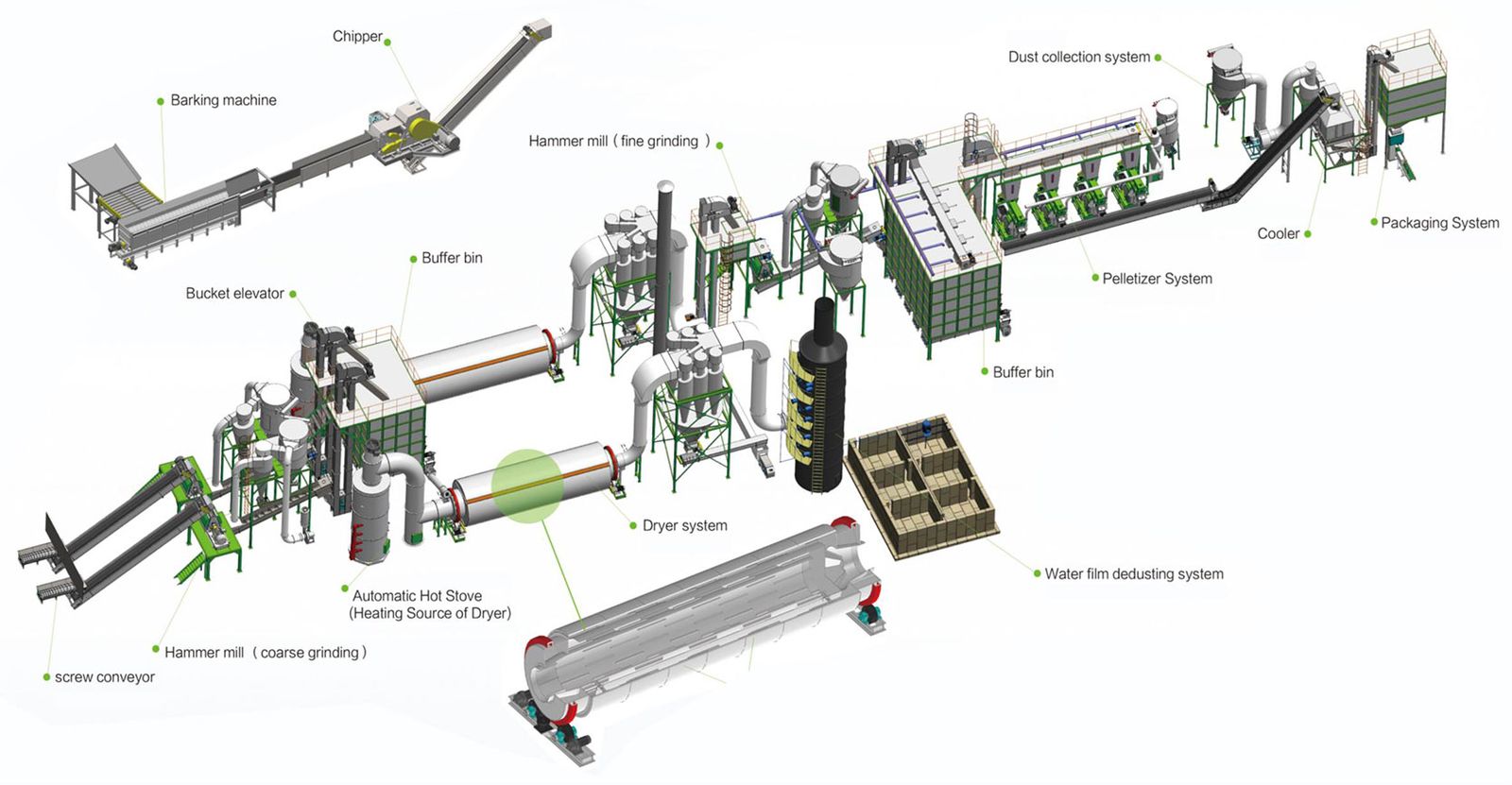
Kingwood’s current pellet mill lineup covers both vertical and horizontal configurations. The vertical series — JWZL-420, JWZL-688, JWZL-688D, JWZL-928, and JWZL-1068 — spans capacities from 1 t/h to 4–5 t/h per unit. The horizontal JZWH-860 also operates at 4–5 t/h. These are not standalone machines: they are engineered as components within complete wet-feed production lines that process high-moisture biomass through an integrated sequence of crushing, coarse grinding, drying, fine grinding, pelletizing, and packaging.
This wet-feed line architecture matters for industrial operators sourcing from agricultural regions or forestry operations where green chips and high-moisture residues are the available feedstock. Processing fresh biomass without pre-drying externally reduces logistics cost and preserves feedstock availability windows. The drum dryer and counter-flow cooler within the line manage moisture precisely, ensuring the finished pellet meets the sub-15% moisture specification required by EU and international standards.
Complete lines are engineered for up to 200,000 metric tons per year — a capacity tier relevant for utility-scale power and industrial heat applications. For reference, Kingwood’s 30 t/h deployment in Chongqing, China (2021) and the 24 t/h wood chip pellet production line in Vietnam (2023) demonstrate what these systems deliver at operational scale.
The Three-Standardization Framework: Automation, Integration, and Dust-Free Operation
Equipment specification alone does not determine pellet plant performance. Production line architecture — how individual units are integrated, how material flows are controlled, and how particulate emissions are managed inside the facility — has an equal impact on output quality, operating cost, and regulatory compliance.
Kingwood’s Three-Standardization Framework addresses this directly. The three pillars are:
- Integrated production lines: All process stages — from raw material intake to finished pellet packaging — are engineered as a single continuous system, eliminating inter-stage bottlenecks and material handling losses.
- Dust-free production lines: The entire processing environment is enclosed with integrated dust removal. This is not a peripheral add-on; it is a design standard built into the line from the outset. Kingwood’s dust-free biomass pellet mill workshop in Guizhou (2024) illustrates this implementation in an operational facility.
- Automated production lines: Automated control covers feeding, pellet formation, drying, cooling, and packaging. Real-time process data allows operators to adjust parameters remotely, schedule preventive maintenance, and document output quality for compliance reporting.
This framework is not a marketing label. It is a structured engineering approach that reduces labor requirements, improves pellet consistency, and brings facilities into compliance with occupational health and environmental standards simultaneously. For industrial buyers evaluating total cost of ownership rather than unit price alone, these distinctions are operationally significant.
Industry 4.0 integration extends this further. Remote monitoring systems tied to equipment sensors give plant managers visibility into energy consumption per ton, die wear rates, moisture deviations, and throughput trends — from any location. Predictive maintenance intervals can be set based on actual operational data rather than fixed schedules, which reduces both unplanned downtime and excessive preventive replacement.
Sustainable Feedstocks and Verified Fuel Performance
The biomass pellet market is not uniform. Power utilities operating under emission trading schemes require pellets with certified calorific values and documented feedstock chains. Industrial boiler operators replacing coal or heavy fuel oil need drop-in fuels that do not require burner modification and that comply with local air quality standards.
Kingwood biomass pellets are produced to the following verified specifications:
- Calorific value: 4,800 kcal/kg
- Moisture content: <15%
- Sulfur content: <0.3%
- Ash content: <18%
- Dioxin content: <0.5 ng TEQ
All emission indicators comply with China’s GB13271-2001 boiler air pollutant standard. The specifications also satisfy EU moisture requirements (<15%), US calorific benchmarks (>2,500 kcal/kg), ISO ash limits (<20%), and Japan’s sulfur standard (≤0.5%). For industrial procurement teams qualifying suppliers across multiple jurisdictions, this cross-standard compliance is a practical requirement, not a marketing point.
On feedstock sourcing, industrial-scale pellet lines process wood chips from responsibly managed forestry operations and sawmill residues, as well as agricultural crop residues including corn stover, wheat straw, and similar materials. Utilizing residues that would otherwise be landfilled or burned in the field directly reduces the net carbon footprint of the fuel chain. Kingwood’s 12 t/h pellet production line in Vietnam (2024) achieved investment payback within 23 months — a data point that quantifies the financial case for responsible-sourcing biomass operations at industrial scale.
The headline economic argument for industrial biomass fuel adoption remains consistent: verified cost savings of 40–50% versus fossil fuel equivalents, with full compliance against applicable emission standards.
Kingwood: Engineering Credentials and Deployment Scope
Jiangsu Kingwood Industrial Co., Ltd. operates from a 31,200 m² facility — 25,000 m² of production space and 6,200 m² of offices — in Liyang, Jiangsu. The company holds ISO 9001 and ISO 14001 certifications, CE marking, and multiple provincial and national technology enterprise designations, including Jiangsu Provincial High-Tech Enterprise and Jiangsu Provincial Specialized & Innovative Niche Leader status. Kingwood is listed on the NEEQ (stock code: 871765) and is a Deputy Director Member Unit of the China Biomass Energy Industry Alliance.
A dedicated R&D team of 20 experts drives ongoing product development. The company’s complete biomass pellet production line offering covers consultation, design, equipment manufacture, logistics, installation, commissioning, operator training, and after-sales service — a full-cycle engineering partnership model suited to industrial capital projects.
For production line inquiries, technical specifications, or project feasibility consultation, contact Kingwood’s engineering team directly.
FAQ
What are the latest innovations driving efficiency in industrial pellet production?
Key innovations include advanced ring die pellet mills capable of processing diverse biomass feedstocks at high throughput, full production line automation covering raw material feeding through packaging, integrated dust removal systems, and real-time Industry 4.0 monitoring platforms that reduce downtime and optimize energy consumption.
What biomass feedstocks can modern pellet production lines process?
Industrial pellet production lines can process wood chips, sawmill residues, agricultural crop residues such as corn stover and wheat straw, forestry waste, and other high-moisture biomass materials. Kingwood's wet-feed pellet production lines are specifically engineered to handle high-moisture inputs through integrated drying and grinding stages.
How does automation improve pellet manufacturing unit performance?
Automated production lines monitor and control raw material feeding, pellet formation, drying, cooling, and packaging in real time. This reduces labor requirements, improves consistency, minimizes waste, and enhances worker safety — all measurable improvements over manually operated systems.
What emission and quality standards do industrial biomass pellets meet?
Kingwood biomass pellets achieve a calorific value of 4,800 kcal/kg, moisture content below 15%, sulfur content below 0.3%, and ash content below 18%. All emission indicators comply with China's GB13271-2001 boiler air pollutant standard, and the fuel specifications also satisfy EU moisture standards, US calorific benchmarks, and ISO ash limits.
How does Industry 4.0 integration benefit pellet plant operators?
Remote monitoring and control systems provide real-time data on equipment performance, energy consumption, and quality metrics across the entire production line. Operators can make timely process adjustments and schedule preventive maintenance without being on-site, maximizing uptime and reducing unplanned stoppages.
What is Kingwood's Three-Standardization Framework and why does it matter?
Kingwood's Three-Standardization Framework standardizes pellet production lines across three dimensions: integrated process design, dust-free enclosed operation, and full automation. This framework is a structural engineering approach that improves product quality, operational safety, and environmental compliance simultaneously.
What throughput capacities are available for industrial biomass pellet production lines?
Kingwood's vertical pellet mills range from 1 t/h (JWZL-420) to 4–5 t/h (JWZL-928), while complete engineered production lines are designed for up to 200,000 metric tons per year. Deployed projects include a 24 t/h line in Vietnam (2023), a 12 t/h line in Vietnam (2024), and a 30 t/h line in Chongqing, China (2021).
- Global biomass pellet production has expanded significantly over the past decade, driven by policy mandates targeting greenhouse gas emission reductions in energy and industrial sectors. (2024, IEA Renewables 2024 Report, International Energy Agency)
- Kingwood biomass pellets deliver a calorific value of 4,800 kcal/kg and reduce fuel costs by 40–50% compared to conventional fossil fuels, based on Kingwood's verified production and customer deployment data. (2025, Kingwood product technical specification sheets, Jiangsu Kingwood Industrial Co., Ltd.)