High-Efficiency Biomass Pellet Line: A Technical Guide
Kingwood · May 26, 2026
Biomass pellets occupy an increasingly strategic position in industrial energy procurement — offering high calorific density, low sulfur emissions, and logistical advantages over raw biomass or coal. For buyers evaluating China OEM wood biomass pellet line production manufacturers, the quality of the final pellet is only as consistent as the engineering decisions made at each stage of the production line. This article breaks down the nine critical process stages and the equipment specifications that determine line performance at industrial scale.
Stage 1–3: Feedstock Preparation
Raw Material Selection
Wood pellet lines process sawdust, wood chips, bark, agricultural straw, and other lignocellulosic residues. Feedstock density, fiber length, and initial moisture content all influence die selection, grinding parameters, and dryer sizing. Kingwood’s wet-feed pellet production lines are engineered to accept high-moisture biomass at the inlet — eliminating the bottleneck of pre-drying before crushing that constrains many conventional configurations.
Drying
Moisture content must reach below 15% before pelletization — the threshold set by EU biomass fuel standards and consistent with ISO specification limits. Kingwood integrates drum dryer systems sized to feedstock type and line throughput. At the 12 t/h and 24 t/h production scales documented in Kingwood’s Vietnam case studies, dryer thermal load is a primary design variable that determines overall line energy efficiency.
Grinding and Particle Size Reduction
Following drying, feedstock passes through a hammer mill for fine grinding. Target particle size is matched to die hole diameter and compression ratio — coarser particle distributions increase die wear and reduce pellet density. Disc mills or secondary hammer mill passes are specified where feedstock variability is high. Consistent particle size distribution is a prerequisite for stable pellet mill throughput.
Stage 4–6: Pelletization, Cooling, and Screening
Pelletization
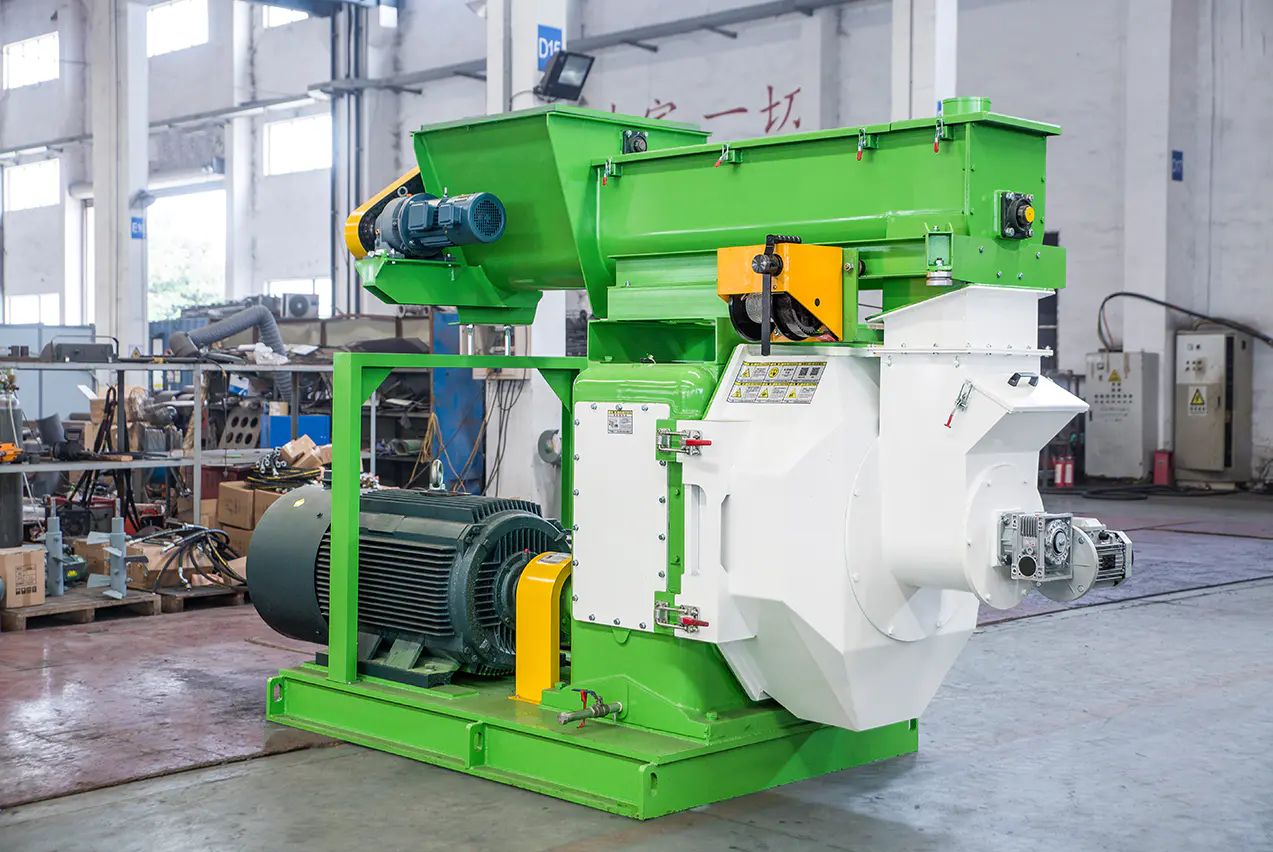
The pellet mill — whether a vertical or horizontal ring die configuration — is the throughput-defining unit in any biomass pellet line. Kingwood’s vertical pellet mill range spans from 1 t/h (JWZL-420) through 4–5 t/h (JWZL-928), while the horizontal JZWH-860 also operates at 4–5 t/h. For large-scale lines exceeding 10 t/h, multiple pellet mills operate in parallel within an integrated, enclosed production hall.
Die specifications — hole diameter, effective length, compression ratio, and steel grade — are selected based on feedstock lignin content, particle size, and target pellet density. Higher-lignin feedstocks require lower compression ratios; fibrous agricultural residues often demand pre-conditioning with steam or binders.
Cooling
Pellets exit the die at 70–90°C. Without controlled cooling, surface moisture migrates inward as the pellet cools, reducing durability and promoting mold in storage. Kingwood’s counter-flow cooler uses an upward ambient airflow against a descending pellet bed, achieving uniform temperature and moisture reduction without thermal shock. This preserves the structural integrity that determines pellet durability index (PDI) scores.
Screening
Post-cooling screening removes fines and oversized fragments using vibrating or rotary screens. Fines are recirculated to the pellet mill inlet rather than discarded. Consistent pellet size — typically 6 mm or 8 mm diameter for industrial fuel applications — is a commercial specification requirement for boiler and co-firing buyers.
Stage 7–9: Packaging, Quality Control, and Automation
Packaging
Automated packaging systems handle both bulk bag (500–1,000 kg) and small bag (15–25 kg) configurations depending on the sales channel. Packaging equipment is integrated into the line control system to synchronize throughput and prevent upstream accumulation. Proper sealing protects pellet moisture content through the distribution chain.
Quality Control
Kingwood pellet production lines are designed to produce biomass fuel meeting the following verified specifications: calorific value of 4,800 kcal/kg, moisture content below 15%, sulfur content below 0.3%, ash content below 18%, and dioxin content below 0.5 ng TEQ — all compliant with or exceeding EU, US, Japanese, and ISO standards, and below China GB13271-2001 boiler emission thresholds. Inline moisture sensors and periodic laboratory sampling are standard quality assurance protocols on automated lines.
Automation and Line Integration
Kingwood’s Three-Standardization Framework requires that all production lines delivered to clients are integrated, dust-free, and automated. PLC-based control systems manage feedstock metering, pellet mill load balancing, dryer temperature regulation, cooler airflow, and packaging throughput from a single interface. This configuration is documented in the Guizhou dust-free biomass pellet workshop and the Beijing biomass pellet demonstration project, both completed in 2024. Automation reduces per-ton labor cost and eliminates the production variance introduced by manual process adjustment.
For operations evaluating a China OEM wood biomass pellet line production manufacturer with full-line engineering capability — from wet feedstock intake through automated pellet packaging — Kingwood’s design experience across 2,000+ projects and 30 countries provides verified reference points across feedstock types, throughput scales, and regulatory environments. Complete lines are engineered up to 200,000 metric tons per year annual capacity.
Contact Kingwood to discuss feedstock analysis, line configuration, and project feasibility for your biomass pellet production requirements.
FAQ
What raw materials are suitable for an industrial biomass pellet production line?
Industrial biomass pellet lines process sawdust, wood chips, agricultural residues, bark, and other lignocellulosic waste. Feedstock selection directly determines die specifications, moisture targets, and grinding parameters. Kingwood's wet-feed pellet production line is engineered specifically for high-moisture biomass, eliminating the need for pre-drying before initial size reduction.
What moisture content is required before pelletization?
Feedstock moisture must be reduced to below 15% prior to pelletizing — aligned with EU biomass fuel standards. Excessive moisture degrades pellet durability, increases energy consumption in the die, and accelerates wear on ring die components. Kingwood's drum dryer systems are sized per feedstock type and line throughput.
What is the role of a ring die in a biomass pellet mill?
The ring die is the core compression component of a horizontal pellet mill. Prepared biomass feedstock is fed into the die chamber, where rollers force material through die holes under high pressure, forming dense cylindrical pellets. Die hole diameter, compression ratio, and material grade are specified based on feedstock characteristics and target pellet density.
How does a counter-flow cooler improve pellet quality?
Freshly extruded pellets exit the die at 70–90°C with elevated surface moisture. A counter-flow cooler passes ambient air upward through a downward-moving pellet bed, reducing temperature and moisture simultaneously without thermal shock. This preserves pellet integrity and prevents post-packaging moisture reabsorption.
What automation levels are available for industrial pellet production lines?
Kingwood's production lines are built on the Three-Standardization Framework, which mandates automated, dust-free, and fully integrated line configurations. PLC-controlled systems manage feedstock flow rates, pellet mill load, dryer temperature, and packaging throughput from a centralized interface, reducing labor requirements and production variance.
What is the maximum annual output for a Kingwood complete pellet production line?
Kingwood designs complete biomass pellet production lines with a maximum engineered capacity of 200,000 metric tons per year. Line capacity is scalable and configured to client throughput requirements, feedstock profile, and site infrastructure.
How long does it take to achieve payback on a biomass pellet line investment?
Payback period depends on line scale, local feedstock cost, and output pricing. A documented Kingwood case in Vietnam (2024) achieved full investment payback in 23 months on a 12 t/h wood pellet line, supported by biomass fuel cost savings of 40–50% versus conventional fossil fuels.
- Kingwood has planned and designed over 2,000 biomass pellet production line projects across 30 countries, with a combined annual biomass fuel output capacity exceeding 10 million metric tons. (2025, Kingwood company profile, kingwoodpellet.com)
- Biomass pellets produced on Kingwood lines achieve a calorific value of 4,800 kcal/kg with sulfur content below 0.3% and ash content below 18%, meeting or exceeding EU, US, Japanese, and ISO biomass fuel standards. (2025, Kingwood product specifications, kingwoodpellet.com)