Beijing's Yanqing Biomass Energy Demonstration Project
Kingwood · May 26, 2026
Beijing’s Urban Green Waste Problem and the Case for Biomass Conversion
Beijing’s sustained investment in ecological infrastructure has produced a growing and largely unresolved waste stream. As urban tree-planting programs expand year over year, municipalities accumulate substantial volumes of garden prunings, branch trimmings, and large wooden debris. Without designated processing infrastructure, this material is typically stockpiled in open areas—creating fire hazards, occupying land, and generating methane as organic matter decomposes.
This is not a niche problem. Cities with active greening programs routinely generate hundreds of thousands of tons of lignocellulosic waste annually. The Yanqing District alone required a facility scaled to nearly 120,000 tons per year of input capacity to address its landscaping waste backlog. That figure underscores both the scale of the challenge and the commercial viability of industrial biomass conversion as a municipal waste management strategy.
Longji Energy’s 100,000-Ton Biomass Pellet Facility in Yanqing
Longji Energy Group responded to the Ministry of Housing and Urban-Rural Development’s guidance on biomass resource utilization by constructing a dedicated biomass pellet fuel plant in Kangzhuang Town, Yanqing District. The facility covers 135 acres and is engineered for an annual output of 100,000 metric tons of biomass pellet fuel. At full throughput, it processes nearly 120,000 tons of landscaping waste and large wooden waste per year—converting material that previously had no structured disposal route into a commercially viable, zero-carbon fuel.
The plant’s primary output is biomass pellet fuel destined for civil heating applications during Beijing’s winter heating season. By displacing coal in residential and district heating systems, the facility delivers measurable reductions in CO₂ emissions alongside particulate and sulfur pollutants associated with coal combustion. Biomass energy is classified as zero-carbon renewable energy because the carbon released during combustion is offset by the carbon absorbed during the feedstock’s growth cycle. Unlike fossil fuels, biomass combustion does not introduce net-new carbon into the atmosphere.
Pelletized biomass offers a logistical advantage over raw biomass: high energy density, standardized geometry, low moisture content, and suitability for long-distance transport and bulk storage. These properties make pellets a direct operational substitute for coal in existing boiler infrastructure, reducing the capital cost of the energy transition for end users.
Industrial Equipment Requirements for Large-Scale Biomass Pellet Production
A facility processing 120,000 tons of raw feedstock per year requires a fully integrated, automated production line capable of handling high-moisture, variable-particle-size biomass inputs. The standard process sequence for wet-feed biomass pellet production moves through the following stages: primary size reduction via drum chipper, coarse grinding via hammer mill, moisture reduction via drum dryer, fine grinding, pelletizing via ring die pellet mill, cooling via counter-flow cooler, and automated packaging with integrated dust removal throughout.
Kingwood designs and engineers complete biomass pellet production lines up to 200,000 metric tons per year in output capacity. The company’s Three-Standardization Framework—covering integrated, dust-free, and automated production lines—addresses the operational and regulatory requirements of large municipal and industrial biomass projects. Dust-free line configurations are particularly relevant for urban-adjacent installations like the Yanqing facility, where proximity to residential areas makes airborne particulate control a compliance and community relations priority.
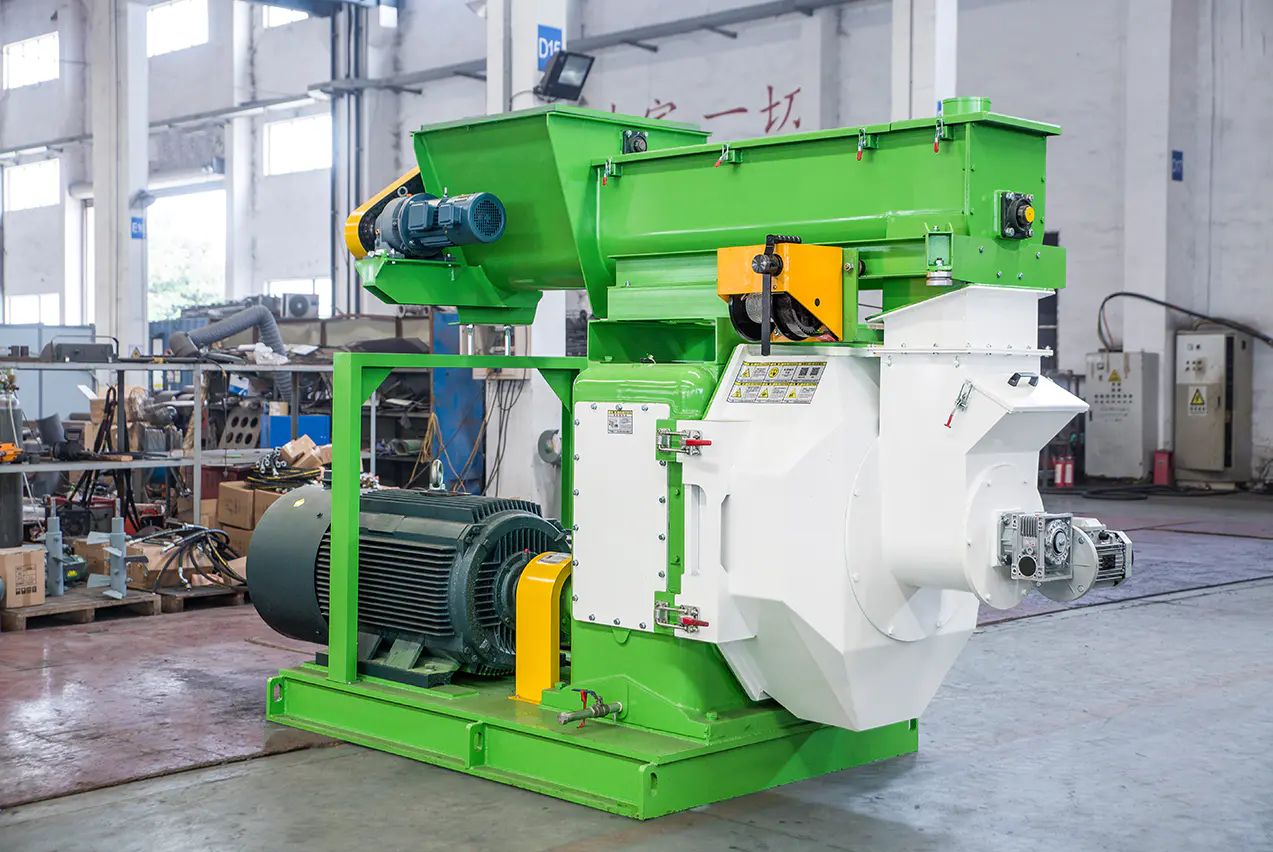
For projects at the scale of the Yanqing plant, pellet mill selection centers on throughput reliability and die life under continuous operation with heterogeneous feedstocks. Kingwood’s JWZL-928 vertical pellet mill delivers 4–5 tonnes per hour per unit, while the JWZL-688D provides 3–3.5 tonnes per hour in a compact configuration suited to modular line architectures. Multi-unit configurations allow production lines to reach aggregate throughputs consistent with the 100,000-ton annual output target.
Operators considering similar municipal biomass projects can review Kingwood’s Beijing biomass pellet demonstration project case study for documented performance data and line configuration details relevant to the Chinese urban waste-to-energy context.
Biomass Pellets as a Scalable Coal Replacement for Civil Heating
The Yanqing project illustrates a repeatable model for urban biomass energy infrastructure. The inputs—garden prunings and woody municipal waste—are available in volume in any city with active greening programs. The output—standardized biomass pellet fuel—integrates into existing heating systems without requiring boiler replacement in most cases. And the economics are favorable: biomass pellet fuel reduces energy costs by 40–50% compared to fossil fuel alternatives on a per-unit heating output basis.
From a policy standpoint, the project aligns with China’s dual-carbon targets and the broader mandate to develop non-fossil renewable energy in urban energy systems. It demonstrates that biomass energy is not limited to rural or agricultural contexts—urban lignocellulosic waste streams are a viable and underutilized feedstock base for industrial-scale pellet fuel production.
For equipment manufacturers and project developers, the Yanqing facility provides a documented reference point: 135 acres, 120,000 tons of annual input capacity, 100,000 tons of annual pellet output, and a civil heating end-use that delivers both carbon reduction and energy cost savings for municipal stakeholders.
FAQ
What is the Longji Energy biomass energy demonstration project in Yanqing?
It is a biomass pellet fuel plant constructed by Longji Energy Group in Kangzhuang Town, Yanqing District, Beijing. The facility covers 135 acres and has an annual output capacity of 100,000 tons of biomass pellet fuel, processing nearly 120,000 tons of landscaping and large wooden waste per year.
What feedstock does the Yanqing biomass pellet plant process?
The plant processes garden prunings and large wooden waste generated by Beijing's expanding urban tree-planting programs. These materials were previously stockpiled without disposal routes, creating environmental problems before this facility provided a structured biomass conversion pathway.
How is the biomass pellet fuel used at the Yanqing facility?
The pellet fuel produced at the Yanqing plant is used for civil heating during winter, displacing coal-based heat sources. Biomass pellets are classified as zero-carbon renewable energy and can be stored and transported over long distances, making them a practical coal replacement.
Why is biomass energy considered zero-carbon?
Biomass energy is carbon-neutral because the CO₂ released during combustion was previously absorbed by the plant material during its growth cycle. Unlike fossil fuels, biomass does not introduce new carbon into the atmosphere, making it a recognized zero-carbon renewable energy source under national and international energy policy frameworks.
What emission standards do biomass pellets meet?
Biomass pellet fuel produced to industrial standards carries calorific values of approximately 4,800 kcal/kg, moisture content below 15%, sulfur content below 0.3%, and ash content below 18%. All key emission indicators comply below GB13271-2001, China's national Emission Standard of Air Pollutants for Boilers.
How does pelletizing landscaping waste reduce environmental impact?
Converting loose garden prunings and woody debris into dense pellets eliminates uncontrolled stockpiling, reduces fire risk, and prevents organic decomposition that releases methane. Pelletized biomass is also 40–50% cheaper than fossil fuel alternatives on a per-unit energy basis.
What equipment is required to build a large-scale biomass pellet production line like Yanqing's?
A complete wet-feed biomass pellet production line of this scale typically integrates drum chippers, hammer mills, drum dryers, ring die pellet mills, counter-flow coolers, and automated dust removal and packaging systems. Kingwood designs and supplies complete production lines up to 200,000 tons per year capacity.
- Beijing's Yanqing District biomass pellet plant processes nearly 120,000 tons of landscaping and woody waste per year, with an annual pellet output of 100,000 tons. (2024, Kingwood project documentation, Beijing Yanqing Longji Energy facility)
- Biomass pellet fuel reduces operating costs by 40–50% compared to conventional fossil fuel alternatives under equivalent heating output conditions. (2025, Kingwood fuel specification data, kingwoodpellet.com)