Wood Pellet Production Line: Process, Equipment & Key Specs
Kingwood · May 26, 2026
A wood pellet production line is an integrated, multi-stage system that converts raw biomass—wood chips, sawdust, agricultural straw, rice husks—into dense, standardized fuel pellets for use in industrial boilers, combined heat-and-power (CHP) plants, and district heating systems. Understanding the sequence of operations, the function of each equipment class, and the critical process parameters is essential for any buyer evaluating a capital investment in biomass fuel manufacturing.
Stage-by-Stage Process Overview
A complete wood pellet production line follows five sequential stages. Each stage has defined input/output specifications that govern equipment selection and line capacity.
1. Size Reduction (Chipping and Coarse Grinding) Oversized feedstock—logs, branches, large wood offcuts—passes first through a drum chipper, which reduces material to chip dimensions suitable for downstream grinding. A hammer mill then processes chips and loose biomass to a target particle size of approximately 3 mm. This particle size is the upstream specification for consistent pellet formation in the die. Hammer mills are motor-driven and sized to match the throughput of the pellet mill they feed.
2. Drying High-moisture feedstock cannot be pelletized efficiently. A drum dryer reduces feedstock moisture content to below 15%—the threshold required for pellet cohesion and compliance with EU moisture standards for biomass fuel. Drying is the most energy-intensive stage and is typically optimized through heat recovery integration. For lines processing green wood chips or freshly harvested agricultural residues, the dryer is a non-negotiable component.
3. Fine Grinding (where required) For certain feedstocks and pellet die configurations, a secondary grinding pass follows drying to achieve the fine, homogeneous particle distribution that maximizes bulk density and die fill efficiency.
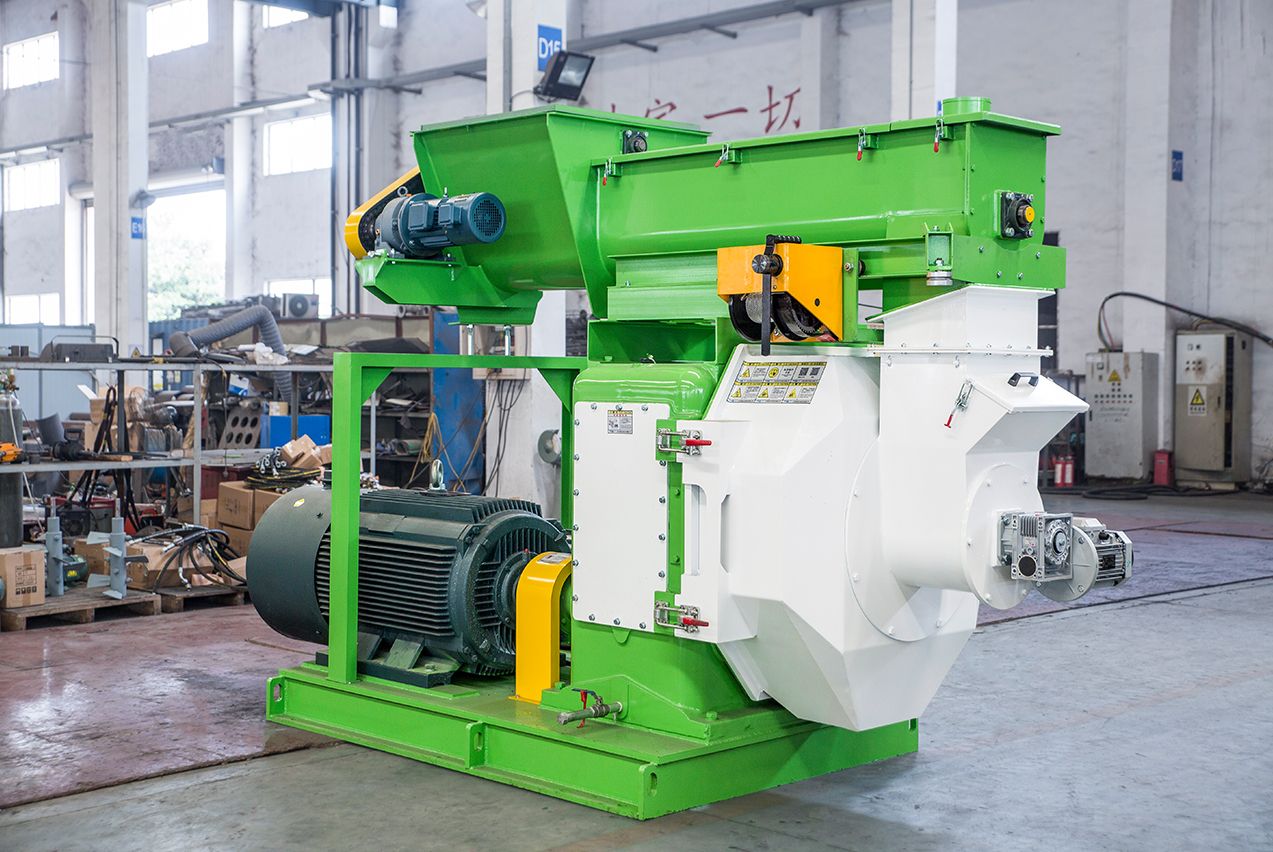
4. Pelletizing The pellet mill is the core unit of the line. Conditioned feedstock enters the pelleting chamber, where rotating rollers compress the material through precision-machined die holes, forming cylindrical pellets of uniform diameter. The die specification—hole diameter, effective length, compression ratio—determines pellet density, hardness, and calorific output. Kingwood’s vertical pellet mill range—the JWZL series—spans from 1 TPH (JWZL-420) to 4–5 TPH per unit (JWZL-928), with multi-unit configurations and complete wet-feed line designs supporting annual capacities up to 200,000 metric tons.
5. Cooling, Screening, and Packaging Pellets exit the mill at 70–90°C and must be cooled before storage or shipment. A counter-flow cooler passes ambient air upward through a descending pellet bed, bringing temperature to within 5°C of ambient. Cooling hardens the pellet surface, reduces fines generation, and stabilizes moisture at approximately 8%—the target final moisture for compliant, storable product. A screening step removes fines before the pellet packaging machine fills and seals bags, typically in 15 kg or 18 kg units via overhead hopper or conveyor belt systems. Each bag is labeled with pellet grade, diameter, and moisture specification.
Key Equipment Specifications and Selection Criteria
Pellet Mill Capacity and Die Configuration The pellet mill determines total line output. Kingwood’s current vertical pellet mill lineup covers the following capacity brackets:
| Model | Rated Capacity |
|---|---|
| JWZL-420 | 1–1.5 TPH |
| JWZL-688 | 2–2.3 TPH |
| JWZL-688D | 3–3.5 TPH |
| JWZL-928 | 4–5 TPH |
| JWZL-1068 | Contact sales |
| JZWH-860 (horizontal) | 4–5 TPH |
For buyers requiring output above 5 TPH, parallel pellet mill configurations within an integrated line are the standard design approach.
Fuel Output Specifications Pellets produced on a properly configured line meet the following performance parameters, consistent with Kingwood’s documented fuel specifications:
- Calorific value: 4,800 kcal/kg
- Moisture content: <15% (EU standard)
- Sulfur content: <0.3% (below Japan’s ≤0.5% threshold)
- Ash content: <18% (below ISO’s <20% ceiling)
- Dioxin content: <0.5 ng TEQ/m³ (below China GB standard of ≤1.0 ng TEQ/m³)
- Emission compliance: All indicators below GB13271-2001
Biomass pellets produced within these parameters deliver a 40–50% cost reduction versus equivalent fossil fuel consumption at equivalent thermal output.
Auxiliary Equipment Integration A fully functional line requires the hammer mill, drum chipper, drum dryer, counter-flow cooler, and pellet packaging machine to operate as a coordinated system. Equipment sizing must be matched across stages—a pellet mill rated at 4 TPH requires upstream grinding and drying capacity sized to sustain that feed rate continuously, accounting for moisture reduction mass loss in the dryer.
Industrial Line Design: What Buyers Should Evaluate
Wet-Feed vs. Dry-Feed Line Architecture Buyers sourcing green or high-moisture biomass—a common situation in Southeast Asian wood processing or in agricultural residue markets—require a wet-feed production line. Kingwood’s wet-feed complete line handles high-moisture biomass through a defined sequence: crushing → coarse grinding → drying → fine grinding → pelletizing → packaging, with fully automated control, enclosed processing, and integrated dust removal. This configuration is documented in Kingwood’s 24 TPH Vietnam wood chip pellet production line (2023) and the 12 TPH Vietnam line that achieved investment payback in 23 months (2024).
Dust Control and Environmental Compliance Industrial buyers in regulated markets must account for dust management across the entire line—particularly at the grinding and pelletizing stages. Kingwood’s Three-Standardization Framework mandates Dust-Free production line design as a core engineering standard, with fully enclosed processing and integrated dust removal systems. This was applied in the 2024 Guizhou facility project as a documented Dust-Free implementation.
Automation and Scalability Automated production lines reduce labor dependency and improve batch consistency. For lines targeting output above 100,000 metric tons per year, centralized PLC control and automated conveying between stages are standard requirements. Complete line design for up to 200,000 metric tons per year is within Kingwood’s engineering scope, drawing on 27 years of R&D and over 2,000 production line projects planned and designed across 30 countries.
Jiangsu Kingwood Industrial Co., Ltd. (NEEQ: 871765) is headquartered at #568 Hongsheng Road, Liyang City, Jiangsu Province, China. For technical specifications, project scoping, or equipment quotations, contact the Kingwood sales engineering team directly.
FAQ
What raw materials can a wood pellet production line process?
Industrial lines handle a broad feedstock range: wood chips, sawdust, forestry residues, agricultural straw, rice husks, and alfalfa. Moisture content and particle size at intake determine which pre-processing steps—chipping, coarse grinding, or drying—are required before pelletizing.
What moisture content is required before pelletizing?
Feedstock must be dried to below 15% moisture content before entering the pellet mill. Finished pellets should reach approximately 8% moisture before storage to prevent degradation and ensure compliance with EU and ISO fuel quality standards.
What is the role of the hammer mill in a pellet production line?
The hammer mill reduces oversized raw material to a particle size of approximately 3 mm—the specification required for consistent die compression in the pellet mill. It is typically powered by an electric motor and positioned upstream of the dryer and pelletizer.
How does a ring die pellet mill work?
In a ring die pellet mill, conditioned feedstock is fed into a rotating die. Rollers press the material through radial die holes, compressing it into cylindrical pellets of uniform diameter. A knife cuts pellets to the specified length as they exit the die.
What capacity range do industrial wood pellet production lines cover?
Entry-level lines start at 1–1.5 TPH using a single pellet mill unit. Large-scale integrated lines—such as Kingwood's complete wet-feed production lines—can reach 200,000 metric tons per year, with documented project throughputs of 12, 24, and 30 TPH.
What is a counter-flow cooler and why is it necessary?
A counter-flow cooler brings hot pellets (typically 70–90°C at mill exit) down to near-ambient temperature by passing ambient air upward through a descending pellet bed. Proper cooling hardens the pellet surface, reduces breakage during packaging, and stabilizes moisture content before bagging.
What certifications should a wood pellet production line supplier hold?
Key certifications include ISO 9001 (quality management), ISO 14001 (environmental management), and CE marking for equipment exported to European markets. Verified emissions compliance—for example, against China's GB13271-2001 boiler air pollutant standard—is also material for industrial buyers.
- Kingwood has planned and designed over 2,000 biomass pellet production line projects across 30 countries since 1999. (2025, Kingwood company profile, kingwoodpellet.com)
- Global wood pellet production capacity exceeded 50 million metric tons in 2023, with industrial-grade pellets accounting for the majority of trade volume. (2024, IEA Bioenergy Task 40, Wood Pellet Trade Report 2024)