Wholesale Hardwood Sawdust Wood Pellets: Industrial Advantages
Kingwood · May 26, 2026
Why Hardwood Sawdust Wood Pellets Are a Technically Sound Fuel Choice
For industrial procurement teams and energy managers evaluating wholesale biomass fuel supply, hardwood sawdust wood pellets present a verifiable performance case—not simply an environmental preference. The fuel specification baseline matters: Kingwood biomass pellets deliver a calorific value of 4,800 kcal/kg, moisture content below 15%, sulfur content below 0.3%, ash content below 18%, and dioxin content below 0.5 ng TEQ. These figures satisfy the EU moisture standard (<15%), ISO ash standard (<20%), the US calorific threshold (>2,500 kcal/kg), and Japan’s sulfur ceiling (≤0.5%)—enabling cross-market specification compliance within a single fuel grade.
The combustion profile of densified pellets differs meaningfully from loose biomass alternatives. Wood chips and raw logs vary in moisture content and bulk density, causing inconsistent feed rates and unpredictable combustion temperatures in industrial boilers. Pellets, by contrast, offer uniform geometry and compressed density, which stabilizes feed into ring die pellet mills during production and ensures a consistent BTU load during end-use combustion. For facilities operating continuous industrial heating processes, this consistency reduces burner adjustment frequency and lowers maintenance intervals.
All emission indicators for these pellets fall below China’s GB13271-2001 national Emission Standard of Air Pollutants for Boilers—a technically rigorous benchmark applicable to industrial-scale combustion equipment.
Cost Economics for Wholesale Buyers and Industrial Operators
The financial case for switching to biomass biofuel pellets at industrial scale is measurable. Operational data from Kingwood-supplied production lines indicates a 40-50% reduction in energy costs compared to fossil fuel alternatives. This figure is driven by three compounding factors: low feedstock acquisition cost (wood residues and sawdust that would otherwise require disposal), high energy density per storage volume, and stable long-term pricing independent of crude oil market volatility.
For reference, Kingwood’s 12 TPH biomass pellet production line in Vietnam achieved full capital recovery within 23 months of commissioning in 2024. The 24 TPH wood chip pellet production line, also in Vietnam, demonstrates the scalability available to operators targeting higher throughput without proportionally scaling operational complexity.
Regulatory incentives in major markets—including EU Renewable Energy Directive compliance pathways, Japanese feed-in tariffs for biomass co-firing, and China’s national biomass energy subsidies—further reduce the effective cost of procurement and operation for qualified buyers. Government policy support across these regions continues to strengthen the commercial foundation for wholesale biomass fuel adoption.
Production Infrastructure: From Raw Feedstock to Wholesale-Grade Pellets
Producing specification-grade hardwood sawdust pellets at wholesale volumes requires more than a single pellet mill. Industrial-scale output demands an integrated processing sequence capable of handling variable-moisture incoming feedstock without compromising final pellet quality.
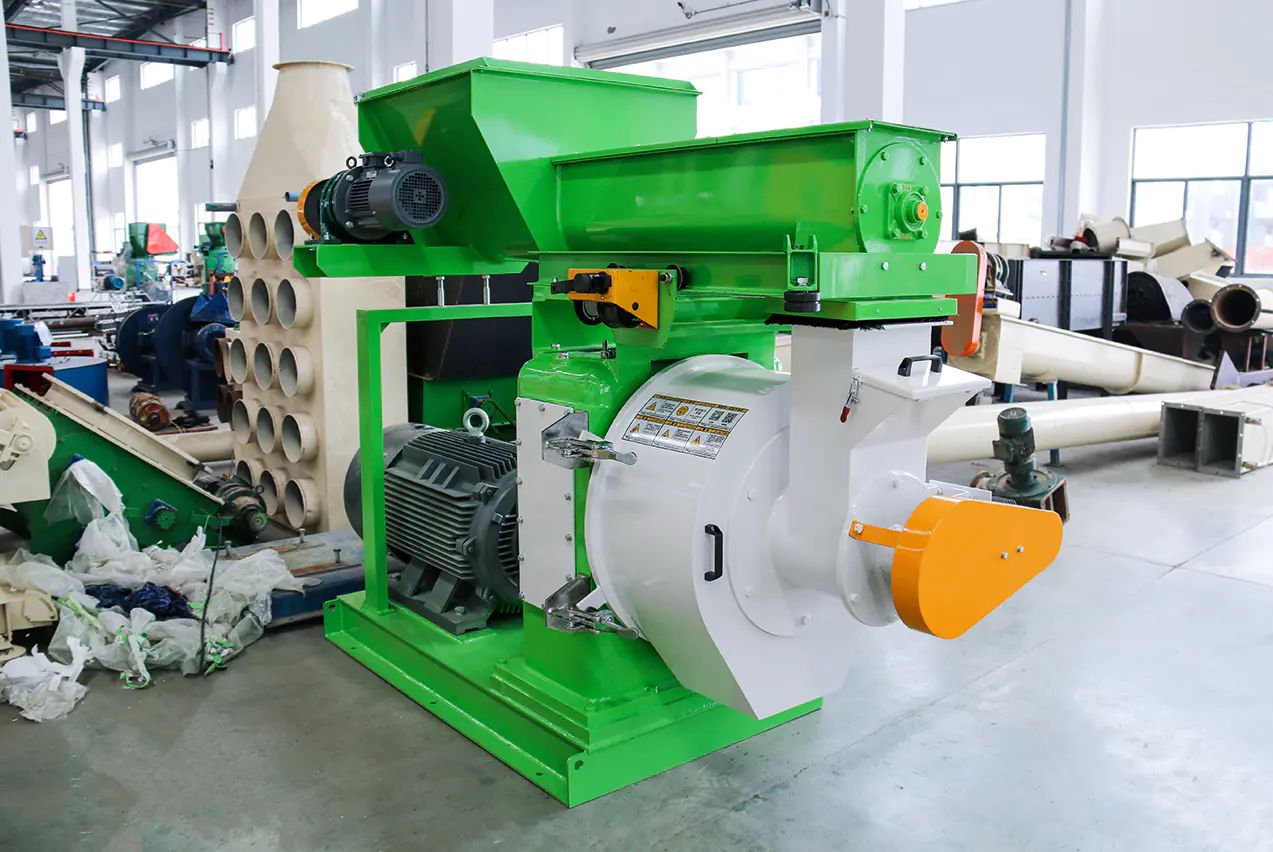
Kingwood’s complete wet-feed pellet production lines address this requirement directly. The processing sequence covers crushing via drum chipper, coarse size reduction via hammer mill, moisture reduction via drum dryer, fine grinding, pelletizing through ring die pellet mills, cooling through counter-flow cooler, and automated packaging—all within a fully enclosed, dust-free processing environment. This architecture aligns with Kingwood’s proprietary Three-Standardization Framework: Integrated production lines, Dust-Free production lines, and Automated production lines.
Complete line design capacity reaches up to 200,000 metric tons per year, supporting wholesale-grade output for both domestic distribution and export logistics. Equipment models including the JWZL-928 (4–5 TPH) and JWZL-688D (3–3.5 TPH) serve mid-range industrial throughput requirements, while the JZWH-860 horizontal pellet mill addresses facilities with alternative layout or feedstock constraints.
Kingwood has planned and designed over 2,000 production line projects across 30 countries, with an aggregate annual biomass fuel capacity exceeding 10 million metric tons. The Beijing biomass pellet demonstration project (2024) and the Guizhou dust-free pellet mill workshop (2024) illustrate how the Three-Standardization Framework performs across regulated urban environments and emission-sensitive industrial zones.
Feedstock Sustainability and Supply Chain Reliability
One underappreciated advantage of hardwood sawdust pellets at the procurement level is supply chain resilience. The primary feedstocks—sawmill residues, wood processing by-products, agricultural lignocellulosic waste—are generated continuously by existing timber and agro-industrial operations. Converting these residues into densified fuel pellets adds value to material flows that would otherwise incur disposal costs, structurally decoupling pellet feedstock pricing from the commodity volatility that affects coal, natural gas, and heavy fuel oil markets.
This circularity also satisfies emerging due diligence requirements under international sustainability procurement frameworks. Buyers supplying European or Japanese industrial customers increasingly require documented feedstock provenance and emissions compliance—criteria that specification-grade hardwood sawdust pellets, produced through ISO 9001 and ISO 14001-certified processes, are positioned to meet.
For industrial buyers evaluating wholesale biomass fuel procurement or vertically integrated pellet production investments, the technical, economic, and regulatory alignment of hardwood sawdust wood pellets has rarely been stronger. Kingwood’s equipment portfolio and production line design capability provide a single-source engineering path from feedstock intake to export-ready pellet output.
FAQ
What are the key fuel specifications for wholesale hardwood sawdust wood pellets?
Kingwood biomass pellets achieve a calorific value of 4,800 kcal/kg, moisture content below 15%, sulfur content below 0.3%, ash content below 18%, and dioxin content below 0.5 ng TEQ—meeting EU, US, Japanese, and ISO international standards.
How much can industrial buyers save by switching from fossil fuels to biomass wood pellets?
Switching to biomass fuel pellets reduces energy costs by 40-50% compared to conventional fossil fuels, based on Kingwood operational data across industrial heating applications.
Are hardwood sawdust pellets compliant with emissions regulations?
Yes. All emission indicators for Kingwood biomass pellets fall below China's GB13271-2001 national Emission Standard of Air Pollutants for Boilers, and the fuel meets EU moisture standards (<15%), ISO ash standards (<20%), and Japanese sulfur standards (≤0.5%).
What raw materials are used to produce hardwood sawdust biomass pellets?
Biomass pellets are produced from wood residues including sawdust, wood chips, and other lignocellulosic agricultural or forestry by-products that would otherwise go to waste—supporting circular economy principles.
What pellet production equipment does Kingwood supply for large-scale biomass fuel output?
Kingwood supplies complete wet-feed pellet production lines with annual capacities up to 200,000 metric tons, incorporating hammer mills, drum chippers, drum dryers, ring die pellet mills, counter-flow coolers, and automated dust-free enclosures.
What is the energy density advantage of wood pellets versus raw wood chips or logs?
Pellets deliver higher energy content per unit volume compared to wood chips or logs, enabling more consistent combustion output, reduced storage footprint, and reliable feed rates into industrial boilers and furnaces.
Which international markets does Kingwood serve with biomass pellet equipment and fuel solutions?
Kingwood has served customers across 30 countries, with documented production line deployments in Vietnam (12 TPH and 24 TPH lines), China (Beijing, Chongqing, Guizhou), and additional markets across Asia, Europe, and beyond.
- Global wood pellet production reached approximately 46 million metric tons in 2023, with industrial-grade fuel pellets accounting for the dominant share of demand in Europe and Asia. (2023, AEBIOM (European Biomass Association) — European Pellet Report 2023)
- Biomass energy accounted for roughly 55% of total renewable energy consumption in the EU in 2022, with solid biomass fuels including wood pellets representing the largest single contributor. (2022, Eurostat — Energy from Renewable Sources statistics, 2022 data release)