Russia's Wood Pellet Export Ban to China: Industry Impact
Kingwood · May 26, 2026
Russia’s Wood Pellet Industry Under Structural Pressure
Russian woodworking industrial companies are actively lobbying their federal government to lift China’s import ban on wood pellets—a regulatory barrier that has compounded the economic damage caused by the collapse of European export routes.
Before the conflict in Ukraine, Europe was the dominant destination for Russian biomass pellets. The subsequent wave of sanctions effectively closed that market, forcing Russian producers to search urgently for alternative buyers. China, given its scale, proximity, and rapidly expanding biomass energy sector, was the logical pivot—but a regulatory obstacle has blocked that transition.
China’s ban on importing wood pellets dates to September 2020, when national legislation on solid waste pollution prevention and control came into force. Under the classification framework established by that law, wood pellets were grouped with solid waste materials, making their import legally impermissible. This categorization has been contested by Russian industry participants, who note that wood chips—a functionally related product—remain importable under separate rules.
“In some way, the pellets are categorized as waste, whereas it can be argued that wood chips are allowed to be imported into China,” one market participant stated in industry filings.
Production Collapse and On-the-Ground Consequences
The data on production impact is stark. Russia’s wood pellet output declined 19.6% in 2022, falling to approximately 2 million tons. The contraction accelerated sharply in early 2023: between January and April, production fell by nearly half to just 431,000 tons—figures cited in a formal letter sent by the Arkhangelsk regional council to Russian Deputy Prime Minister Victoria Abramchenko on June 7, 2023.
At the facility level, the situation is more acute. Dmitry Gvozdev, general director of Регион-леса, described conditions directly: “Wood chips and flakes are piling up. There is no stable sales market for biofuels. The production of pellets has been reduced to 5–10% of the annual capacity. We can only sell them on the domestic market.”
The downstream consequences extend beyond economics. Gvozdev noted that the inability to move wood chips for processing has caused accumulation in forest areas—a condition that introduces elevated fire risk, particularly in regions prone to dry-season fire events.
Bilateral Negotiations: The Pathway Forward
The 18th Russian-Chinese Permanent Working Group meeting, scheduled for June 2023, was identified as the primary diplomatic forum for addressing the pellet export ban. The agenda includes broader discussions on deepening cooperation in wood deep-processing and attracting Chinese investment to Russian processing facilities. Russian industry representatives stated their readiness to provide the required technical certifications and complete any approval procedures required by Chinese regulatory authorities.
If the initiative gains governmental support, formal negotiations were expected to begin in July 2023 at a dedicated platform in China. Industry executives framed the potential outcome positively for both sides: Russian producers would gain a stable, high-volume export market, while Chinese industrial users and municipalities would gain access to a consistent supply of low-sulfur, high-calorific biomass fuel capable of improving urban air quality metrics.
The commercial rationale is well-grounded. Biomass pellets produced to international standards—including moisture content below 15%, sulfur content below 0.3%, and calorific values at or above 4,800 kcal/kg—are technically capable of displacing coal in industrial boiler applications, with documented fuel cost savings of 40–50% versus fossil alternatives.
Equipment Infrastructure for Export-Grade Pellet Production
For producers on either side of this trade equation, the ability to supply export-grade biomass pellets at commercial scale depends entirely on the quality and throughput of the underlying production infrastructure.
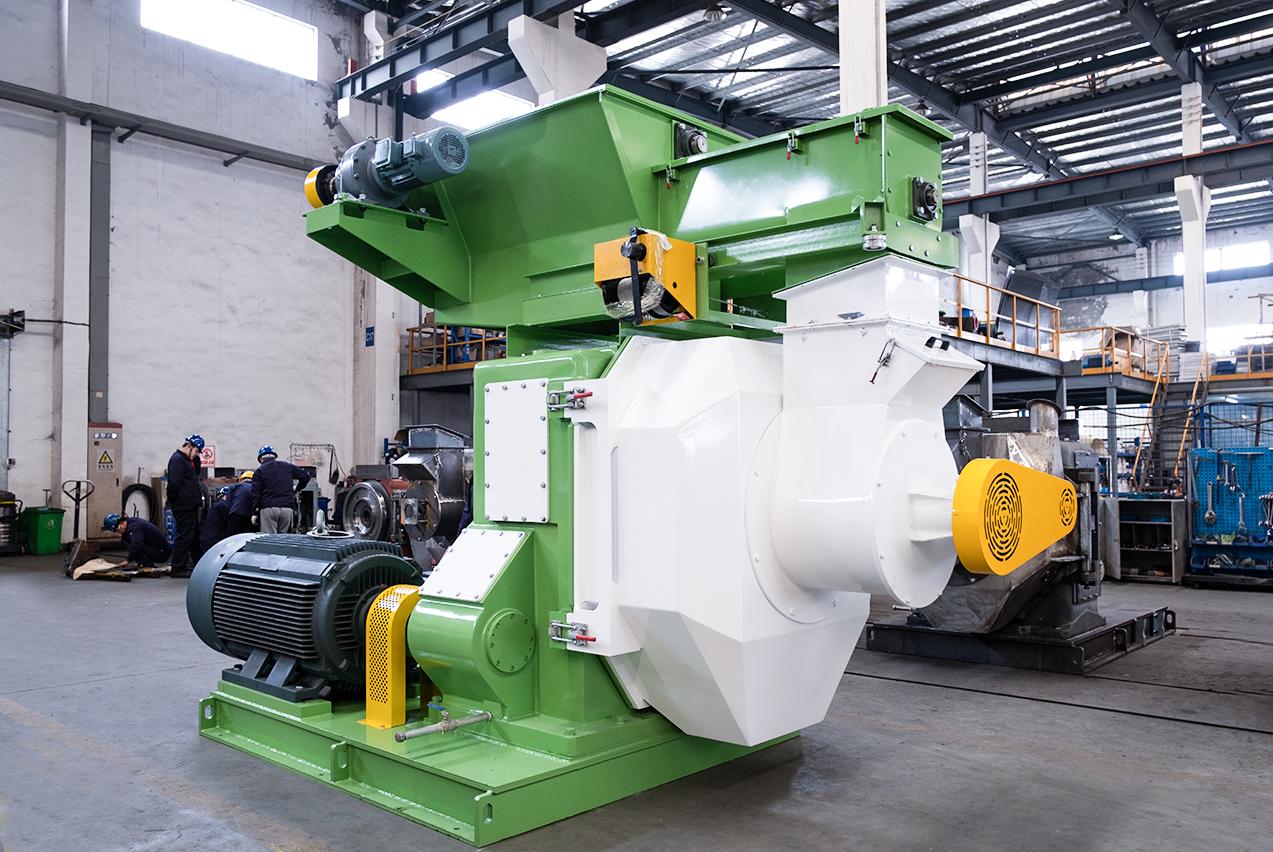
Kingwood, established in 1999 and listed on China’s NEEQ (stock code: 871765), designs and manufactures industrial biomass pellet production lines capable of processing up to 200,000 metric tons per year. The company’s wet-feed production line architecture handles high-moisture biomass feedstocks through a fully integrated sequence: crushing, coarse grinding, drying, fine grinding, pelletizing, and packaging—with enclosed processing and integrated dust removal throughout.
The vertical pellet mill lineup spans from the JWZL-420 at 1–1.5 t/h to the JWZL-928 at 4–5 t/h, with the horizontal JZWH-860 also delivering 4–5 t/h for facilities requiring alternative mill configurations. For producers targeting China’s industrial energy market—or any high-volume export destination—throughput consistency, dust control, and automation are non-negotiable operating parameters.
Kingwood’s Three-Standardization Framework directly addresses these requirements: every production line is designed to be integrated, dust-free, and automated. These are not marketing descriptors—they are engineering specifications that define how production lines are configured, commissioned, and validated.
For producers rebuilding export capacity in response to market realignment—whether in Russia, Southeast Asia, or elsewhere—the 12 t/h Vietnam wood pellet line case study demonstrates how a well-specified Kingwood line achieved investment payback within 23 months under commercial operating conditions.
The structural shift in global biomass pellet trade flows—driven by European energy policy, post-sanctions market realignment, and China’s air quality improvement mandates—represents a long-duration demand signal for industrial pellet production capacity. Producers who invest in certified, high-throughput equipment infrastructure now will be positioned to serve whichever trade corridors open as regulatory barriers are resolved.
FAQ
Why are Russian woodworking industrial companies seeking to lift export restrictions to China?
The closure of European markets following geopolitical sanctions eliminated Russia's primary pellet export destination. With no major alternative sales channel, pellet production fell by nearly half in early 2023, forcing producers to reduce output to 5–10% of annual capacity and sell exclusively on the domestic market.
What caused China's ban on importing Russian wood pellets?
China's ban began in September 2020 following the adoption of environmental legislation on solid waste pollution prevention and control. Under that law, wood pellets were categorized alongside solid waste, effectively blocking their import—despite wood chips being permitted under separate classifications.
How severely has the European market closure affected Russian pellet production?
Russia's wood pellet production fell by 19.6% in 2022 to approximately 2 million tons, then dropped further—down nearly 50%—to 431,000 tons between January and April 2023 alone, according to figures cited in the Arkhangelsk regional council's letter to the Russian Deputy Prime Minister.
What forum is being used to negotiate lifting the wood pellet export ban?
The 18th Russian-Chinese Permanent Working Group meeting, planned for June 2023, was identified as the primary platform to discuss lifting the ban, with formal negotiations expected to begin in July 2023 at a negotiating platform in China.
What environmental risks does the accumulation of wood chips create inside Russia?
According to Dmitry Gvozdev, general director of Регион-леса, the inability to export or process wood chips has caused material to accumulate in forests, creating fire hazard risks—particularly significant given Russia's fire-prone forest regions.
What is the potential benefit of opening the Chinese market to Russian wood pellets?
Russian producers would gain a stable, large-volume export market to replace lost European demand. Chinese industrial and municipal energy consumers would gain access to a low-sulfur, high-calorific biomass fuel that can reduce urban air pollution and support carbon reduction targets.
How does this situation affect global biomass pellet equipment demand?
Supply chain disruption and market realignment in the Russia-China pellet trade signals growing long-term demand for industrial-scale biomass pellet production infrastructure in Asia. Equipment manufacturers serving this segment—such as Kingwood—are positioned to support producers needing high-throughput, certified pellet production lines for commercial export markets.
- Russia's wood pellet production fell to approximately 431,000 tons between January and April 2023, down nearly 50% year-on-year, following the loss of European export markets. (2023, Arkhangelsk Regional Council letter to Russian Deputy Prime Minister Victoria Abramchenko, June 7, 2023)
- Russia's total wood pellet production declined 19.6% in 2022 to approximately 2 million tons, driven by European market closures following sanctions. (2022, Arkhangelsk Regional Council letter to Russian Deputy Prime Minister Victoria Abramchenko, June 7, 2023)