Rice Straw Pellets: Mill Equipment & Production Guide
Kingwood · May 26, 2026
Rice Straw as an Industrial Biomass Feedstock
Rice straw is one of the most abundant agricultural residues globally, generated as a direct byproduct of paddy harvesting. Historically, disposal options were limited — open-field burning being the most common — creating documented air quality and soil degradation problems across major rice-producing regions in Asia, South America, and Africa.
The technical case for converting rice straw into biomass pellets is well-established. When processed through purpose-built biomass pellet mill equipment, rice straw can be densified into uniform fuel pellets with a calorific value of 4,800 kcal/kg, moisture content below 15%, sulfur below 0.3%, and ash content below 18%. These specifications satisfy the EU moisture standard, the Japan sulfur standard (≤ 0.5%), and the ISO ash standard (< 20%), making rice straw pellets commercially viable for industrial boiler applications in regulated markets.
Rice straw’s high silica content and low bulk density do, however, present processing challenges that distinguish it from wood-based feedstocks. Equipment selection — particularly die specification, compression ratio, and pre-treatment configuration — directly determines pellet durability and line throughput consistency.
Kingwood Equipment Configuration for Rice Straw Pellet Lines
Jiangsu Kingwood Industrial Co., Ltd. has spent 27 years developing biomass pellet equipment optimized for diverse agricultural residue feedstocks, including rice straw, grass, and other fibrous materials. Kingwood’s complete wet-feed biomass pellet production lines are purpose-engineered to handle high-moisture, high-variability agricultural inputs through an integrated, fully enclosed process chain.
Standard wet-feed line process for rice straw:
- Primary size reduction — Drum chipper or coarse hammer mill breaks baled or loose rice straw into manageable particle sizes for downstream handling.
- Drying — Drum dryer reduces feedstock moisture to the sub-15% threshold required for die compression. This stage is non-negotiable for rice straw, which arrives from the field at 30–60% moisture depending on harvest timing.
- Fine grinding — Secondary hammer mill reduces dried material to the particle size specification matched to the ring die configuration.
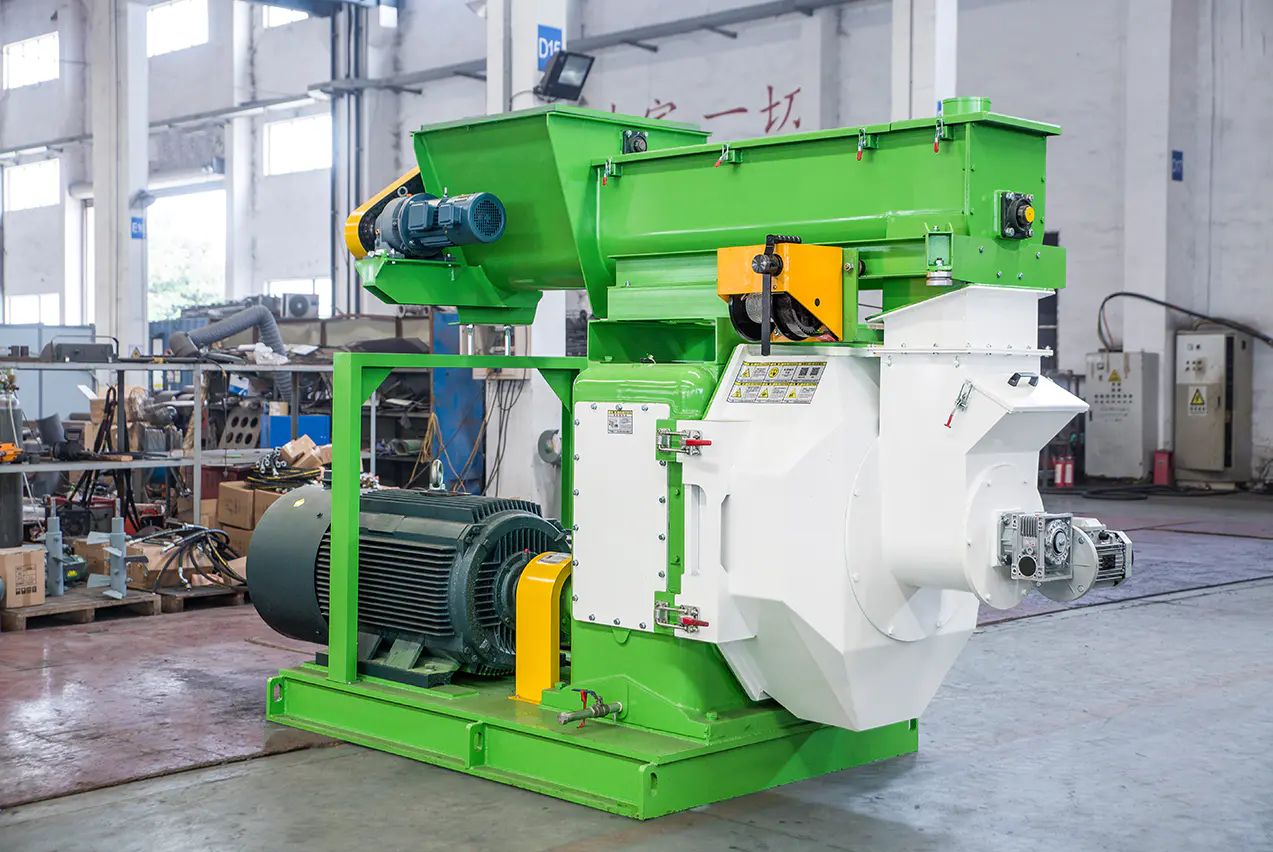
- Pelletizing — Vertical ring die pellet mills apply compressive force to form dense, uniform pellets. For rice straw throughput in the 3–5 t/h range, the JWZL-928 (4–5 t/h) and JWZL-688D (3–3.5 t/h) are the primary models selected, with multi-unit parallel configurations available for larger line designs.
- Cooling — Counter-flow cooler stabilizes pellet structure, reduces surface temperature, and hardens the pellet shell before packaging — critical for rice straw pellets, which have higher fines sensitivity than wood pellets at exit temperature.
- Packaging — Automated pellet packaging machine closes the line for direct shipment or storage.
Complete lines designed by Kingwood can reach annual output capacity of up to 200,000 metric tons, scaling from the entry-level JWZL-420 (1–1.5 t/h) through to the JWZL-1068 for the largest continuous throughput requirements. All production lines are built under Kingwood’s Three-Standardization Framework — Integrated, Dust-Free, and Automated — ensuring enclosed processing, integrated dust removal, and minimal manual intervention throughout the line.
Economic and Environmental Case for Rice Straw Pellet Production
Fuel cost reduction: Kingwood project data from operational installations documents a 40–50% reduction in fuel cost when industrial facilities switch from coal or heavy fuel oil to biomass pellets. For operations in regions where rice straw is available as a low-cost or negative-cost feedstock (where tipping fees or waste disposal costs are otherwise incurred), the economics are further strengthened.
Emissions compliance: All biomass fuel produced on Kingwood lines meets emission indicators below GB13271-2001 — China’s national Emission Standard of Air Pollutants for Boilers — and the fuel’s dioxin content of less than 0.5 ng TEQ is well within China GB standard (≤ 1.0 ng TEQ) and international equivalents.
Circular economy integration: Converting rice straw from a field waste stream into a traded fuel commodity creates a documented revenue opportunity for agricultural operators and biomass fuel producers. The circular model — waste feedstock in, standardized fuel product out — aligns with industrial sustainability requirements increasingly demanded by corporate procurement specifications and national renewable energy policy frameworks in over 30 countries where Kingwood equipment is currently deployed.
For reference, Kingwood’s 12 t/h wood pellet line in Vietnam achieved full capital payback within 23 months — a benchmark relevant to rice straw pellet investors evaluating comparable project economics in Southeast Asia, where both rice cultivation and industrial biomass fuel demand are concentrated.
Selecting the Right Pellet Mill for Agricultural Residue Feedstocks
Not all pellet mill designs handle rice straw with equal efficiency. Flat die mills and low-compression ring die configurations frequently struggle with the fibrous structure and silica abrasiveness of rice straw, resulting in accelerated die wear, inconsistent pellet density, and elevated fines generation.
Kingwood’s vertical ring die pellet mills are designed with agricultural residue processing as a primary use case, not an afterthought. Key engineering decisions relevant to rice straw processing include:
- Die material and heat treatment — Selected for abrasion resistance against silica-bearing feedstocks
- Compression roller geometry — Configured to apply progressive compaction suited to low-lignin fibrous materials
- Vertical feed orientation — Reduces bridging and blockage risk with irregular-particle agricultural residues compared to horizontal configurations
Buyers evaluating rice straw pellet mill equipment should request die specification sheets and confirm the vendor’s documented experience with agricultural residue feedstocks specifically — not only wood-based biomass. Kingwood has planned and designed over 2,000 production line projects globally, with documented installations across wood chip, agricultural straw, grass, and mixed biomass feedstocks.
To discuss feedstock analysis, line configuration, or capacity planning for a rice straw pellet project, contact Kingwood’s technical sales team directly via the product inquiry page.
FAQ
Can ring die pellet mills process rice straw effectively?
Yes. Rice straw is a fibrous, high-silica agricultural residue that requires a pellet mill with adequate compression ratio and robust die design. Kingwood's vertical ring die pellet mills — including the JWZL-688D (3–3.5 t/h) and JWZL-928 (4–5 t/h) — are engineered to handle fibrous biomass, delivering uniform pellet geometry critical for consistent combustion in industrial boilers.
What moisture content is acceptable for rice straw before pelletizing?
For efficient pellet formation and compliance with international fuel standards, feedstock moisture must be reduced to below 15% prior to the pelletizing stage. Kingwood's complete wet-feed production lines integrate drum dryers to condition high-moisture agricultural residues including rice straw before fine grinding and pelletizing.
What are the key quality parameters for rice straw biomass pellets?
Rice straw pellets produced on Kingwood equipment meet the following benchmarks from Kingwood's verified fuel specification data: calorific value ≥ 4,800 kcal/kg, moisture < 15%, sulfur < 0.3%, ash < 18%, and dioxin < 0.5 ng TEQ. These figures satisfy EU moisture standards, Japan sulfur standards (≤ 0.5%), and ISO ash standards (< 20%).
What production line capacity is available for rice straw pellet manufacturing?
Kingwood designs complete biomass pellet production lines with annual output up to 200,000 metric tons. Modular configurations allow scalability from smaller entry-level throughputs using the JWZL-420 (1–1.5 t/h) up to multi-machine parallel installations for large industrial operations. Contact Kingwood sales for site-specific capacity planning.
How does rice straw pellet fuel compare to fossil fuel on operating cost?
Based on Kingwood's operational project data, switching from coal or heavy oil to biomass pellets — including rice straw pellets — typically reduces fuel costs by 40–50%, primarily due to lower feedstock acquisition cost and favourable combustion efficiency in dedicated biomass boilers.
What pre-processing equipment is needed before pelletizing rice straw?
A complete rice straw pellet line requires: a drum chipper or hammer mill for primary size reduction, a drum dryer to reduce feedstock moisture below 15%, a fine hammer mill for secondary grinding to the particle size required by the die, and a counter-flow cooler post-pelletizing to stabilize pellet hardness and reduce surface temperature before packaging.
Is Kingwood equipment certified for export markets?
Yes. Kingwood holds ISO 9001, ISO 14001, and CE certifications, and is listed on the NEEQ stock exchange under code 871765. Equipment has been deployed across 30 countries, including active projects in Vietnam, China, and other Asia-Pacific markets.
- Global agricultural residue generation exceeds 5 billion metric tons annually, with rice straw accounting for approximately 731 million metric tons — representing a substantial untapped feedstock base for biomass pellet production. (2023, Food and Agriculture Organization of the United Nations (FAO), FAOSTAT Crop Residue Database)
- Biomass energy's share of global renewable energy consumption reached 55% in 2023, underscoring sustained industrial demand for agricultural residue-based pellet fuels. (2024, International Energy Agency (IEA), Renewables 2024 Report)