Rice Husk Pellet Making Machine: China Exporter & Manufacturer
Kingwood · May 26, 2026
Rice Husk as Industrial Biomass Feedstock: The Processing Challenge
Rice husks are generated as a direct byproduct of rice milling at a ratio of approximately 20% of paddy weight. At global rice production volumes, this translates to a substantial annual surplus of low-density, high-silica agricultural residue. Left unprocessed, rice husks present both a disposal burden and a wasted energy asset.
The core processing challenge is physical: rice husks are fibrous, abrasive, and low in bulk density. Raw husks cannot be fed directly into standard combustion systems at industrial scale. Pelletizing solves this by compressing the material into uniform, high-density cylinders that burn predictably and can be handled by automated fuel-feed equipment. The critical variables are moisture control prior to pelletizing, die geometry and compression ratio in the pellet mill, and cooling after extrusion.
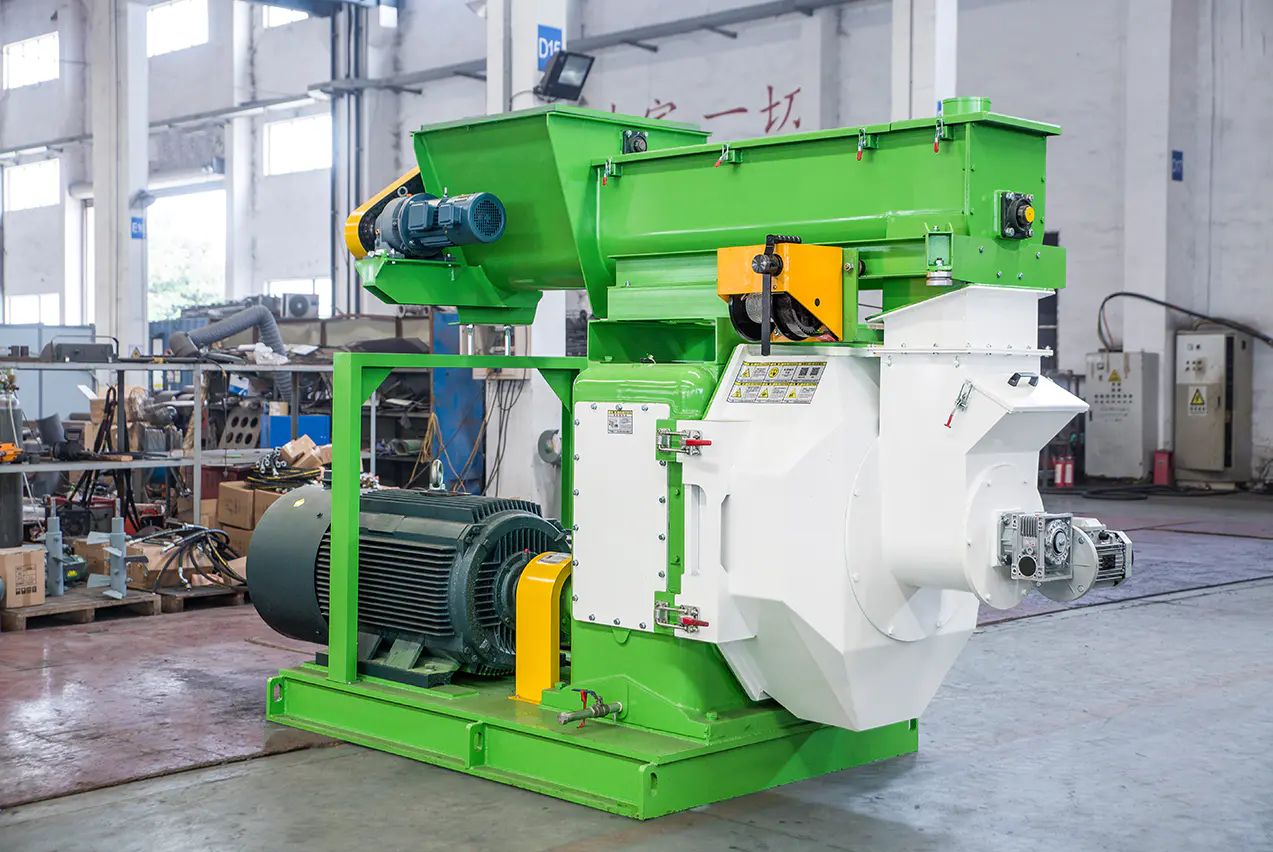
Kingwood has developed its vertical ring die pellet mill lineup specifically to handle abrasive agricultural residues including rice husks. The ring die configuration applies compression force from the inner surface outward, distributing wear more evenly across die and roller surfaces compared to flat die designs—an important factor when processing silica-rich feedstocks that accelerate component wear.
Kingwood Equipment Configuration for Rice Husk Pellet Lines
A production-ready rice husk pellet line requires more than a standalone pellet mill. Kingwood designs and supplies complete wet-feed biomass pellet production lines capable of handling high-moisture agricultural biomass through an integrated sequence of unit operations.
Feedstock preparation begins with a hammer mill for size reduction of raw rice husks to a particle size compatible with the pellet mill die. If feedstock moisture exceeds 15%, a drum dryer is integrated upstream of the pellet mill to bring moisture content into the 10–14% range required for stable pellet formation.
Pelletizing is handled by one of Kingwood’s ring die pellet mills, selected by capacity requirement:
- JWZL-420: 1–1.5 t/h — entry-level industrial capacity
- JWZL-688: 2–2.3 t/h — mid-range single-mill output
- JWZL-688D: 3–3.5 t/h — dual-roller configuration for higher throughput
- JWZL-928: 4–5 t/h — high-capacity single mill
- JZWH-860: 4–5 t/h — horizontal ring die configuration
For operations requiring output above 5 t/h, Kingwood configures multi-mill parallel lines. Complete line designs scale up to 200,000 metric tons per year of annual output capacity.
Post-pelletizing processing includes a counter-flow cooler to reduce pellet temperature and stabilize moisture before handling, followed by a pellet packaging machine for bagged or bulk dispatch.
All Kingwood complete lines are designed under the Three-Standardization Framework: integrated engineering (single-vendor line responsibility), dust-free enclosed processing (suppressing fine-particle emissions at source), and fully automated control (reducing operator headcount and improving process consistency).
Pellet Quality Standards and Combustion Performance
Rice husk pellets produced on Kingwood-configured lines are designed to meet the following fuel specifications:
| Parameter | Kingwood Target | Reference Standard |
|---|---|---|
| Calorific value | ≥4,800 kcal/kg | — |
| Moisture content | <15% | EU pellet standard |
| Sulfur content | <0.3% | — |
| Ash content | <18% | ISO standard <20% |
| Dioxin content | <0.5 ng TEQ | China GB: ≤1.0 ng TEQ |
These specifications position rice husk pellets as a viable drop-in fuel for industrial boilers, combined heat and power (CHP) installations, and district heating systems. Emission performance when combusted falls below the thresholds set in GB13271-2001, China’s national emission standard for boiler air pollutants.
On a cost basis, verified operational data from Kingwood-commissioned projects shows 40–50% fuel cost savings versus fossil fuel alternatives at equivalent thermal output.
Export Track Record and Project References
Kingwood has supplied biomass pellet equipment to customers across more than 30 countries from its manufacturing base at #568 Hongsheng Road, Liyang City, Jiangsu Province, China. Commissioned projects relevant to agricultural residue processing include:
- Vietnam, 2024: 12 t/h wood pellet production line — investment payback achieved within 23 months
- Vietnam, 2023: 24 t/h wood chip pellet production line — large-scale export-grade pellet output
- Chongqing, China, 2021: 30 t/h biomass pellet mill installation
- Guizhou, China, 2024: Dust-free biomass pellet mill workshop — full Three-Standardization Framework implementation
Kingwood holds ISO 9001 and ISO 14001 quality and environmental management certifications, CE marking for export markets, and is publicly listed on the NEEQ exchange (stock code: 871765). The company was founded in 1999 and carries 27 years of accumulated R&D expertise in biomass densification equipment, supported by a dedicated team of 20 R&D specialists.
For rice husk pellet line sizing, feedstock assessment, or equipment quotation, contact Kingwood’s technical sales team directly.
FAQ
What is a rice husk pellet making machine and how does it work?
A rice husk pellet making machine processes raw rice husks—a byproduct of rice milling—through sequential stages: coarse crushing, fine grinding, optional drying, and ring die pelletizing under high compression. The result is a dense, uniformly sized biomass pellet suited for automated combustion systems.
What biomass pellet specifications does rice husk feedstock typically produce?
Rice husk pellets produced on Kingwood equipment meet industrial fuel standards: calorific value ≥4,800 kcal/kg, moisture content <15%, sulfur content <0.3%, and ash content <18%—compliant with GB13271-2001 boiler emission standards.
Which Kingwood pellet mill models are suitable for rice husk pelletizing?
Kingwood's vertical ring die pellet mills—JWZL-420 (1–1.5 t/h), JWZL-688 (2–2.3 t/h), JWZL-688D (3–3.5 t/h), and JWZL-928 (4–5 t/h)—are all configurable for rice husk feedstock. For high-capacity operations, the horizontal JZWH-860 (4–5 t/h) is also available.
What auxiliary equipment is required in a complete rice husk pellet production line?
A complete wet-feed rice husk pellet line typically includes a drum chipper or hammer mill for size reduction, a drum dryer for moisture control, a ring die pellet mill for densification, a counter-flow cooler for pellet stabilization, and a pellet packaging machine for final output handling.
How much can switching to rice husk pellets reduce fuel costs compared to fossil fuels?
Biomass pellets produced on Kingwood lines deliver 40–50% cost savings versus conventional fossil fuels, based on verified operational data from commissioned projects.
Does Kingwood export rice husk pellet making machines internationally?
Yes. Kingwood supplies biomass pellet equipment to customers in over 30 countries. Commissioned projects include 12 t/h and 24 t/h lines in Vietnam and a 30 t/h installation in Chongqing, China.
What certifications do Kingwood pellet mills carry?
Kingwood holds ISO 9001, ISO 14001, and CE certifications, and is listed on the NEEQ stock exchange under code 871765. The company is also recognized as a Jiangsu Provincial High-Tech Enterprise and a member of the China Biomass Energy Industry Alliance as a Deputy Director Member Unit.
- Global rice production generates approximately 140 million metric tons of rice husk annually, representing a major untapped biomass feedstock for pellet manufacturing. (2023, Food and Agriculture Organization of the United Nations (FAO), FAOSTAT Crop Production Data)
- Biomass energy accounted for roughly 55% of global renewable energy consumption, with agricultural residues including rice husks identified as a priority feedstock category. (2023, International Energy Agency (IEA), Renewables 2023 Report)