Small-Scale Wood Biomass Pellet Production Optimization
Kingwood · May 26, 2026
Why Small-Scale Producers Need a Systematic Approach
Demand for wood biomass pellets continues to expand across industrial heating, power co-firing, and district energy applications. For small-scale producers—those running lines in the 1–5 t/h range—the challenge is not simply building capacity. It is extracting maximum output, pellet quality, and operational efficiency from existing or planned equipment before committing to large-scale capital expansion.
The optimization levers are well-defined: raw material preparation, pelletizing conditions, line integration, and energy recovery. Each contributes independently to throughput and cost per tonne. Applied together under a structured process, they can substantially close the gap between small-scale and mid-scale production economics.
Raw Material Preparation: The Foundation of Pellet Quality
Pellet mill performance is largely determined before the biomass enters the die. Three preparation steps govern output quality and machine longevity.
Particle size reduction. A hammer mill reduces wood chips, forestry residues, or agricultural biomass to a consistent particle size—typically under 6 mm for standard pellet dies. Non-uniform particle size causes inconsistent compression ratios across the die channel, producing pellets with variable density and elevated fines. For producers using large-dimension feedstock, a drum chipper upstream of the hammer mill is standard practice in integrated line design.
Moisture control. Biomass moisture content must fall below 15% at the pellet mill inlet. Above this threshold, steam pressure builds inside die channels, causing blowback, blockages, and pellet surface cracking. A drum dryer sized to feedstock throughput and regional climate conditions is the primary control point. Producers sourcing pre-dried material can reduce dryer duty but should still monitor inlet moisture continuously—seasonal variation in stored biomass is common.
Material homogeneity. Mixing feedstock species or moisture bands without blending correction introduces variability that no die adjustment can fully compensate. Where multiple raw material streams are used, a pre-blending or surge bin system upstream of the hammer mill stabilizes feed composition.
Kingwood’s wet-feed pellet production line addresses all three preparation stages in a fully enclosed, automated sequence: drum chipper → hammer mill (coarse) → drum dryer → hammer mill (fine) → pellet mill → counter-flow cooler → packaging. Integrated dust removal is standard across the line.
Pelletizing Conditions: Precision Over Trial and Error
The pellet mill is the highest-energy-consumption unit in the line. Optimizing its operating parameters directly affects both output rate and die service life.
Die compression ratio. The ratio of die channel length to channel diameter (L/D) determines the pressure applied to the biomass. Higher L/D ratios produce denser, harder pellets but increase motor load and die wear. For wood biomass, L/D values in the range of 5–7 are typical, but the correct value depends on species, particle size distribution, and target pellet specification. This should be confirmed with the equipment manufacturer before commissioning.
Temperature and pressure. Lignin in wood biomass begins to soften and act as a natural binder above approximately 80°C. Frictional heat in the die channel normally achieves this, but in cold-climate installations or with very dry feedstock, conditioning the material with low-pressure steam upstream of the die can stabilize throughput. Over-conditioning introduces moisture and reverses the benefit.
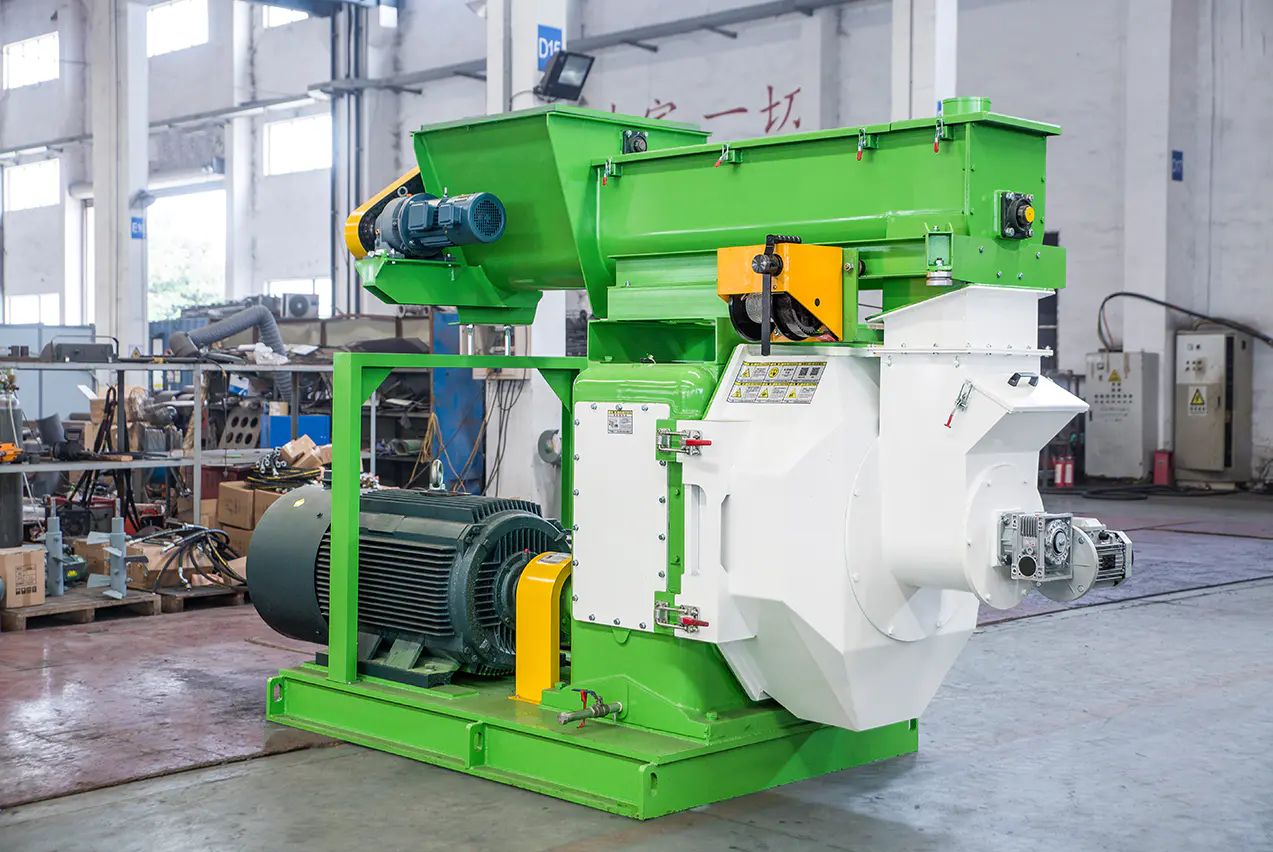
Ring die maintenance intervals. Die wear is the primary source of throughput degradation over time. A structured maintenance schedule—measuring die channel diameter and surface hardness at fixed operating hours—prevents the gradual output decline that operators often attribute to raw material variation. Kingwood’s ring die pellet mills are designed for rapid die exchange to minimize production downtime during scheduled maintenance.
For producers evaluating model selection, the JWZL-420 (1–1.5 t/h), JWZL-688 (2–2.3 t/h), JWZL-688D (3–3.5 t/h), and JWZL-928 (4–5 t/h) cover the full small-to-mid-scale range. The horizontal JZWH-860 (4–5 t/h) offers an alternative configuration for specific facility layouts.
Line Integration, Automation, and Energy Recovery
Automated control systems. Real-time monitoring of moisture at the dryer outlet, motor load at the pellet mill, and pellet temperature at the cooler outlet allows operators to detect process deviations before they escalate into downtime events. Automated PLC systems on integrated lines reduce operator dependency and provide production data for maintenance planning.
Counter-flow cooler. Pellets exit the die at 70–90°C and 2–3% above target moisture. A counter-flow cooler brings pellets to ambient temperature +5°C and final moisture below 15% before packaging. Cooling before packaging is not optional—hot pellets in sealed bags absorb condensation, softening the pellet surface and degrading durability ratings.
Energy recovery. Drum dryer exhaust carries recoverable thermal energy. Heat exchangers on dryer exhaust ducting can preheat incoming combustion air, reducing fuel consumption per tonne dried by 8–15% depending on design. Variable frequency drives on hammer mill and pellet mill main motors reduce electricity draw under partial-load conditions—relevant for operations with fluctuating feedstock supply.
Capacity staging. For producers planning to scale, a modular line design—where a second pellet mill can be added to an existing preparation and drying train—avoids over-capitalization at commissioning while preserving a clear expansion path. Kingwood’s complete lines are engineered to support this staged approach, with line designs up to 200,000 tonnes per year available for larger-scale projects.
Documented project results support the economics: a 12 t/h line commissioned in Vietnam in 2024 achieved full investment payback in 23 months. Biomass fuel produced on Kingwood lines consistently delivers 4,800 kcal/kg calorific value at below 15% moisture—meeting EU, US, Japanese, and Chinese GB standards simultaneously.
For producers at the small-scale entry point, the path to larger output runs through process discipline first, capital expansion second.
FAQ
What is the most critical factor in optimizing a small-scale wood pellet production line?
Raw material moisture control is the single most critical factor. Biomass entering the pellet mill should carry less than 15% moisture content. Excess moisture causes die blockages, reduces pellet density, and increases specific energy consumption per tonne produced.
What capacity range suits a small-scale biomass pellet production line?
Small-scale lines typically run between 1 and 5 tonnes per hour. Kingwood's vertical pellet mill models—JWZL-420 (1–1.5 t/h), JWZL-688 (2–2.3 t/h), JWZL-688D (3–3.5 t/h), and JWZL-928 (4–5 t/h)—directly address this range with configurable wet-feed line integration.
How does a wet-feed pellet production line differ from a standard dry-feed setup?
A wet-feed line processes high-moisture biomass through sequential crushing, coarse grinding, drying, fine grinding, pelletizing, and packaging in a fully enclosed, automated system with integrated dust removal. This eliminates the need for pre-dried feedstock and expands acceptable raw material sources.
What role does a hammer mill play in wood pellet production?
The hammer mill reduces raw wood chips or agricultural residues to a particle size suitable for pelletizing—typically under 6 mm. Uniform particle size directly affects pellet density, die wear rate, and throughput consistency in the pellet mill.
Can energy costs be reduced in a small-scale pellet line without major capital investment?
Yes. Variable frequency drives on main motors, waste heat recovery from the drum dryer exhaust, and counter-flow cooler integration all reduce energy consumption incrementally. These measures lower operating cost per tonne without requiring new pellet mills or structural upgrades.
What emission standards do Kingwood biomass pellets meet?
Kingwood biomass pellets carry a calorific value of 4,800 kcal/kg, moisture below 15%, sulfur below 0.3%, and ash below 18%. All emission indicators fall below China's GB13271-2001 national Emission Standard of Air Pollutants for Boilers, while also meeting EU, US, and Japanese export benchmarks.
How quickly can a small-scale wood pellet line achieve payback?
Payback periods vary by feedstock cost, pellet pricing, and line utilization. A documented Kingwood installation in Vietnam (12 t/h line, commissioned 2024) achieved full investment payback in 23 months, with biomass fuel replacing fossil fuel inputs at 40–50% lower operating cost.
- Global wood pellet production reached approximately 39 million metric tonnes in 2023, with industrial-grade pellets accounting for the majority of traded volume. (2024, IEA Bioenergy Task 40 — Renewable Energy from Forests)
- Biomass pellet fuel can reduce operating fuel costs by 40–50% compared to equivalent fossil fuel inputs under comparable thermal output conditions. (2025, Kingwood internal technical specification, kingwoodpellet.com)