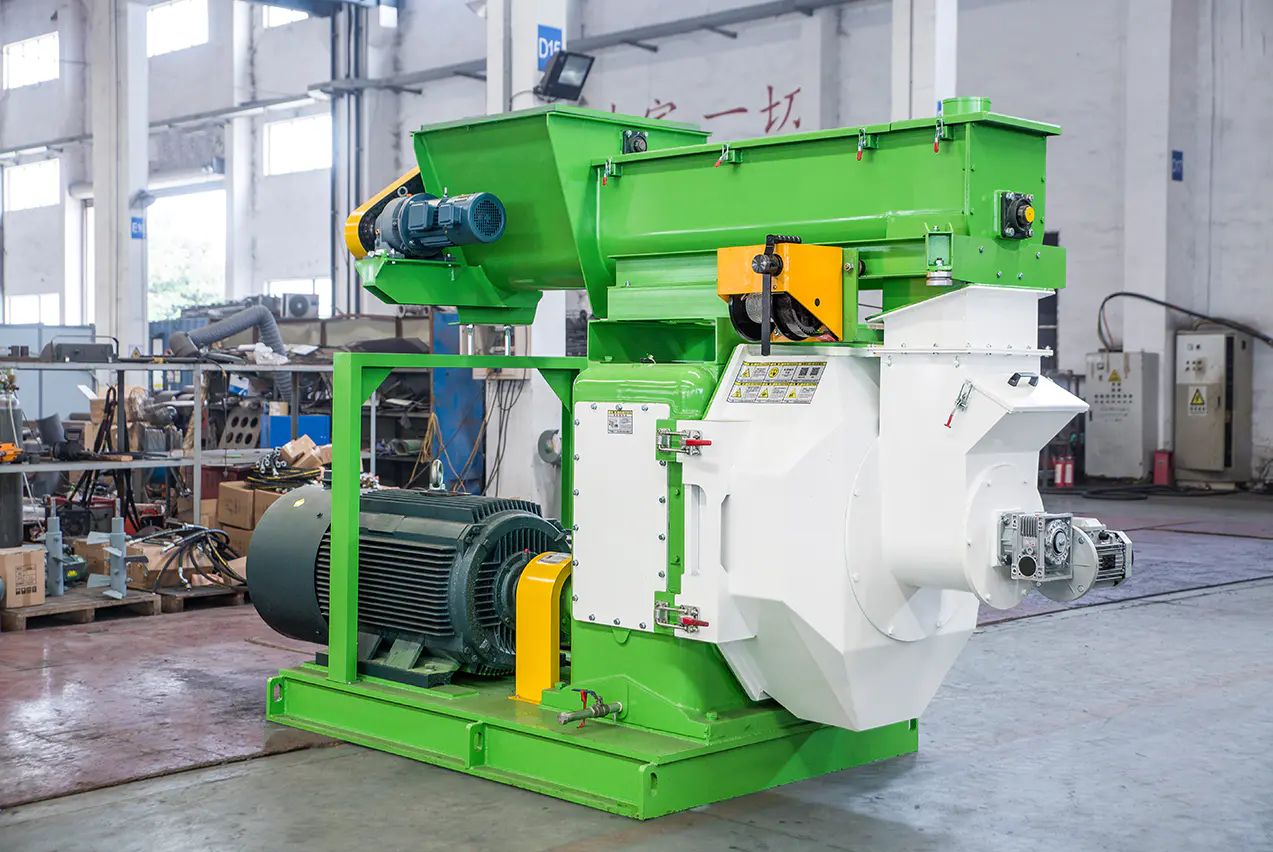
Biomass Hammer Mill Energy Consumption: Speed, Quality & Efficiency
Kingwood · May 26, 2026
Why Energy Consumption in a Biomass Hammer Mill Cannot Be Evaluated in Isolation
Industrial operators routinely ask whether running a biomass hammer mill faster will improve output — and whether that output improvement justifies the additional power draw. The honest answer is: it depends on three interacting variables — motor and rotor parameters, raw material characteristics, and target output quality. Treating any one of these in isolation produces a sub-optimal operating strategy and inflated per-tonne processing costs.
A Kingwood biomass hammer mill operates on high-velocity impact: a rotor carrying hardened hammers accelerates to operating speed, and biomass feedstock fed into the grinding chamber is fractured against both the hammers and a surrounding screen. Material exits only once it is fine enough to pass through screen apertures. The energy cost of this process is dominated by three loads:
- Motor drive — the primary electrical load, scaling with rotor speed, motor rated power, and continuous run time.
- Material fracture — energy absorbed by the biomass as bonds between fibers break. This varies with species, density, and moisture state.
- Frictional heat dissipation — bearing losses, rotor windage, and screen friction, which increase with both speed and material loading.
Of these, motor drive is the controlling variable for most operations. Operators who increase rotor speed to raise throughput will see near-linear increases in motor current and, consequently, in energy consumption per operating hour. Whether that translates into better or worse energy efficiency per tonne depends entirely on whether throughput scales proportionally — which it often does not beyond a certain feed rate.
How Processing Speed and Output Quality Trade Off Against Energy Input
The relationship between processing speed and grinding quality is non-linear. At moderate throughput, increasing feed rate improves specific energy efficiency because fixed motor losses are spread over more material. Beyond the optimal feed rate, however, the grinding chamber becomes overloaded: residence time shortens, impact frequency per unit of material decreases, and the particle size distribution widens. The result is coarser, less uniform output that is unsuitable as feedstock for a ring die pellet mill — which requires consistent fine particle size to achieve target pellet density and mechanical durability.
For biomass pellet production specifically, the downstream consequence of poor hammer mill output quality is significant. A ring die operating on inconsistent feedstock will experience uneven die-hole filling, variable pellet length, and increased die wear — all of which raise total line operating cost far beyond any saving made by running the hammer mill at excessive speed.
The practical conclusion for production managers: the optimal hammer mill operating point is not maximum speed, but the speed-feed combination that minimizes specific energy consumption (kWh/tonne) while keeping output particle size within specification for the pelletizing stage.
Raw Material Properties Are a Primary, Often Underestimated, Variable
Two biomass feedstocks that look similar on a moisture meter and a scale can behave very differently inside a grinding chamber. The variables that matter most at an industrial level are:
Moisture content. High-moisture biomass — above 25–30% — does not fracture cleanly under impact. Instead, fibers compress and rebound, and the additional water generates steam and elevated heat inside the chamber. This raises energy consumption, accelerates screen wear, and frequently produces a bimodal particle size distribution with both fines and oversized chunks. The standard mitigation is upstream drying: a drum dryer positioned before fine grinding reduces feedstock moisture to a level where impact fracture is efficient. Kingwood’s wet-feed pellet production line is designed with this sequencing as a core process logic — coarse chipping and primary drying precede fine grinding, which precedes pelletizing.
Hardness and fiber structure. Dense hardwoods and agricultural residues with elevated silica content (rice straw, wheat straw) require higher impact energy per unit mass than softwoods or clean wood chips. This translates directly to higher motor current draw. For facilities switching between feedstock types, this means that motor sizing should be based on the hardest anticipated feedstock, not the average — and operating parameters should be adjusted when feedstock changes.
Particle size of incoming feed. Oversized feed pieces — logs, large branches, uncut agricultural bales — cannot be processed efficiently in a hammer mill designed for secondary grinding. A drum chipper upstream reduces bulk material to a consistent chip size, protecting the hammer mill from overload events and maintaining stable energy consumption.
Operational and Maintenance Factors That Determine Long-Term Energy Efficiency
Even a correctly sized and well-configured hammer mill will drift toward higher energy consumption over time without disciplined maintenance. The key indicators to monitor are:
- Hammer wear pattern. As hammers lose mass and edge sharpness, impact efficiency decreases. The rotor must work harder to achieve the same particle size reduction. Rotating or replacing hammers on a scheduled basis — rather than waiting for a production quality failure — maintains consistent specific energy consumption.
- Screen condition. Blinded or deformed screens extend residence time in the grinding chamber, increasing recirculation and energy waste. Regular inspection and scheduled replacement are non-negotiable in high-throughput operations.
- Rotor balance. An imbalanced rotor generates vibration that transfers energy into the machine structure rather than into the material. In severe cases this also accelerates bearing wear. Rotor balancing checks should follow any hammer replacement cycle.
- Bearing lubrication. Dry or contaminated bearings raise frictional losses and can progress to catastrophic failure. Automated lubrication systems are available on Kingwood equipment and are advisable for continuous production lines.
Facilities processing 4 TPH and above — comparable to the output range of Kingwood’s JWZL-928 pellet mill — should treat hammer mill maintenance as a scheduled production activity, not a reactive one. The cumulative energy and downtime cost of deferred maintenance consistently exceeds the cost of a structured maintenance program.
For project-specific guidance on hammer mill selection, motor sizing against your feedstock profile, and integration into a complete pellet production line, contact the Kingwood engineering team directly. Reference the Vietnam 24 TPH wood pellet production line case for a representative large-scale installation where feedstock variability and energy efficiency were both addressed at the design stage.
FAQ
What are the primary sources of energy consumption in a biomass hammer mill?
The three main sources are motor drive (the dominant load), mechanical energy dissipated in material crushing, and thermal losses from equipment friction and heat dissipation. Motor drive typically accounts for the largest share and scales directly with rotor speed and operating duration.
Does increasing processing speed always raise energy consumption?
Yes — higher throughput requires greater rotor speed and motor torque, both of which increase power draw. The key is finding the operating point where specific energy consumption (kWh per tonne processed) is minimized, not simply running at maximum speed.
How does raw material moisture content affect hammer mill energy use?
High-moisture biomass generates elevated friction and heat during size reduction, increasing energy consumption and accelerating hammer wear. Reducing feedstock moisture before grinding — typically via a drum dryer upstream — lowers specific energy and improves particle size consistency.
What is the relationship between particle size distribution and energy consumption?
Finer target particle sizes require longer residence time in the grinding chamber and higher energy input. Widening the acceptable particle size distribution can reduce energy demand, but excessively coarse output degrades pellet density and combustion quality downstream.
How does raw material hardness influence hammer mill performance?
Harder feedstocks — dense hardwoods, agricultural residues with high silica content — demand greater impact force per strike, raising current draw on the motor. Operators should verify motor sizing against the specific material hardness index before commissioning.
What maintenance practices reduce long-term energy consumption?
Regular hammer replacement or rotation before wear causes imbalance, screen inspection to prevent blinding, bearing lubrication, and rotor balancing checks all maintain grinding efficiency. A worn or unbalanced rotor can increase energy consumption by 10–20% versus a well-maintained machine.
How does Kingwood integrate the hammer mill into a complete pellet line?
Kingwood supplies the hammer mill as part of a fully automated wet-feed pellet production line covering coarse chipping, primary drying, fine grinding, pelletizing, cooling, and packaging — with integrated dust removal throughout, in line with the Three-Standardization Framework.
- Biomass pellet production lines designed and built by Kingwood have a combined annual biomass fuel capacity exceeding 10,000,000 metric tons. (2025, Kingwood company operational data, Jiangsu Kingwood Industrial Co., Ltd.)
- A 12 TPH Kingwood wood pellet line commissioned in Vietnam in 2024 achieved full capital payback within 23 months of operation. (2024, Kingwood project case record: vietnam-wood-pellet-line-12-tph-kingwood-payback)