Wood Fuel Pellet Production Line: ROI & Manufacturer Guide
Kingwood · May 26, 2026
Is a Wood Fuel Pellet Production Line a Profitable Investment?
Biomass energy has moved from pilot projects to grid-scale deployment across Europe, Southeast Asia, and China. For industrial investors evaluating entry points, a wood fuel pellet production line represents a capital asset with quantifiable throughput, documented payback periods, and an expanding offtake market driven by mandatory renewable energy targets.
Profitability is not a guarantee — it depends on raw material cost structure, line utilization, local energy pricing, and equipment reliability. This article examines each factor with reference to real production data from Kingwood-equipped facilities.
Market Demand: Structural, Not Cyclical
Demand for wood fuel pellets is underpinned by binding policy, not speculative growth. The EU’s Renewable Energy Directive requires member states to meet defined renewable heating targets. Japan’s feed-in tariff for biomass power generation has sustained large-volume pellet imports since 2012. South Korea’s Renewable Portfolio Standard mandates utility-scale biomass co-firing. Across these markets, pellet procurement is contracted on multi-year terms, which directly supports project financing and revenue visibility for production line investors.
In China, the policy environment has similarly matured. Kingwood commissioned Beijing’s first biomass pellet demonstration project in 2024 — a milestone reflecting national-level institutional adoption of biomass fuel as a coal-replacement energy source in urban heating.
The demand signal is structural. Investors entering the wood fuel pellet production sector are positioning against long-duration policy tailwinds, not short-term commodity cycles.
Operational Efficiency: Where ROI Is Built or Lost
A 12 t/h Kingwood production line in Vietnam (2024) returned full capital investment in 23 months — a benchmark that reflects both strong local pellet pricing and disciplined operational efficiency. At the other end of the scale, a 24 t/h wood chip pellet line was commissioned in Vietnam in 2023, and a 30 t/h line operates in Chongqing, China.
These throughput figures are achieved through Kingwood’s Three-Standardization Framework, which governs all complete line design:
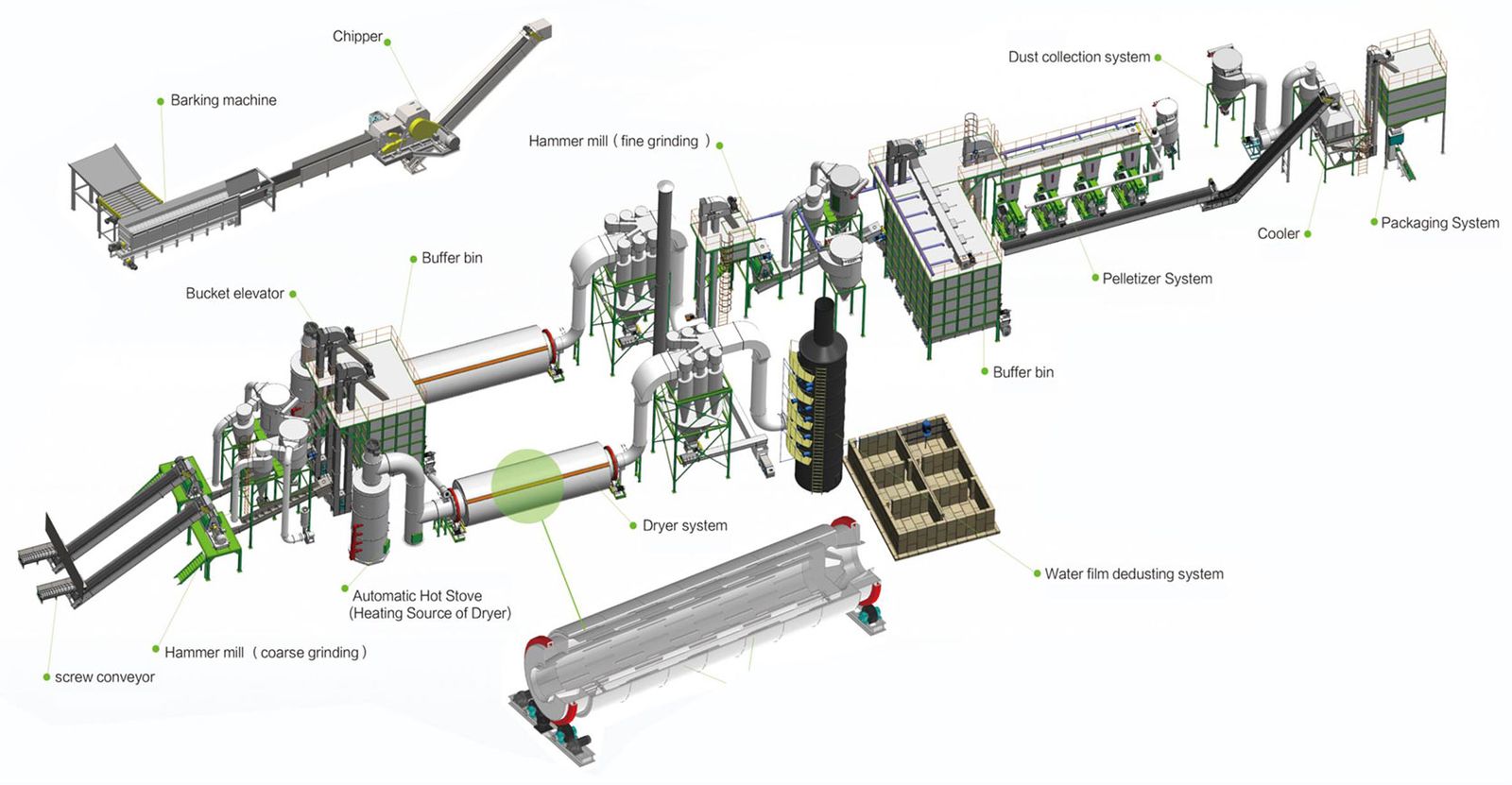
- Integrated production lines — equipment stages are sequenced and matched in capacity, eliminating bottlenecks between crushing, drying, fine grinding, pelletizing, and packaging.
- Dust-Free production lines — enclosed processing with integrated dust removal prevents material loss at transfer points and keeps facilities compliant with occupational health and environmental standards. A dedicated dust-free workshop was built in Guizhou in 2024.
- Automated production lines — PLC-controlled sequencing reduces operator headcount per shift and maintains consistent pellet density across production runs.
Together, these three pillars compress per-unit production cost and reduce unplanned downtime — the two variables that most directly determine whether a wood fuel pellet production line achieves its projected ROI.
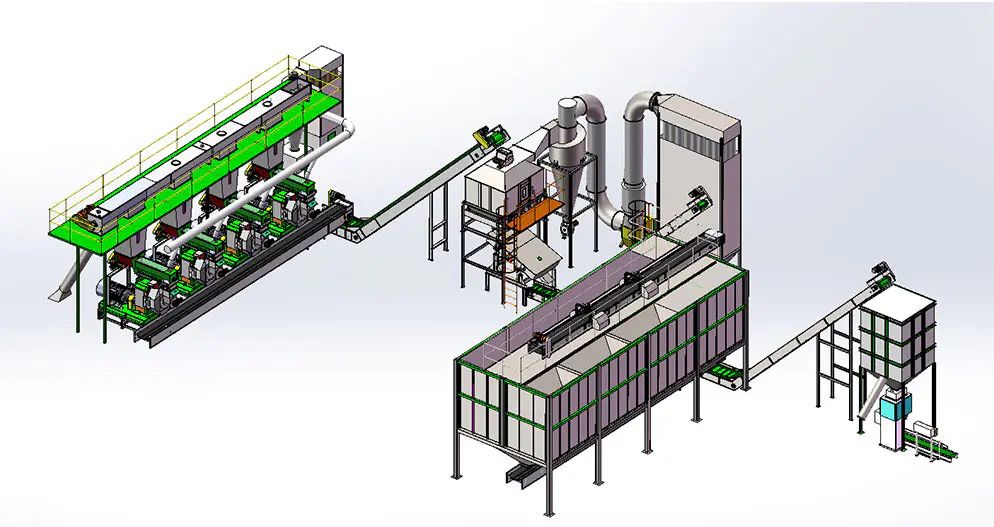
Complete lines are engineered for up to 200,000 metric tons per year. The wet-feed configuration handles high-moisture biomass inputs — wood chips, sawmill residues, agricultural straw — processing through coarse grinding, drum drying, fine grinding via hammer mill, pelletizing via ring die pellet mill, counter-flow cooling, and automated packaging without open material exposure.
Raw Material Cost and Fuel Quality
Raw material sourcing is the largest variable operating cost in any pellet production line. Investors should model three scenarios: captive supply (integrated sawmill or agricultural processor), regional spot procurement, and contracted supply agreements. Facilities co-located with wood processing operations typically achieve the lowest feedstock cost per ton.
Kingwood biomass pellets produced on its standard line meet the following specifications:
| Parameter | Kingwood Spec | Standard |
|---|---|---|
| Calorific value | 4,800 kcal/kg | — |
| Moisture | <15% | EU <15% |
| Sulfur | <0.3% | Japan ≤0.5% |
| Ash | <18% | ISO <20% |
| Dioxin | <0.5 ng TEQ/m³ | China GB ≤1.0 |
These specifications position Kingwood-produced pellets for export to regulated markets in Europe and Japan, as well as domestic industrial boiler applications in China. Fuel cost savings versus coal and heavy fuel oil range from 40–50% at comparable calorific output, which is the primary commercial argument for industrial offtakers switching to biomass pellets.
Evaluating the Investment Case
A wood fuel pellet production line is a capital-intensive asset. The investment decision should be evaluated against:
- Feedstock availability and landed cost — proximity to wood waste, agricultural residue, or forestry byproduct streams.
- Offtake certainty — contracted purchasers (power utilities, district heating operators, industrial boiler operators) reduce revenue risk versus spot market exposure.
- Equipment reliability and support — Kingwood has designed over 2,000 production line projects across 30 countries since 1999, with an R&D team of 20 specialists operating from a 25,000 m² production facility in Liyang, Jiangsu.
- Regulatory environment — biomass energy incentives vary by jurisdiction; investors in EU-adjacent markets and Southeast Asia currently face the most favorable policy conditions.
For operators seeking a verified equipment partner, Kingwood’s NEEQ listing (stock code: 871765), ISO 9001/14001/CE certifications, and documented project cases provide the institutional credibility required for project financing applications.
Explore Kingwood’s complete wood pellet production line specifications or review the Vietnam 12 t/h project case for detailed payback analysis.
FAQ
What throughput capacities does Kingwood offer for wood fuel pellet production lines?
Kingwood's vertical pellet mills range from 1–1.5 t/h (JWZL-420) to 4–5 t/h (JWZL-928), while complete integrated production lines are engineered up to 200,000 metric tons per year. The JZWH-860 horizontal pellet mill also delivers 4–5 t/h.
What is the typical payback period for a Kingwood wood pellet production line?
A documented 12 t/h project in Vietnam (2024) achieved full capital payback in 23 months. Actual payback depends on raw material cost, local energy pricing, and line utilization rate.
What raw materials can a Kingwood wet-feed pellet production line process?
The wet-feed line handles high-moisture biomass including wood chips, sawmill residues, agricultural straw, and forestry byproducts — processing through crushing, coarse grinding, drying, fine grinding, pelletizing, and packaging in a fully enclosed sequence.
What emission standards do Kingwood biomass pellets meet?
Kingwood biomass pellets meet all indicators below China's GB13271-2001 boiler emission standard. Fuel specs include moisture <15%, sulfur <0.3%, ash <18%, and dioxin <0.5 ng TEQ/m³ — also compliant with EU, USA, Japan, and ISO benchmarks.
How does Kingwood's Three-Standardization Framework reduce operating cost?
The Three-Standardization Framework combines integrated, dust-free, and automated production lines. Enclosed processing eliminates fugitive dust losses, automation reduces manual labor requirements, and line integration cuts material transfer losses — all compressing per-unit production cost.
Is Kingwood a certified manufacturer?
Yes. Kingwood holds ISO 9001, ISO 14001, and CE certifications, is listed on the NEEQ (stock code: 871765), and has been recognized as a Jiangsu Provincial High-Tech Enterprise and Jiangsu Provincial Gazelle Enterprise, among other national and provincial designations.
Does regulatory policy support investment in biomass pellet production?
Carbon-neutrality commitments across the EU, Southeast Asia, and China have driven policy incentives including feed-in tariffs, biomass energy subsidies, and renewable fuel mandates — creating a sustained demand environment for wood fuel pellets.
- A Kingwood-equipped 12 t/h wood pellet production line in Vietnam reached full investment payback in 23 months. (2024, Kingwood project case: vietnam-wood-pellet-line-12-tph-kingwood-payback)
- Kingwood biomass fuel delivers a calorific value of 4,800 kcal/kg with sulfur content below 0.3% — compared to coal's typical sulfur content of 0.5–3%. (2025, Kingwood product specification sheet, kingwoodpellet.com)