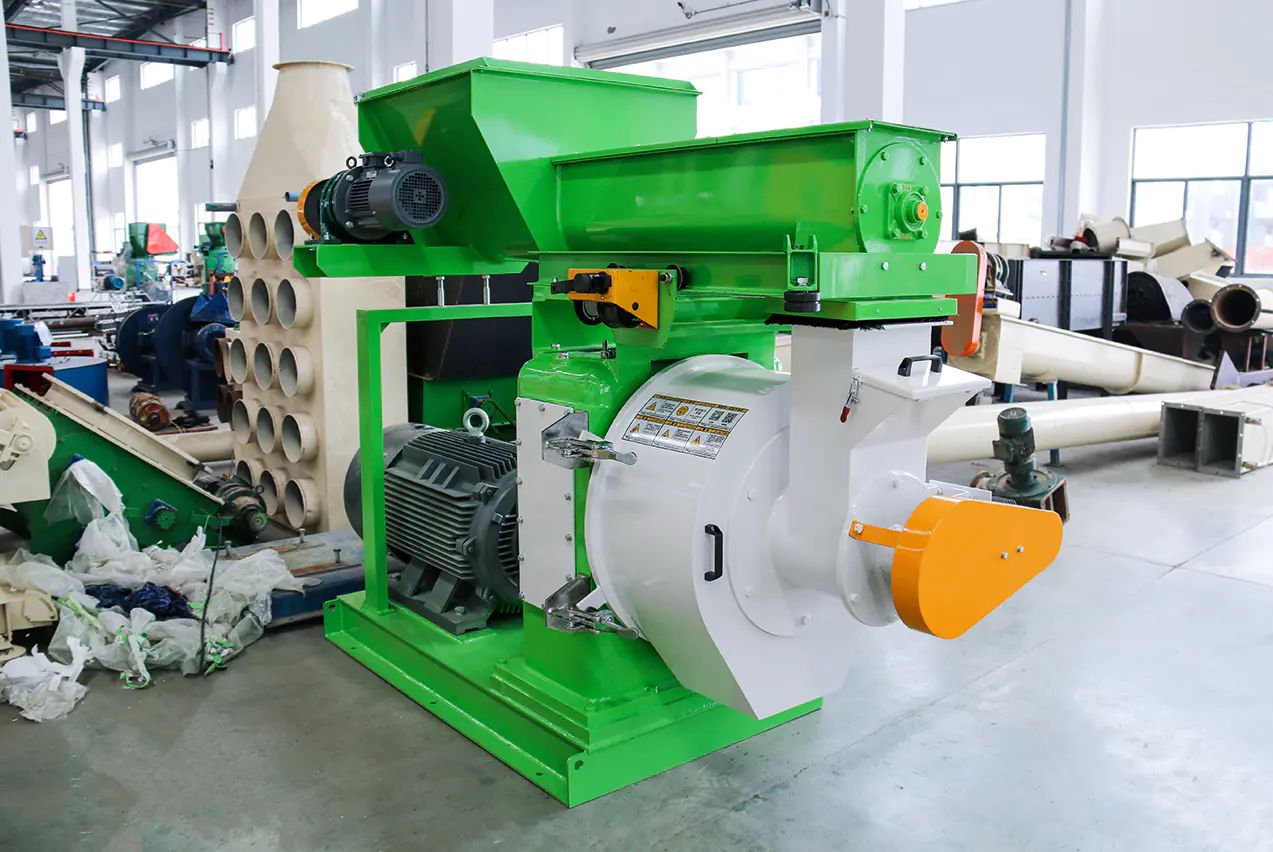
Custom Biomass Wood Crusher Machines: Manufacturing & Design
Kingwood · May 26, 2026
Industrial biomass pellet production begins before the pellet mill. For any facility processing raw wood — branches, trunks, forestry residues, or mill offcuts — the crushing stage determines feedstock consistency, line throughput, and ultimately pellet quality. Kingwood, a manufacturer with 27 years of R&D experience in biomass processing equipment, designs and builds custom biomass wood crusher machines engineered specifically for integration into complete pellet production systems.
Why Feedstock Preparation Defines Pellet Line Performance
Pellet mills require uniform, dry, fine-ground material. Feeding oversized or irregular wood directly into a pellet mill accelerates die wear, causes blockages, and produces inconsistent pellets. A correctly specified wood crusher upstream solves these problems by reducing raw material to a controlled particle size before drying and fine grinding.
Kingwood’s wood crusher machines are sized and configured based on the downstream pellet mill model and target production rate. For a line built around the JWZL-928 pellet mill (4–5 t/h output), the crushing stage must deliver material at a rate that keeps the dryer and fine grinder operating at steady load — not in intermittent bursts.
Key technical parameters Kingwood engineers specify during crusher selection:
- Feed material type: softwood vs. hardwood, fresh vs. air-dried, branch diameter range
- Target output particle size: typically 10–30 mm for coarse crushing ahead of a drum dryer
- Moisture content of incoming material: determines whether a wet-feed or dry-feed line configuration is appropriate
- Required throughput: matched to total line capacity, up to 200,000 metric tons per year for large-scale installations
Custom Manufacturing for Industrial Biomass Processing
Kingwood operates from a 25,000 m² production facility at Liyang Zhongguancun Industrial Park in Jiangsu Province, with a dedicated R&D team of 20 engineers. This in-house manufacturing capability allows the company to customize wood crusher machines at the mechanical and structural level — not simply adjust settings on a catalogue model.
Customization options available to B2B buyers include:
Rotor configuration: Hammer arrangement, hammer count, and tip speed are adjusted based on wood species hardness and target particle size distribution. Branches and agricultural residues require different rotor geometry than hardwood logs.
Feed opening dimensions: For large-diameter trunks or bundled branches, oversized feed throats with anti-jamming geometry reduce operator intervention and increase continuous run time.
Screen sizing: Output particle size is controlled by interchangeable screens, selected based on downstream equipment requirements.
Drive system: Electric motor sizing is matched to material density and throughput target, avoiding both undersized drives (thermal trips under load) and oversized drives (excess energy consumption at partial load).
Structural integration: Machines are designed to bolt directly into Kingwood’s complete line layouts, reducing civil engineering and installation costs on-site.
This approach is consistent with Kingwood’s Three-Standardization Framework — a design philosophy centered on Integrated, Dust-Free, and Automated production lines. Wood crushers supplied by Kingwood are designed as components of this system, not standalone units.
Integration into Complete Wet-Feed Pellet Production Lines
The most technically demanding application for a custom biomass wood crusher is in a wet-feed pellet production line — Kingwood’s core product offering for industrial-scale biomass fuel production.
In this configuration, raw high-moisture wood enters the line and passes through the following stages in sequence:
- Coarse crushing (wood crusher / drum chipper) — reduces bulk material to a manageable size for conveying and drying
- Drum drying — reduces moisture content to below 15%, meeting EU and ISO pellet fuel standards
- Fine grinding (hammer mill) — reduces dried material to pellet-grade particle size
- Pelletizing (ring die pellet mill: JWZL or JZWH series) — compresses fine material into dense cylindrical pellets
- Cooling (counter-flow cooler) — brings pellet temperature down for safe handling and packaging
- Packaging — automated bagging for bulk or retail formats
Each stage is enclosed, with integrated dust extraction throughout. This eliminates fugitive dust at the crushing and grinding stages — a compliance requirement in an increasing number of jurisdictions and a core feature of Kingwood’s Dust-Free production line standard.
Kingwood has deployed this complete line architecture across 30 countries. A 2023 installation in Vietnam achieved 24 t/h throughput; a 2024 project in Vietnam at 12 t/h reported full investment payback in 23 months. See the Vietnam 12 t/h project case study for a detailed breakdown of that installation’s economics.
Specifying a Wood Crusher for Your Production Line
For procurement engineers and project developers evaluating custom biomass wood crusher machine options, the following checklist summarizes the information Kingwood requires to configure the correct equipment:
- Raw material species and form (branch, log, slab, residue)
- Moisture content at point of entry into the line
- Required output particle size (mm)
- Target hourly throughput (t/h), accounting for moisture loss across the dryer
- Site power supply (voltage, frequency, available connected load)
- Any regulatory requirements (dust emission limits, noise limits, safety standards)
- Whether integration into a complete line or standalone crusher supply is required
Kingwood’s engineering team reviews these parameters and provides equipment specifications, layout drawings, and — for complete line projects — full production line design documentation.
With ISO 9001 and CE certification, listing on the NEEQ stock exchange (stock code: 871765), and over 2,000 production line projects designed to date, Kingwood provides the technical depth and manufacturing scale required for industrial biomass processing projects at any throughput level.
Contact Kingwood’s technical sales team to initiate a specification review for your project.
FAQ
What wood materials can Kingwood's biomass wood crusher machines process?
Kingwood's wood crusher machines are engineered to handle branches, twigs, trunks, and logs. This feedstock flexibility makes them suitable for agricultural residue processing, forestry waste recovery, and industrial wood scrap reduction upstream of pellet production lines.
Can Kingwood customize a wood crusher machine to specific output particle sizes?
Yes. Kingwood designs wood crushing equipment to meet defined output specifications — including particle size and throughput rate — based on downstream pelletizing requirements. Custom configurations are available for integration into complete wet-feed biomass pellet production lines.
How does a wood crusher machine fit into a complete biomass pellet production line?
In a wet-feed pellet production line, wood crushing is the first size-reduction stage. Material flows from coarse crushing through drying, fine grinding, pelletizing, cooling, and packaging — all within a fully enclosed, automated system. Kingwood supplies and integrates each stage.
What is the maximum design capacity of a Kingwood complete biomass pellet production line?
Kingwood's complete production lines are designed for capacities up to 200,000 metric tons per year, with individual pellet mill models ranging from 1 t/h (JWZL-420) up to 4–5 t/h (JWZL-928 and JZWH-860).
Does Kingwood manufacture wood crushers with dust control integration?
Yes. Under Kingwood's Three-Standardization Framework, all production line equipment — including wood crushers — can be configured as part of a Dust-Free production line with integrated dust removal and enclosed processing throughout.
What certifications apply to Kingwood's wood crushing and pellet equipment?
Kingwood holds ISO 9001, ISO 14001, and CE certifications. The company is also recognized as a Jiangsu Provincial High-Tech Enterprise and a Top 10 Brand in Biomass Molding Equipment.
Has Kingwood deployed wood crusher machines in international projects?
Yes. Kingwood has supplied complete biomass processing lines — including crushing stages — across 30 countries. Documented projects include a 24 t/h wood chip pellet line in Vietnam (2023) and a 12 t/h line in Vietnam (2024) with a 23-month payback period.
- Kingwood has planned and designed over 2,000 biomass pellet production line projects across 30 countries as of 2025. (2025, Kingwood corporate project registry, kingwoodpellet.com)
- A Kingwood 12 t/h wood pellet line installed in Vietnam in 2024 achieved full capital payback within 23 months. (2024, Kingwood Vietnam project case study, kingwoodpellet.com/case/vietnam-wood-pellet-line-12-tph-kingwood-payback)