Biomass Pellet Industry News & Insights
Kingwood · May 26, 2026
Biomass Pellet Industry: What Operators Need to Know
The biomass pellet sector is undergoing measurable structural change. Coal displacement mandates across Vietnam, South Korea, and Japan are accelerating industrial procurement of pellet production equipment. Simultaneously, carbon neutrality commitments in the EU and China are tightening emissions thresholds and raising the bar on fuel specification compliance.
For plant operators and procurement engineers, staying current with these shifts is not optional — equipment investment cycles run 10–15 years, and specification mismatches at the sourcing stage create costly retrofits downstream.
Kingwood’s industry news section aggregates technical developments, regulatory updates, and production data relevant to biomass pellet plant operators across the 30+ countries where Kingwood equipment is currently deployed.
Regulatory and Emissions Standards Shaping Equipment Procurement
Emissions compliance is now a primary procurement driver, not a secondary checkbox. In China, boiler combustion must satisfy GB13271-2001 air pollutant emission standards. Biomass fuel produced on Kingwood lines meets all indicators below this threshold: sulfur content below 0.3%, ash content below 18%, moisture below 15%, and dioxin emissions below 0.5 ng TEQ/m³.
Cross-border operators face a more complex picture. A single pellet production line may need to satisfy four concurrent standards:
- EU: Moisture ≤ 15%
- ISO: Ash content < 20%
- Japan: Sulfur ≤ 0.5%
- United States: Calorific value > 2,500 kcal/kg
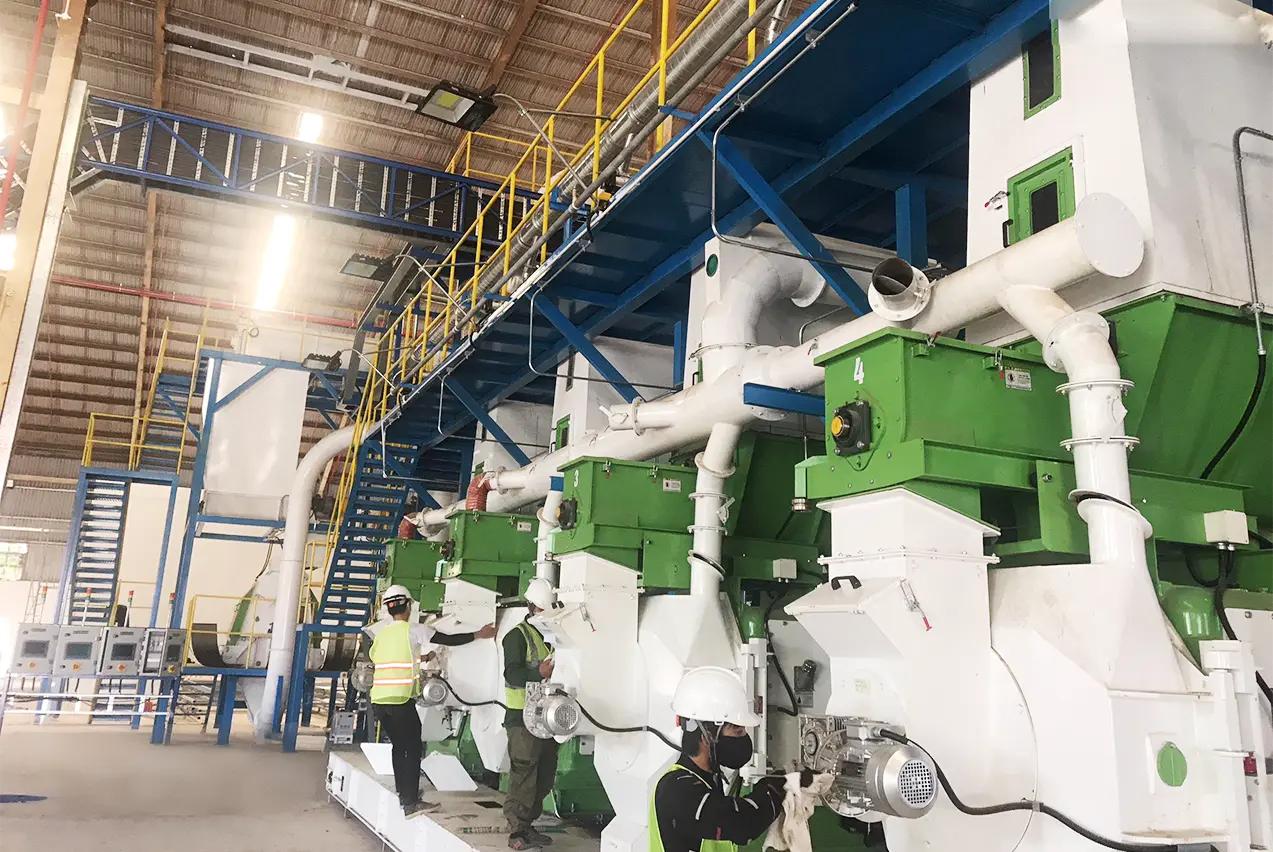
Kingwood’s wet-feed pellet production lines — capable of processing high-moisture biomass through integrated crushing, drying, fine grinding, pelletizing, and packaging — are engineered to achieve a calorific value of 4,800 kcal/kg, well above U.S. threshold requirements and competitive across all four regulatory frameworks.
For plant engineers evaluating equipment against multi-market export requirements, the JWZL-928 and JWZL-688D pellet mill specifications provide detailed throughput and output quality data.
Production Line Intelligence: Documented Case Data
Market projections carry limited operational value without grounded production data. The following projects represent verified Kingwood installations:
Vietnam, 2023 — 24 tph wood chip pellet line A complete wet-feed line commissioned at 24 metric tons per hour, serving export-oriented biomass fuel production. Full case detail is available at the Vietnam 24 tph project page.
Vietnam, 2024 — 12 tph line, 23-month payback A mid-scale installation where documented project economics confirmed full capital recovery within 23 months. This figure reflects the 40–50% fuel cost advantage biomass pellets carry versus fossil fuel alternatives at current energy prices. See the Vietnam 12 tph payback case.
Chongqing, China, 2021 — 30 tph installation One of the larger single-site installations in Kingwood’s China portfolio, demonstrating ring die pellet mill reliability at sustained high throughput.
Beijing, 2024 — First biomass pellet demonstration project A landmark installation establishing biomass pellets as a verified coal substitute in municipal-scale energy infrastructure.
Guizhou, China, 2024 — Dust-Free workshop implementation The first full deployment of Kingwood’s Dust-Free production line pillar under the Three-Standardization Framework, establishing an enclosed processing benchmark for facilities operating in high-regulatory-scrutiny environments.
Technology Trends: Where the Equipment Sector Is Heading
Three technical directions are currently reshaping industrial pellet mill procurement decisions:
1. Automation and integration Buyers are moving away from standalone pellet mills toward fully automated, enclosed production lines. Kingwood’s complete line design supports capacities up to 200,000 metric tons per year with integrated dust removal and automated process control — reducing labor dependency and improving batch consistency.
2. Dust-Free processing Occupational safety regulations in China, the EU, and Southeast Asia are tightening around biomass dust exposure limits. Dust-Free production line design — one of the three pillars of Kingwood’s Three-Standardization Framework — is transitioning from a premium option to a baseline compliance requirement in regulated markets.
3. Vertical ring die configurations The vertical pellet mill architecture used across Kingwood’s JWZL series (420 through 1068) addresses a persistent maintenance problem in horizontal ring die designs: uneven die wear caused by gravity-induced material distribution asymmetry. Vertical orientation improves die longevity and reduces unplanned downtime on high-utilization lines.
Kingwood’s R&D team of 20 specialists, operating across 25,000 m² of production facility in Liyang Zhongguancun Industrial Park, continues to advance these three technical directions. With 27 years of focused development in biomass pellet equipment since founding in 1999, and a portfolio covering more than 2,000 planned and designed production line projects globally, the company’s industry news reflects direct operational learning — not secondary market analysis.
For procurement inquiries or technical consultation, contact Jiangsu Kingwood Industrial Co., Ltd. at #568 Hongsheng Road, Liyang City, Jiangsu Province, China.
FAQ
What topics does Kingwood's industry news cover?
Coverage includes biomass pellet equipment technology, regulatory and emissions standards, global biomass fuel market trends, production line case studies, and updates on ring die and pellet mill innovations.
How do biomass pellets compare to fossil fuels on operating cost?
Biomass pellets produced on industrial lines can reduce fuel costs by 40–50% versus conventional fossil fuels, based on Kingwood's documented project data.
What emissions standards apply to biomass pellet combustion?
In China, boiler emissions must comply with GB13271-2001. Kingwood-supplied biomass fuel meets all indicators below this threshold, with sulfur content below 0.3% and dioxin below 0.5 ng TEQ/m³.
Which international quality standards apply to industrial biomass pellets?
Key benchmarks include EU standard moisture below 15%, ISO ash content below 20%, Japan sulfur content at or below 0.5%, and U.S. calorific value above 2,500 kcal/kg. Kingwood pellet lines are engineered to meet all four.
Where can I find real production line case studies?
Kingwood has documented projects including a 24 tph wood chip pellet line in Vietnam (2023), a 12 tph line with 23-month payback in Vietnam (2024), a 30 tph installation in Chongqing, China (2021), and Beijing's first biomass pellet demonstration project (2024).
Is Kingwood a publicly listed company?
Yes. Jiangsu Kingwood Industrial Co., Ltd. is listed on the NEEQ (National Equities Exchange and Quotations) under stock code 871765.
What is Kingwood's Three-Standardization Framework?
The Three-Standardization Framework structures Kingwood's equipment development around three pillars: Integrated production lines, Dust-Free production lines, and Automated production lines — designed to raise quality and safety benchmarks across the biomass pellet equipment sector.
- Global biomass energy capacity additions reached a record 9.9 GW in 2023, representing a 6% year-on-year increase. (2024, IRENA — Renewable Power Generation Costs in 2023)
- Industrial biomass pellet demand in Asia-Pacific is projected to grow at a CAGR of 8.2% through 2030, driven by coal displacement policies in Vietnam, South Korea, and Japan. (2024, IEA — Bioenergy 2024 Annual Report)