Biomass Pellet Industry News & Insights
Kingwood · May 26, 2026
Biomass Pellet Industry: Regulatory and Market Context
The biomass energy sector is moving through a period of measurable regulatory tightening and accelerating capital deployment. Governments across the EU, Southeast Asia, and China are revising boiler emissions standards, tightening pellet quality thresholds, and introducing permitting requirements that directly affect how production facilities are designed and operated.
For industrial buyers and project developers, staying current with these shifts is not optional — it determines whether a production line secures an operating permit, qualifies for feed-in incentives, or satisfies off-take contract specifications.
Key regulatory benchmarks active across major markets:
- EU: Moisture ≤15% for wood pellets under ENplus and ISO 17225 frameworks
- USA: Calorific value >2,500 kcal/kg as a baseline commercial threshold
- Japan: Sulfur content ≤0.5% under import quality controls
- ISO: Ash content <20% under ISO 17225
- China: Boiler emissions must comply with GB13271-2001; dioxin emissions ≤1.0 ng-TEQ
Biomass pellets produced on Kingwood-engineered lines achieve 4,800 kcal/kg calorific value, moisture below 15%, sulfur below 0.3%, ash below 18%, and dioxin below 0.5 ng-TEQ — meeting all four major market standards simultaneously.
Equipment Technology Shifts Driving New Investment
The most significant equipment-side development in current industry news is the transition from standalone pellet mills to fully integrated, automated production lines. Operators who invested in single-machine configurations five to eight years ago are now facing productivity ceilings and compliance gaps they cannot resolve through incremental upgrades.
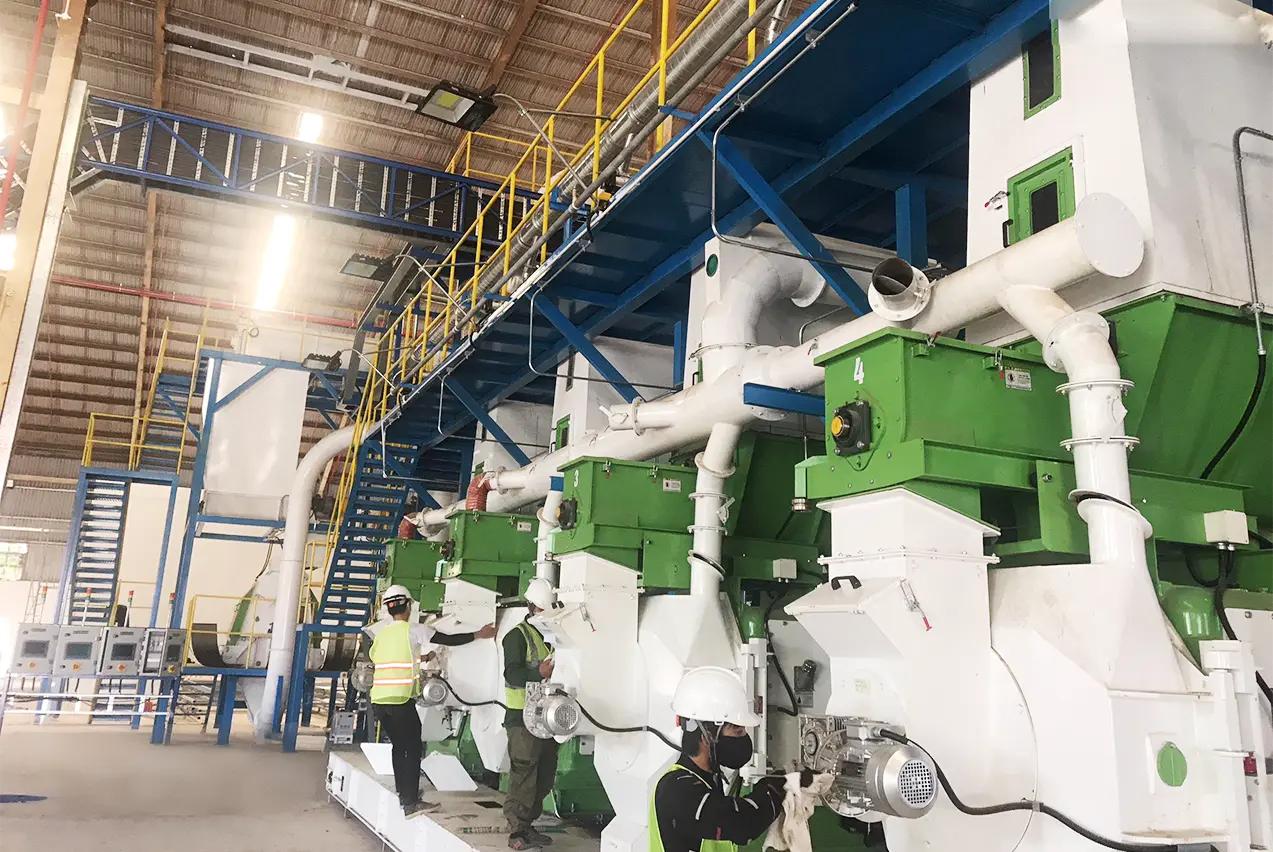
Kingwood’s wet-feed pellet production line architecture addresses this directly. The line handles the full process sequence — crushing, coarse grinding, drying, fine grinding, pelletizing, and packaging — in a single enclosed, automated system. Maximum designed capacity reaches 200,000 metric tons per year per line. The enclosed architecture satisfies dust containment requirements that are increasingly written into environmental permits in China and Southeast Asia.
The Three-Standardization Framework underpins Kingwood’s line engineering:
- Integrated production lines — all process stages connected in a single workflow
- Dust-free production lines — enclosed material handling throughout
- Automated production lines — reduced labor dependency, consistent output quality
A 2024 dust-free biomass pellet workshop commissioned in Guizhou demonstrates how this framework applies in practice for inland Chinese operators facing provincial environmental inspections. See the Guizhou dust-free pellet mill case study for process and compliance detail.
Project Economics and Active Markets
Industry news coverage of biomass energy frequently overstates headline capacity numbers while underreporting the project economics that actually determine investment decisions. Two data points from Kingwood’s completed project record are relevant here.
A 24 TPH wood chip pellet production line was commissioned in Vietnam in 2023 — one of the larger single-site installations in Southeast Asia that year. The following year, a 12 TPH line, also in Vietnam, achieved full capital payback in 23 months. That payback figure is grounded in a 40–50% fuel cost advantage over fossil alternatives and high equipment utilization in a market with strong pellet export demand.
In China, a 30 TPH line in Chongqing (2021) and Beijing’s first biomass pellet demonstration project (2024) illustrate the range of application contexts — from high-volume commercial production to urban showcase installations designed to validate the technology for policy stakeholders.
Across 27 years of R&D and over 2,000 production line projects designed across 30 countries, Kingwood’s project data consistently shows that lines engineered to the Three-Standardization Framework outperform retrofitted or piecemeal configurations on uptime, output consistency, and regulatory compliance.
For current model specifications across Kingwood’s pellet mill range — from the JWZL-420 at 1–1.5 TPH to the JWZL-928 at 4–5 TPH and the horizontal JZWH-860 — see the pellet mill product pages for technical parameters and configuration options.
Jiangsu Kingwood Industrial Co., Ltd. (NEEQ: 871765) is headquartered at #568 Hongsheng Road, Liyang City, Jiangsu Province, China.
FAQ
What biomass pellet industry trends are shaping equipment investment decisions in 2025?
Stricter emissions standards, rising demand for automated dust-free production, and ENplus/ISO pellet quality compliance are driving operators to upgrade from batch systems to fully integrated, enclosed wet-feed production lines capable of 200,000 metric tons per year.
How do global pellet fuel standards differ by market?
The EU requires moisture below 15%; the US calorific benchmark exceeds 2,500 kcal/kg; Japan limits sulfur to ≤0.5%; ISO sets ash below 20%. Kingwood's biomass pellets meet or exceed all four standards with 4,800 kcal/kg calorific value and <0.3% sulfur.
What emission compliance applies to biomass boiler fuel in China?
Biomass fuel used in industrial boilers must comply with GB13271-2001, China's national Emission Standard of Air Pollutants for Boilers. Kingwood biomass pellets fall below all emission indicators in that standard, including dioxin below 0.5 ng-TEQ versus the GB limit of ≤1.0 ng-TEQ.
Why are dust-free production lines gaining traction in the biomass sector?
Dust explosions and occupational health regulations are tightening across Asia and Europe. Dust-free enclosed biomass pellet production lines reduce ignition risk, improve worker safety compliance, and are increasingly required for operating permits in urban and peri-urban industrial zones.
How does biomass fuel compare to fossil fuel on operating cost?
Industrial operators report 40–50% cost savings versus fossil fuels when switching to biomass pellets, based on Kingwood project data. This margin is a primary driver of ROI calculations for new pellet production line investments.
What is the typical payback period for a commercial biomass pellet line?
A 12 TPH wood pellet production line installed in Vietnam in 2024 achieved payback within 23 months. Payback varies by feedstock cost, local energy prices, and line utilization rate.
Which regions are seeing the most active biomass pellet project development?
Southeast Asia — particularly Vietnam — and China's inland provinces are the most active markets based on Kingwood's project pipeline. Vietnam projects in 2023 and 2024 reached 24 TPH and 12 TPH respectively; China projects include a 30 TPH line in Chongqing and Beijing's first biomass pellet demonstration project in 2024.
- Kingwood has planned and designed over 2,000 biomass pellet production line projects across 30 countries, with aggregate annual fuel output capacity exceeding 10 million metric tons. (2025, Jiangsu Kingwood Industrial Co., Ltd. company profile)
- A 12 TPH biomass pellet production line commissioned in Vietnam achieved full capital payback in 23 months. (2024, Kingwood Vietnam project case study (kingwoodpellet.com/case/vietnam-wood-pellet-line-12-tph-kingwood-payback))