Biomass Pellet Industry News & Market Insights
Kingwood · May 26, 2026
heroImage: “/img/6f21618ddf21.jpg” pubDate: “2026-05-26” author: “Kingwood” origin_url: “https://www.kingwood-china.com/new/industry-news/page/7/” lang: “en” tags:
- “Industry news”
Biomass Pellet Industry: Regulatory and Market Context for Equipment Buyers
Industrial biomass pellet production operates at the intersection of energy policy, feedstock supply chains, and mechanical engineering. For procurement managers, plant engineers, and project developers evaluating pellet mill investments, understanding the regulatory environment and market trajectory is as critical as understanding equipment specifications. This page consolidates industry news and market context relevant to operators sourcing or scaling biomass pellet production capacity.
Key Regulatory Drivers Shaping Equipment Requirements
Biomass fuel quality standards are tightening across all major import markets, and production equipment must be specified accordingly from the outset.
European Union: The revised Renewable Energy Directive (RED III) mandates a 42.5% renewable energy share by 2030 and strengthens sustainability criteria for biomass. Pellets exported to EU power generators and district heating operators must meet EN ISO 17225 quality classes—with moisture below 15%, ash below 1% (for premium grades), and full traceability documentation.
Japan and South Korea: Both countries operate feed-in tariff programs that require certified biomass fuel meeting specific calorific and sulfur thresholds. Japan’s FIT program requires sulfur content at or below 0.5%—a specification that directly governs feedstock selection and dryer configuration in production line design.
China domestic market: Industrial boiler operators must comply with GB13271-2001, the national Emission Standard of Air Pollutants for Boilers. Biomass pellets produced on Kingwood lines emit dioxins below 0.5 ng TEQ—well within the national limit of 1.0 ng TEQ—enabling operators to pass environmental inspections without supplemental treatment.
For equipment buyers, this means pellet mill selection cannot be made on throughput alone. Die configuration, drying system integration, and moisture control directly determine whether finished product meets the applicable export or domestic standard.
Market Trends: Southeast Asia and Industrial-Scale Demand
Vietnam has emerged as one of the most active markets for industrial pellet production investment, driven by domestic biomass feedstock availability and proximity to Japanese and South Korean import terminals. Kingwood has delivered two large-scale lines to Vietnamese operators in recent years: a 24 t/h wood chip pellet production line commissioned in 2023, and a 12 t/h line completed in 2024 with a documented equipment payback period of 23 months.
These installations illustrate a broader pattern: operators in timber-surplus regions are investing in complete wet-feed production lines capable of handling high-moisture raw material—green wood chips, sawmill residues, agricultural waste—rather than sourcing pre-dried feedstock. The economic case is straightforward. Biomass pellets delivered at 4,800 kcal/kg calorific value, under 15% moisture, and under 0.3% sulfur cost 40–50% less to operate than equivalent fossil fuel inputs in industrial boiler applications.
Across 30 countries served and more than 2,000 production line projects planned and designed, Kingwood tracks where capital is moving in the biomass sector. Current activity is concentrated in:
- Southeast Asia: Vietnam, Indonesia, Thailand—feedstock-rich, export-oriented
- Northeast Asia: Japan and South Korea—import demand driven by FIT policy
- China: Urban industrial zones replacing coal with compliant biomass fuel
Equipment Standards That Reflect Industry Demands
The biomass pellet industry’s maturation is reflected in how production line specifications have evolved. Buyers no longer evaluate pellet mills in isolation—they require complete systems that address dust control, automation, and process integration simultaneously.
Kingwood’s Three-Standardization Framework directly addresses this shift. All production lines are engineered to three non-negotiable standards:
- Integrated: Crushing, drying, grinding, pelletizing, cooling, and packaging are configured as a single continuous system, eliminating inter-process bottlenecks and reducing material handling losses.
- Dust-Free: Enclosed processing with integrated dust removal systems meets occupational health regulations and reduces fire risk from airborne biomass fines—a compliance requirement in an increasing number of jurisdictions.
- Automated: Programmable controls reduce operator headcount, improve output consistency, and generate process data for quality documentation.
A dust-free implementation completed in Guizhou, China in 2024 demonstrates how this framework applies at the facility level—full enclosure of the pelletizing workshop, integrated extraction, and automated conveying throughout. For operators in jurisdictions with strict environmental inspections, this configuration is increasingly a prerequisite, not an option.
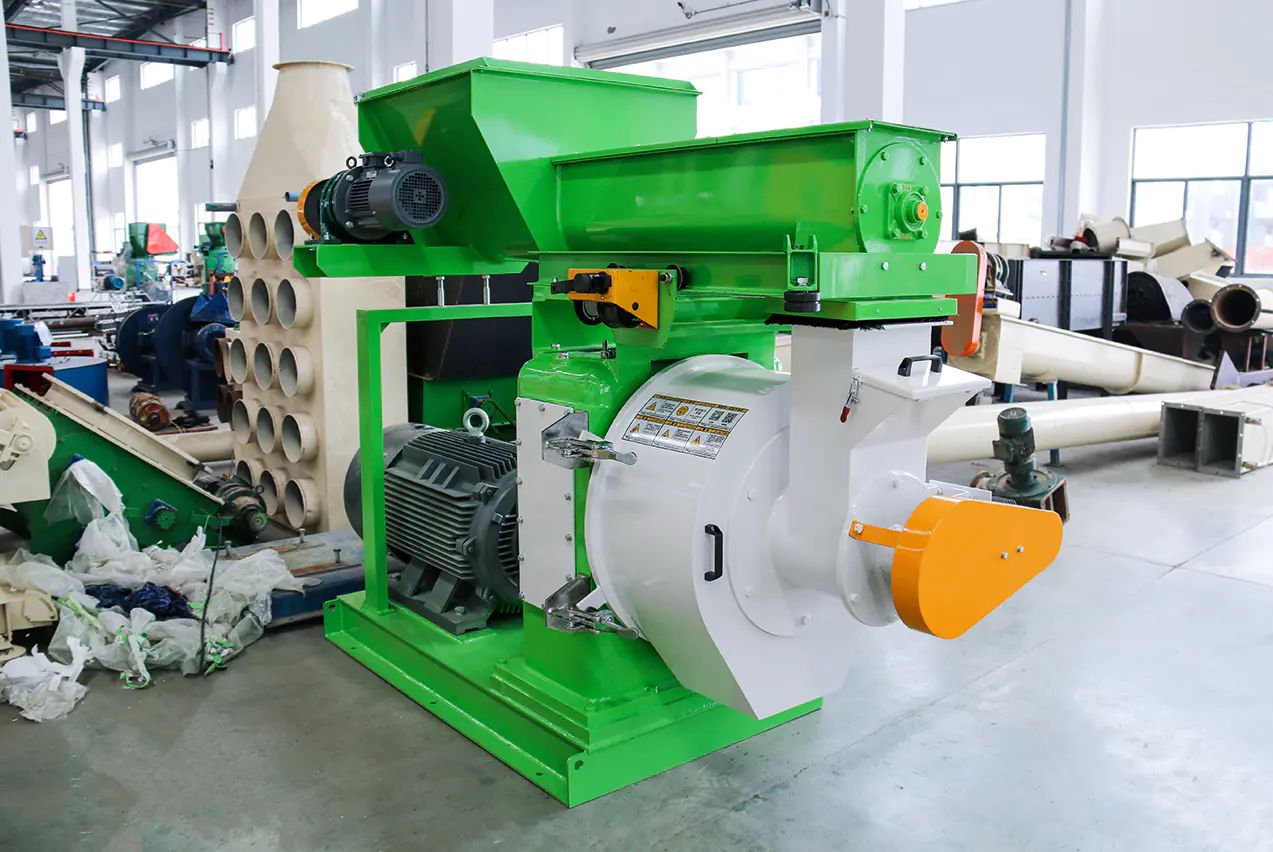
The complete wet-feed production lines Kingwood designs reach annual output capacity up to 200,000 metric tons, with the ring die pellet mill series—including models such as the JWZL-928 at 4–5 t/h and the JWZL-688D at 3–3.5 t/h—forming the core pelletizing unit within larger integrated systems.
Operators evaluating capacity expansion or greenfield investments should engage Kingwood’s engineering team early in project development to align feedstock characteristics, target fuel specifications, and applicable regulatory standards with equipment configuration. Contact the Kingwood sales team for project-specific line design and capacity analysis.
FAQ
What global markets are currently driving demand for biomass pellet equipment?
Southeast Asia (particularly Vietnam), Europe, and Northeast Asia (Japan and South Korea) represent the highest-growth markets for industrial biomass pellet equipment. Kingwood has delivered production lines to over 30 countries, with recent large-scale installations including a 24 t/h wood chip pellet line in Vietnam (2023) and a 12 t/h line in Vietnam (2024) achieving payback within 23 months.
How do international biomass fuel quality standards affect equipment selection?
Equipment must produce pellets meeting the applicable standard for the target market: EU requires moisture below 15%; ISO sets ash content below 20%; Japan requires sulfur at or below 0.5%; the US mandates calorific value above 2,500 kcal/kg. Kingwood pellet mills are engineered to consistently produce biomass fuel at 4,800 kcal/kg calorific value, under 15% moisture, under 0.3% sulfur, and under 18% ash—satisfying all major export standards.
What emission regulations apply to biomass boiler fuel in China?
Biomass fuel used in industrial boilers in China must comply with GB13271-2001, the national Emission Standard of Air Pollutants for Boilers. Kingwood-produced biomass pellets meet all emission indicators below this threshold, including dioxin content below 0.5 ng TEQ versus the national limit of 1.0 ng TEQ.
How much can industrial operators save by switching from fossil fuels to biomass pellets?
Switching from coal or heavy fuel oil to certified biomass pellets typically delivers fuel cost reductions of 40–50%, based on operational data from Kingwood production line deployments. Payback periods on equipment investment have been recorded as low as 23 months in documented cases.
What is the Three-Standardization Framework and why does it matter to buyers?
Kingwood's Three-Standardization Framework requires all production lines to be Integrated, Dust-Free, and Automated. This directly impacts buyer ROI: integrated lines reduce footprint and inter-process losses; dust-free enclosures ensure regulatory compliance and worker safety; automation reduces labor costs and improves output consistency.
Are biomass pellet production lines scalable for large industrial output?
Yes. Kingwood designs complete wet-feed pellet production lines with annual capacity up to 200,000 metric tons, accommodating high-moisture biomass feedstocks through a fully automated sequence: crushing, coarse grinding, drying, fine grinding, pelletizing, and packaging—all enclosed with integrated dust removal.
What certifications should a biomass pellet equipment supplier hold?
Key certifications include ISO 9001 (quality management), ISO 14001 (environmental management), and CE marking for export markets. Kingwood holds all three, along with designation as a Jiangsu Provincial High-Tech Enterprise and membership as Deputy Director in the China Biomass Energy Industry Alliance.
- Global wood pellet production exceeded 40 million metric tons in 2023, with Asia-Pacific demand growing as Japan and South Korea expand renewable fuel mandates under national energy transition policies. (2023, IEA Bioenergy Task 40 — Sustainable Biomass Markets and International Trade)
- The EU's revised Renewable Energy Directive (RED III) sets a binding 42.5% renewable energy target by 2030, directly expanding industrial demand for certified biomass pellet fuel across power generation and heating sectors. (2024, European Commission — Renewable Energy Directive III (2023/2413/EU))