Biomass Pellet Industry News & Market Insights
Kingwood · May 26, 2026
Why Biomass Pellet Industry News Matters for Equipment Buyers
Industrial biomass pellet production is a capital-intensive, regulation-sensitive business. Policy shifts — feed-in tariff revisions, updated emissions thresholds, new fuel quality mandates — can alter the economics of a production line within a single fiscal year. Equipment buyers and project developers who track industry news systematically make better procurement decisions: they size dryer capacity correctly for target-market moisture standards, select ring die specifications that match feedstock variability, and structure project payback models around verified fuel pricing benchmarks rather than assumptions.
Kingwood has designed and planned over 2,000 production line projects across 30 countries since its founding in 1999. The pattern is consistent: clients who engage early with current market intelligence — on feedstock costs, on grid-side biomass acceptance rates, on environmental permitting timelines — commission lines that perform at specification from day one. Those who don’t often return for costly process modifications.
This news section documents developments across three dimensions: regulatory and standards updates, technology and equipment advances, and real-world project performance data.
Key Standards and Regulatory Developments Shaping Pellet Production
Fuel quality standards are not static. The principal benchmarks currently governing industrial biomass pellet trade include:
- EU standard: moisture content below 15%
- ISO ash standard: below 20%
- Japanese sulfur standard: ≤0.5%
- US calorific standard: above 2,500 kcal/kg
- China GB13271-2001: national emissions standard for air pollutants from boilers; all emission indicators from Kingwood-designed lines operate below this threshold
Biomass pellets produced on Kingwood-engineered lines achieve 4,800 kcal/kg calorific value, under 0.3% sulfur, under 18% ash, and dioxin content below 0.5 ng TEQ — satisfying multi-market compliance simultaneously. This multi-standard alignment is not accidental; it is built into line design during the engineering phase.
For producers targeting Japanese or South Korean power utility contracts, sulfur and ash specifications are frequently the binding constraints. For EU wood pellet traders, moisture consistency across production batches determines ENplus certification eligibility. Equipment configuration — particularly drum dryer residence time and counter-flow cooler throughput — must be specified with these endpoints in mind, not retrofitted afterward.
Regulatory news also increasingly covers dust and emissions control at the facility level. China’s environmental inspection cycles have tightened permitting requirements for biomass processing facilities, directly raising demand for enclosed, dust-controlled production architecture. Kingwood’s Dust-Free production line pillar — one of three within its Three-Standardization Framework — addresses this directly, as demonstrated by the 2024 Dust-Free facility implementation in Guizhou, China.
Technology Trends in Industrial Biomass Pellet Equipment
Two equipment categories are seeing the most active development in industrial pellet lines: pellet mills and drying systems.
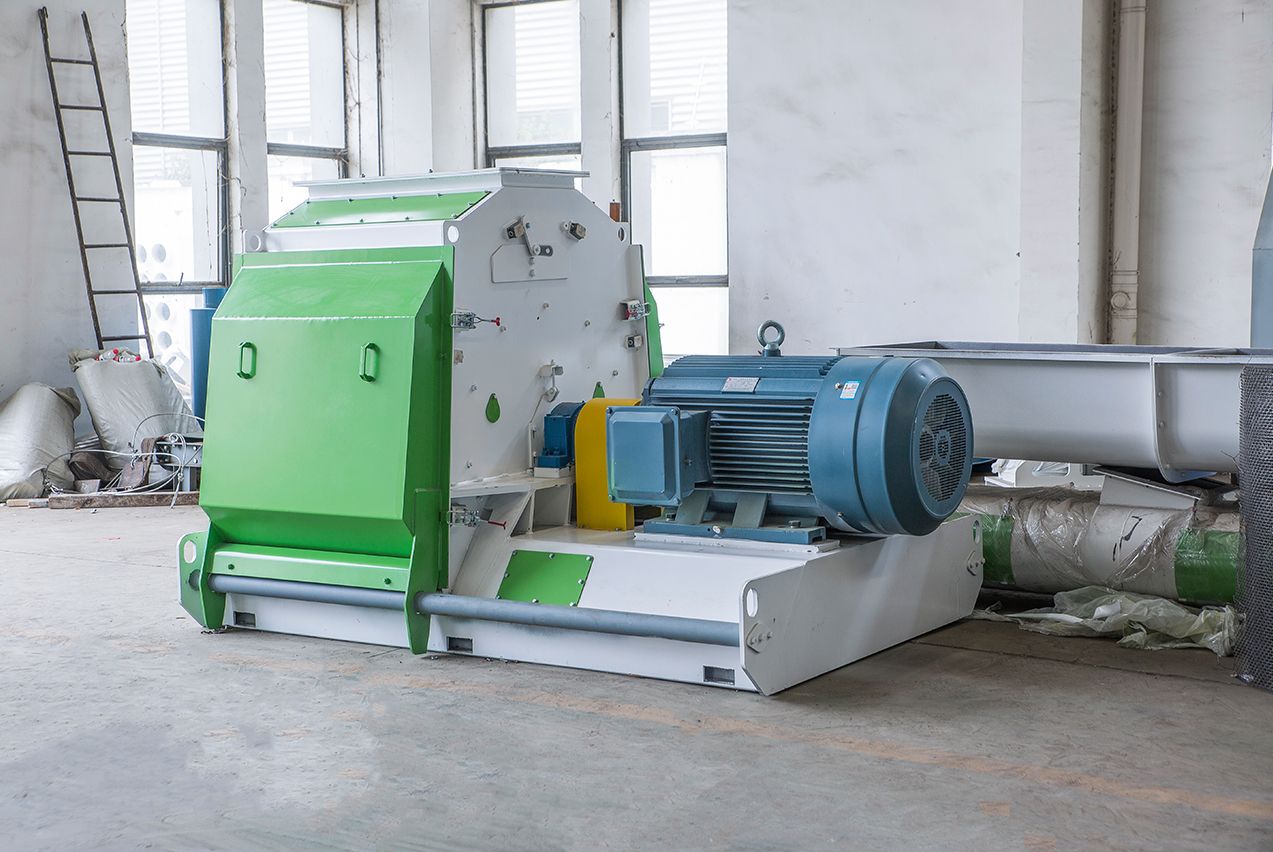
Pellet mills: The industry continues to move toward larger-diameter ring die designs for high-throughput applications. Kingwood’s current vertical pellet mill lineup spans from the JWZL-420 at 1–1.5 t/h through the JWZL-688 (2–2.3 t/h), JWZL-688D (3–3.5 t/h), JWZL-928 (4–5 t/h), and JWZL-1068 for higher-capacity requirements. The JZWH-860 horizontal pellet mill delivers 4–5 t/h for operations where floor layout favors horizontal configuration. For projects requiring complete line output above single-machine capacity, Kingwood engineers multi-mill parallel configurations up to 200,000 metric tons per year in complete line design capacity.
Drying systems: High-moisture feedstocks — green wood chips, agricultural residues above 40% moisture content — require robust drying upstream of the pellet mill. Drum dryer selection directly determines operating cost per ton, since thermal energy for drying represents the largest variable cost in a wet-feed pellet line. Kingwood’s wet-feed complete lines integrate crushing, coarse grinding, drying, fine grinding, pelletizing, packaging, and dust removal as a fully automated, enclosed sequence — eliminating the moisture variability that undermines ring die longevity and pellet density consistency.
Automation and data integration: Automated production lines — the third pillar of the Three-Standardization Framework — are becoming a baseline expectation rather than a premium option for industrial buyers. Labor cost pressures in both domestic Chinese and export markets, combined with tighter quality control requirements from offtake buyers, make fully automated material handling and process monitoring standard on new greenfield lines.
Project Intelligence: What Real Installations Reveal
Published case data from operating lines provides ground-truth input for feasibility modeling that generic market reports cannot. Selected recent Kingwood reference projects:
- Vietnam, 2024: 12 t/h wood pellet production line. Verified payback period of 23 months. This figure reflects actual fuel pricing, feedstock cost, and operating cost data from a commissioned and operating line — not a pro forma projection. See the full case study for process configuration details.
- Vietnam, 2023: 24 t/h wood chip pellet production line, demonstrating the scalability of Kingwood’s integrated line design for export-grade pellet production.
- Chongqing, China, 2021: 30 t/h line, one of the larger single-site installations in the domestic Chinese market at time of commissioning.
- Beijing, 2024: Beijing’s first biomass pellet demonstration project, significant for its role in establishing urban biomass fuel substitution precedent under China’s air quality management framework.
For developers evaluating biomass pellet projects in Southeast Asia, the Vietnam cases are directly applicable: feedstock (eucalyptus and acacia wood chips), export pellet quality standards, and grid infrastructure are comparable across the region.
Kingwood, listed on the NEEQ stock exchange under code 871765, maintains a 20-person R&D team and holds ISO 9001, ISO 14001, and CE certifications, alongside recognition as a Jiangsu Provincial High-Tech Enterprise. Project inquiries and technical consultation requests can be directed through the contact page for line-specific engineering assessment.
FAQ
What topics does Kingwood cover in its industry news section?
Kingwood's industry news covers biomass pellet market developments, equipment technology advances, emissions and fuel quality standards, policy changes affecting biomass energy, and project case studies from markets including China, Vietnam, and other regions across 30+ countries served.
How do international fuel quality standards affect biomass pellet production line design?
Standards vary by market: the EU requires moisture content below 15%, the ISO ash standard is below 20%, Japan's sulfur standard is ≤0.5%, and China's GB13271-2001 governs boiler air pollutant emissions. Equipment selection — particularly dryer configuration and pellet mill die geometry — must align with the target market's compliance thresholds.
What calorific value do Kingwood biomass pellets achieve?
Biomass pellets produced on Kingwood-designed lines achieve a calorific value of 4,800 kcal/kg, with moisture content below 15%, sulfur content below 0.3%, and ash content below 18% — meeting or exceeding China, EU, US, and Japanese standards.
How much can biomass fuel reduce energy costs compared to fossil fuels?
Biomass fuel can reduce energy procurement costs by 40–50% compared to conventional fossil fuels, based on operational data from production lines designed and commissioned by Kingwood.
What is Kingwood's Three-Standardization Framework and why does it matter to producers?
The Three-Standardization Framework comprises three production line pillars: Integrated, Dust-Free, and Automated. It is Kingwood's proprietary design standard for high-quality biomass pellet lines, directly addressing regulatory compliance, worker safety, and output consistency — all critical factors for industrial-scale producers.
Has Kingwood delivered large-scale biomass pellet projects internationally?
Yes. Reference projects include a 24 t/h wood chip pellet production line in Vietnam (2023), a 12 t/h line in Vietnam with a verified 23-month payback period (2024), and a 30 t/h line in Chongqing, China (2021), among others across 30 countries.
Where is Kingwood headquartered and what is its production scale?
Jiangsu Kingwood Industrial Co., Ltd. is headquartered at #568 Hongsheng Road, Liyang City, Jiangsu Province, China, within Liyang Zhongguancun Industrial Park. Its facility covers 31,200 m², including 25,000 m² of production space and 6,200 m² of office space.
- Global biomass power generation capacity reached approximately 145 GW in 2023, with Asia-Pacific accounting for the fastest growth segment driven by policy mandates in China, Vietnam, and Japan. (2024, International Renewable Energy Agency (IRENA), Renewable Power Generation Costs 2023)
- Wood pellet trade volumes exceeded 30 million metric tons globally in 2023, with industrial-grade pellets for power generation representing the dominant share of cross-border shipments. (2024, IEA Bioenergy Task 40, Global Wood Pellet Industry and Trade Study 2023)