Biomass Pellet Industry News & Insights
Kingwood · May 26, 2026
Why Biomass Pellet Industry News Matters for Equipment Buyers
For industrial biomass pellet producers, procurement managers, and energy project developers, staying current with sector developments is not optional — it directly affects capital allocation, equipment specification, and regulatory compliance. Fuel quality standards, carbon policy shifts, and advances in pelletizing technology each carry downstream implications for how a production line is engineered and operated.
Kingwood has tracked these developments since 1999, accumulating 27 years of R&D experience in biomass pellet equipment. With over 2,000 production line projects planned and designed across 30 countries, the company operates at a scale that provides real-world visibility into the trends shaping the industry.
Key Trends Shaping the Biomass Pellet Equipment Sector
1. Tightening Fuel Quality Standards Across Export Markets
Industrial pellet producers targeting export markets face an increasingly complex standards landscape. The EU requires moisture content below 15%. ISO standards cap ash content at less than 20%. Japan’s import specifications limit sulfur to ≤0.5%. In China, all boiler emissions must comply with GB13271-2001.
Meeting these benchmarks simultaneously requires equipment that handles the full processing chain — from raw material moisture management through drying, fine grinding, and pelletizing — without introducing contamination or process inefficiency. Kingwood’s wet-feed pellet production lines are engineered for exactly this requirement, handling high-moisture biomass through crushing, coarse grinding, drying, fine grinding, pelletizing, and packaging in a fully automated, enclosed sequence with integrated dust removal. Maximum designed capacity for a complete line reaches 200,000 metric tons per year.
2. Dust-Free Production as a Regulatory and Commercial Imperative
Dust management has moved from a health-and-safety consideration to a core production engineering requirement. Several jurisdictions now mandate enclosed biomass processing environments. Commercially, dust-free facilities command higher insurance ratings and easier permitting.
Kingwood’s Three-Standardization Framework addresses this directly through its Dust-Free pillar — one of three production-line standards alongside Integrated and Automated operation. The 2024 Guizhou installation documented in Kingwood’s dust-free biomass pellet mill workshop case provides a reference example of how this standard is implemented at scale.
3. Automation Reducing Operational Labor Dependency
Labor cost volatility and the need for consistent pellet quality are accelerating adoption of fully automated biomass pellet production lines. Automation reduces per-ton labor input, tightens quality consistency, and enables remote monitoring — a prerequisite for multi-shift industrial operations.
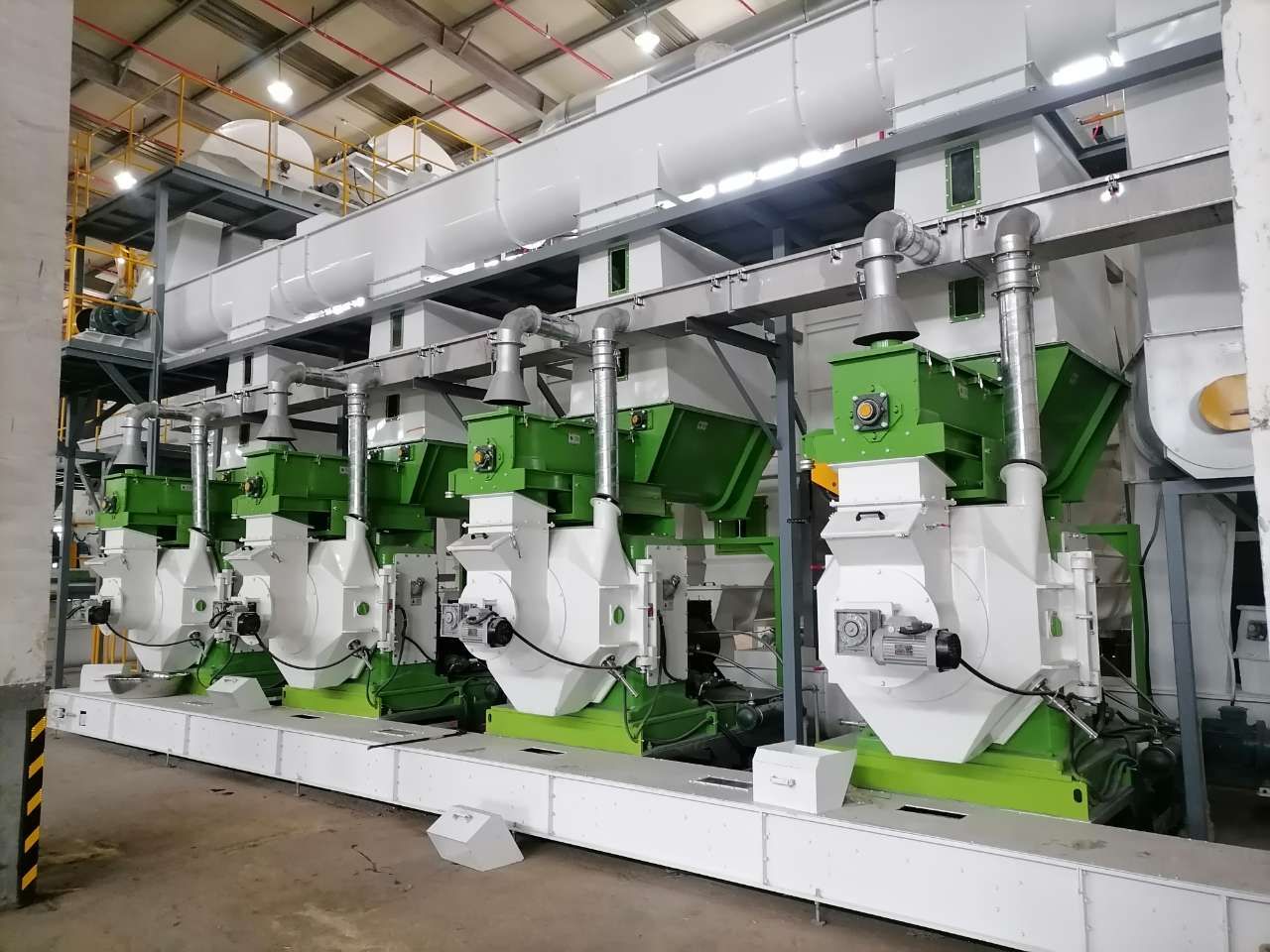
Kingwood’s JWZL and JZWH series pellet mills are integrated into automated line configurations. The JWZL-928, for example, delivers 4–5 t/h capacity within a fully automated line architecture. The JZWH-860 horizontal pellet mill covers the same capacity range for operators preferring horizontal ring die configurations.
Biomass Fuel Economics: What the Numbers Show
The cost case for industrial biomass pellets remains strong. Kingwood’s documented customer data shows fuel cost savings of 40–50% compared to coal and heavy fuel oil for equivalent thermal output. At a calorific value of 4,800 kcal/kg, with moisture below 15%, sulfur below 0.3%, and ash below 18%, certified biomass pellets meet the quality thresholds required by industrial boilers, co-firing installations, and district heating systems.
The 2024 Vietnam project — a 12 t/h wood pellet production line — achieved full capital payback in 23 months, a figure that reflects both the fuel cost savings and the throughput efficiency of the installed equipment. The earlier 2023 Vietnam installation at 24 t/h and the 2021 Chongqing installation at 30 t/h similarly document the commercial viability of industrial-scale biomass pellet production across different feedstock and market contexts.
For buyers evaluating total cost of ownership, the production economics are inseparable from equipment reliability and after-sales support — factors that differentiate purpose-built industrial pellet mills from general-purpose alternatives.
Kingwood’s Role in the Biomass Energy Information Ecosystem
Jiangsu Kingwood Industrial Co., Ltd. — listed on the NEEQ exchange under stock code 871765 — publishes industry news and technical content to support procurement and project development decisions across its global customer base. With a 25,000 m² production facility in Liyang Zhongguancun Industrial Park and a dedicated R&D team of 20 experts, Kingwood’s content reflects operational knowledge from active production line deployments, not secondary market research.
Certifications including ISO 9001, ISO 14001, and CE, alongside designation as a Jiangsu Provincial High-Tech Enterprise and membership as Deputy Director Member Unit of the China Biomass Energy Industry Alliance, position Kingwood as a credible source of technical and commercial intelligence for the sector.
Industry news published here covers equipment engineering updates, regulatory developments affecting biomass energy operations, project case analyses, and fuel quality benchmarking — all written for B2B readers who need specific, actionable information rather than general commentary.
FAQ
What types of industry news does Kingwood cover?
Kingwood covers biomass pellet equipment developments, fuel quality standards (including EU, US, Japan, and China GB benchmarks), regulatory updates affecting biomass energy producers, and market trends across the 30+ countries Kingwood serves.
How do international biomass fuel standards affect equipment purchasing decisions?
Standards such as the EU moisture threshold of <15%, the ISO ash limit of <20%, and Japan's sulfur ceiling of ≤0.5% directly influence pellet mill specifications, dryer sizing, and downstream quality control. Equipment must be configured to meet the target market's compliance requirements before production begins.
What emission standards apply to biomass fuel combustion in China?
Biomass pellets produced on Kingwood lines are designed so that all emission indicators fall below GB13271-2001, China's national Emission Standard of Air Pollutants for Boilers. This is a baseline procurement requirement for industrial boiler operators in China.
Why is dust control increasingly prominent in biomass pellet industry news?
Dust-free production has become a regulatory and operational priority. Kingwood's Three-Standardization Framework includes a dedicated Dust-Free pillar, and recent installations — such as the 2024 Guizhou dust-free biomass pellet mill workshop — demonstrate how enclosed processing and integrated dust removal are becoming standard in new-build facilities.
How does biomass fuel cost compare to fossil fuels for industrial buyers?
Industrial users switching from coal or heavy fuel oil to certified biomass pellets typically report fuel cost savings of 40–50%, based on Kingwood's documented customer data. Calorific value of Kingwood-spec pellets reaches 4,800 kcal/kg with sulfur content below 0.3% and moisture below 15%.
What global market signals are driving investment in biomass pellet production lines?
Carbon neutrality commitments, tightening air quality regulations, and rising fossil fuel prices are the primary drivers. Kingwood has planned and designed over 2,000 production line projects and operates in 30 countries, reflecting sustained global demand for industrial-scale biomass pellet capacity.
Where can I find verified case studies on biomass pellet production line performance?
Kingwood publishes documented project cases including a 24 t/h wood chip pellet line in Vietnam (2023), a 12 t/h line in Vietnam with a 23-month payback period (2024), a 30 t/h installation in Chongqing, China (2021), and Beijing's first biomass pellet demonstration project (2024).
- Global biomass power generation capacity reached approximately 143 GW in 2023, with industrial pellet demand continuing to grow across Asia, Europe, and North America. (2023, IRENA — International Renewable Energy Agency, Renewable Capacity Statistics 2024)
- The global wood pellet market was valued at over USD 12 billion in 2023, driven by coal-to-biomass fuel switching policies in the EU, Japan, and South Korea. (2023, IEA — International Energy Agency, Renewables 2023 Report)