Grass Granulator Industry Growth: Technology & Biomass Innovation
Kingwood · May 26, 2026
Grass Granulation as a Scalable Biomass Processing Strategy
The industrial sector converting grass, straw, and crop residues into biomass pellets has moved from niche application to mainstream energy and feed supply chain component. This shift is underpinned by three converging factors: tightening landfill and open-burning regulations for agricultural waste, expanding renewable energy procurement obligations in major economies, and measurable improvements in pellet mill throughput and energy efficiency at the equipment level.
Grass and herbaceous biomass present specific processing challenges that distinguish them from woody feedstocks. Higher silica and ash content, greater variability in moisture, and lower bulk density require production line configurations designed specifically for these materials — not simple adaptations of wood pellet equipment. Industrial buyers evaluating this sector need equipment partners with documented experience across feedstock types, not generalized pellet mill suppliers.
Kingwood, operating from its 25,000 m² production facility at Liyang Zhongguancun Industrial Park in Jiangsu Province, has been engineering biomass pellet equipment since 1999. Over 27 years of R&D and more than 2,000 production line projects planned and designed have produced a product range and process methodology directly applicable to high-volume grass pelletizing.
Equipment Architecture for Grass Pellet Production Lines
A complete grass pelletizing line differs structurally from a standard wood pellet line. Grass feedstock — whether fresh-cut, field-dried hay, or processed straw — typically enters the line at moisture contents well above the 10–15% target for pelletizing. Kingwood’s wet-feed production line design addresses this directly: the line sequence integrates coarse size reduction, primary drying, fine grinding, pelletizing, counter-flow cooling, and automated packaging in a single enclosed and dust-controlled system.
Key equipment in a Kingwood-configured grass pellet line includes:
- Drum chipper — initial size reduction for bulky or long-stem grass materials
- Hammer mill — secondary grinding to achieve the particle size distribution required for consistent ring die compression
- Drum dryer — moisture reduction to target specification before pelletizing; critical for herbaceous feedstocks that often arrive at 30–50% moisture
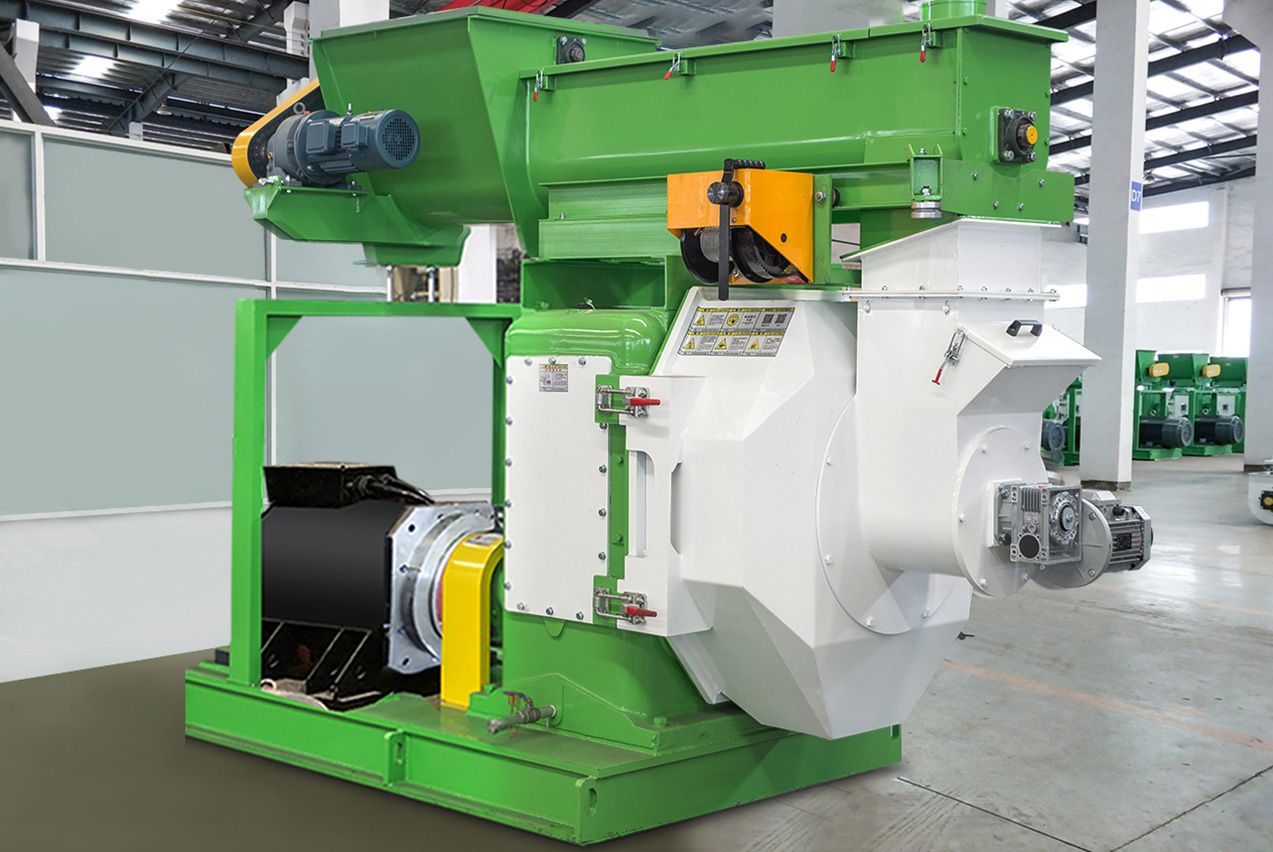
- Pellet mill (ring die) — core compression unit; Kingwood’s vertical pellet mill range spans 1 t/h (JWZL-420) through 4–5 t/h (JWZL-928), with the horizontal JZWH-860 also rated at 4–5 t/h for high-volume applications
- Counter-flow cooler — post-pelletizing temperature and moisture stabilization
- Pellet packaging machine — automated bagging for commercial distribution
For operations requiring output above 5 t/h, multiple pellet mills operate in parallel within a single integrated line. Complete Kingwood production line projects have been engineered to annual capacities up to 200,000 metric tons.
The pellets produced through this process, when manufactured to specification, achieve a calorific value of 4,800 kcal/kg, moisture content below 15%, sulfur content below 0.3%, and ash content below 18% — figures that satisfy GB13271-2001 emission compliance thresholds for industrial boiler applications and align with ISO and EU biomass fuel standards.
Sustainability Economics and Market Drivers
The business case for industrial grass granulation is no longer primarily regulatory — it has become a direct cost management tool. Biomass pellets produced from grass and agricultural residues deliver fuel cost savings of 40–50% compared to conventional fossil fuels in industrial boiler applications, based on Kingwood’s documented operational data across installed customer sites.
For the agricultural sector, grass granulation converts a liability — excess biomass that must otherwise be disposed of — into a monetizable output. Farmers and agricultural cooperatives processing crop residues through pelletizing can supply fuel to nearby industrial users, integrate pellets into on-farm heating systems, or produce high-protein feed pellets for livestock operations. This circular processing model reduces input costs on both the waste management and feed procurement sides of the farm P&L.
Environmental performance is verifiable. Kingwood’s biomass pellets produce dioxin emissions below 0.5 ng-TEQ, well within China’s national GB standard of ≤1.0 ng-TEQ and meeting the threshold requirements of Japan’s ≤0.5% sulfur standard. These specifications matter increasingly to industrial buyers operating under tightening emissions audit regimes in regulated markets.
Kingwood’s Three-Standardization Framework — covering Integrated, Dust-Free, and Automated production lines — directly addresses the operational compliance requirements that industrial grass pellet producers face. Dust-Free line design is particularly relevant to grass processing, where fine organic particulates generated during hammer milling and pelletizing create occupational health and fire risk if not managed through enclosed processing and integrated dust extraction. Kingwood has implemented Dust-Free production line design in documented projects including the Guizhou dust-free biomass pellet mill workshop, demonstrating the engineering approach in active commercial operations.
Kingwood’s Industrial Positioning in the Grass Pellet Equipment Sector
Jiangsu Kingwood Industrial Co., Ltd. (NEEQ: 871765) is a publicly listed, ISO 9001 and ISO 14001 certified manufacturer holding CE certification and multiple provincial high-tech enterprise recognitions. The company’s 20-person R&D team and 6,200 m² engineering and office facility support the full project cycle from process design through commissioning and after-sales technical support.
International deployment is established: Kingwood equipment operates across 30 countries. The 24 t/h Vietnam wood chip pellet production line commissioned in 2023 and the 12 t/h Vietnam pellet line commissioned in 2024 — which achieved full investment payback in 23 months — demonstrate the financial performance attainable with correctly specified industrial pellet equipment.
For buyers evaluating equipment for grass pelletizing projects, the critical specification questions are feedstock moisture range, required throughput in tonnes per hour, target pellet specification (fuel grade vs. feed grade), and site infrastructure constraints. Kingwood’s engineering team provides line configuration proposals based on these parameters, drawing on a project reference base of over 2,000 designed production lines.
Contact Kingwood’s industrial sales team to receive a project-specific equipment recommendation and capacity verification for your grass pelletizing application.
FAQ
What is a grass granulator and how does it work?
A grass granulator is industrial pellet mill equipment that compresses grass, crop residues, and other organic biomass into dense, uniform pellets. The process involves size reduction (chipping or hammer milling), optional drying, and pelletizing under high pressure through a ring die or flat die. The resulting pellets are used as biomass fuel or livestock feed.
What raw materials can be processed by grass granulation equipment?
Grass granulators can process a wide range of organic feedstocks including straw, hay, alfalfa, rice husks, corn stalks, and mixed crop residues. Equipment must be matched to feedstock moisture content and bulk density — high-moisture materials typically require a wet-feed production line with upstream drying.
What are the main applications for grass pellets?
Grass pellets serve two primary markets: biomass fuel for industrial boilers and heating systems, and high-protein feed supplements for livestock. As a biomass fuel, properly manufactured grass pellets can deliver a calorific value of approximately 4,800 kcal/kg with moisture content below 15%, meeting international combustion standards.
How does Kingwood's Three-Standardization Framework apply to grass pellet lines?
Kingwood's Three-Standardization Framework covers Integrated, Dust-Free, and Automated production lines. For grass pelletizing, this means enclosed processing to contain fine organic dust, fully automated material handling to reduce labor dependency, and integrated line design that coordinates crushing, drying, pelletizing, cooling, and packaging in one cohesive system.
What production capacity can Kingwood grass pellet lines achieve?
Kingwood designs complete biomass pellet production lines up to 200,000 metric tons per year. Individual pellet mill models range from 1 t/h (JWZL-420) to 4–5 t/h (JWZL-928 and JZWH-860), and multiple units are deployed in parallel for large-scale grass pelletizing operations.
What cost advantages do grass biomass pellets offer compared to fossil fuels?
Biomass pellets produced from grass and agricultural residues can reduce fuel costs by 40–50% compared to conventional fossil fuels, based on Kingwood's operational data. This margin is driven by low feedstock acquisition costs for agricultural byproducts and the higher energy density achieved through industrial pelletizing.
Does Kingwood serve international buyers for grass pellet equipment?
Yes. Kingwood has supplied biomass pellet equipment and complete production lines to customers across 30 countries. Documented international projects include a 24 t/h wood chip pellet line in Vietnam (2023) and a 12 t/h line also in Vietnam (2024) with a verified payback period of 23 months.
- Global biomass pellet production capacity is projected to exceed 50 million metric tonnes annually by 2027, driven by renewable energy mandates across the EU, UK, Japan, and South Korea. (2024, IEA Bioenergy Task 40 — Sustainable International Bioenergy Trade)
- Agricultural residues including grass and straw account for an estimated 140 EJ of technically recoverable biomass energy potential globally each year. (2023, IRENA — Renewable Power Generation Costs 2023 and Global Biomass Supply Outlook)