How Industrial Biomass Pellet Machines Support Sustainable Energy
Kingwood · May 26, 2026
The Carbon Logic Behind Industrial Biomass Pellet Production
Industrial biomass pellet machines do not simply compress organic material—they close a carbon loop that fossil fuel combustion cannot replicate. When wood chips, agricultural straw, or forestry residues are pelletized and burned, the CO₂ released was already part of the active biosphere: absorbed by the source plants during their growth cycle. The net atmospheric carbon contribution is structurally different from burning coal or heavy oil, which mobilizes carbon that has been geologically sequestered for millions of years.
This distinction has direct regulatory and commercial consequences for industrial energy buyers. Biomass fuel produced on Kingwood production lines carries a calorific value of 4,800 kcal/kg, sulfur content below 0.3%, ash content below 18%, and dioxin emissions below 0.5 ng TEQ—all figures that satisfy the EU moisture standard (<15%), the Japan sulfur standard (≤0.5%), the ISO ash standard (<20%), and China’s GB13271-2001 boiler emission limits. For procurement teams comparing alternative fuels, these are auditable specifications, not claims.
The waste-to-energy dimension compounds the environmental case. Agricultural residues and forestry offcuts left to decompose release methane, a greenhouse gas with a 100-year global warming potential approximately 28 times that of CO₂ (IPCC AR6, 2021). Pelletizing this material intercepts the methane generation pathway, converts embedded energy into a standardized solid fuel, and reduces landfill volume simultaneously. This multi-benefit profile is why biomass pellets are increasingly specified in industrial boiler and district heating tenders across Asia, Europe, and North America.
Scalable Production Architecture: From Single Mill to Full-Line Integration
A single pellet mill is rarely the complete answer for industrial-scale operators. Throughput consistency, moisture management, and dust containment require a systems approach—which is where Kingwood’s wet-feed production line architecture is engineered to deliver.
Kingwood’s complete lines handle the full processing sequence for high-moisture biomass: coarse crushing via drum chipper, size reduction via hammer mill, moisture reduction via drum dryer, fine grinding, pelletizing, cooling via counter-flow cooler, and automated packaging. The entire flow is enclosed, integrated with dust removal, and designed for continuous unattended operation. Engineered line capacity reaches up to 200,000 metric tons per year per facility.
At the pellet mill level, the vertical ring die product range covers:
- JWZL-420: 1–1.5 t/h — entry-scale or satellite operations
- JWZL-688: 2–2.3 t/h — mid-range single-mill throughput
- JWZL-688D: 3–3.5 t/h — dual-compression configuration
- JWZL-928: 4–5 t/h — high-capacity vertical format
- JWZL-1068: contact Kingwood sales for specification
- JZWH-860: 4–5 t/h — horizontal ring die configuration
For projects requiring throughput beyond a single machine, parallel mill configurations are standard practice. A 24 t/h wood chip pellet production line commissioned in Vietnam in 2023 demonstrates how multi-mill integration scales to meet commercial fuel supply contracts.
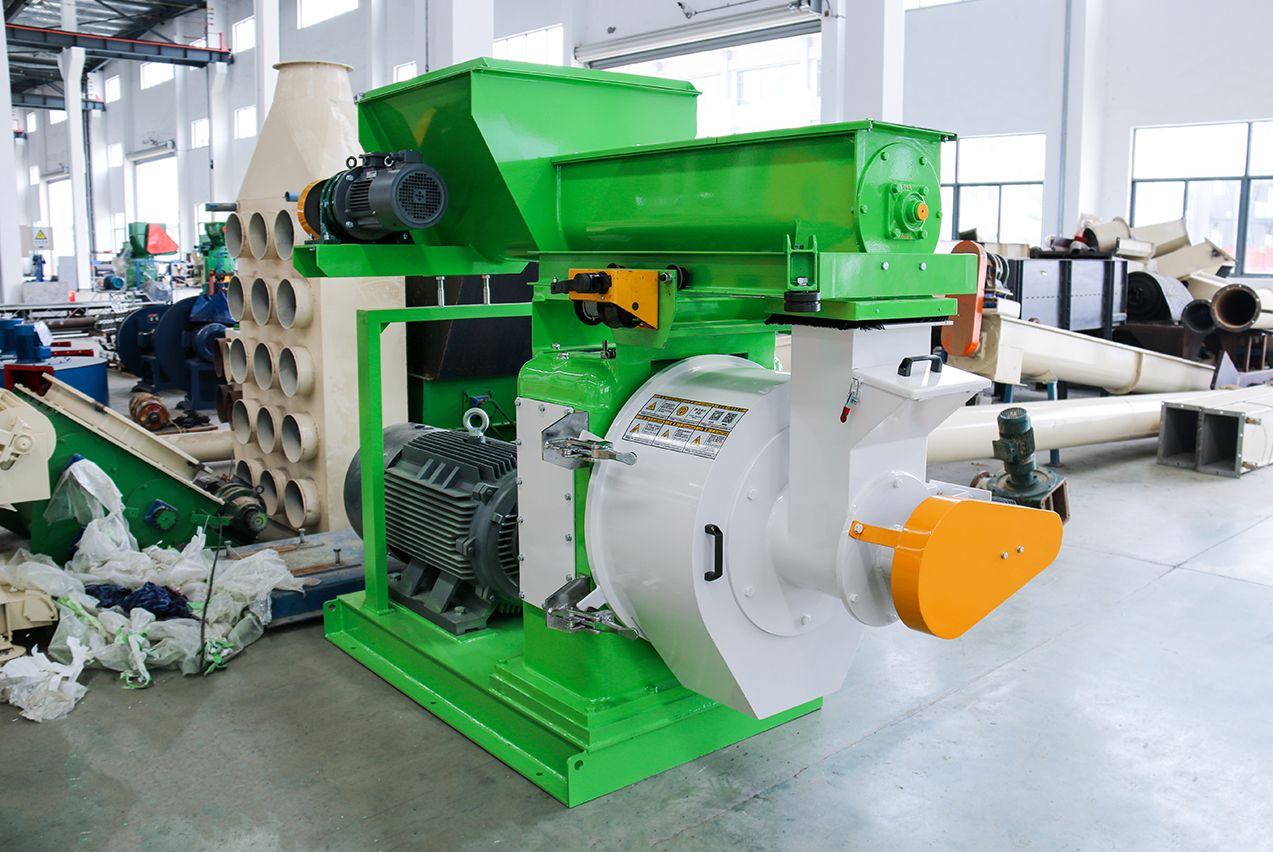
The JWZL-420 pictured above represents the entry point in Kingwood’s vertical pellet mill range. Full specifications are available on the JWZL-420 product page.
Economic and Operational Drivers for Industrial Adopters
Sustainability objectives and commercial performance are not competing priorities in biomass pellet production—when the system is correctly engineered, they converge.
Fuel cost reduction is the most direct economic argument. Biomass pellets produced on Kingwood lines deliver a 40–50% reduction in fuel cost versus coal or heavy oil at equivalent thermal output. For an industrial facility running a 10 MW boiler at high annual utilization, this differential translates to material savings measurable in the first operating year.
Payback timelines are documented, not projected. A 12 t/h installation in Vietnam (2024) achieved full capital payback in 23 months—a figure derived from actual operational and revenue data, not modeling assumptions. This is a relevant reference point for developers evaluating biomass pellet projects in Southeast Asia, where feedstock availability and local fuel pricing create favorable project economics.
Decentralized production reduces supply chain exposure. When pellet mills are co-located with biomass feedstock sources—sawmills, rice processing facilities, plantation operations—transportation costs drop and feedstock traceability improves. This model also creates direct employment and procurement activity in rural areas, a factor increasingly weighted in environmental and social governance (ESG) reporting for energy companies and industrial manufacturers.
Kingwood’s Three-Standardization Framework—integrated production lines, dust-free production lines, and automated production lines—directly addresses the operational reliability and regulatory compliance requirements that large industrial buyers impose on equipment suppliers. Dust-free design is not a cosmetic feature: it reduces fire and explosion risk in biomass handling, lowers maintenance burden, and satisfies increasingly stringent occupational health regulations across all major markets. A dust-free biomass pellet workshop implementation in Guizhou (2024) illustrates how this standard is applied at the facility level.
With over 27 years of R&D focus in biomass pellet equipment, 2,000+ production line projects planned and designed, and active installations across 30 countries, Kingwood—listed on NEEQ under stock code 871765—provides the engineering depth and reference base that industrial procurement requires when specifying equipment for long-cycle energy infrastructure projects.
FAQ
How do industrial biomass pellet machines reduce greenhouse gas emissions?
Biomass combustion releases CO₂, but that carbon was absorbed by the source plants during growth—creating a closed carbon loop. Unlike fossil fuels, which release sequestered carbon, biomass pellet combustion produces no net increase in atmospheric carbon when feedstock is sustainably managed. Kingwood pellet production lines yield biomass fuel with sulfur content below 0.3% and dioxin emissions below 0.5 ng TEQ, both well within international and China GB13271-2001 standards.
What feedstocks can industrial biomass pellet machines process?
Industrial pellet mills process a wide range of lignocellulosic feedstocks: wood chips, sawdust, agricultural straw, rice husks, palm shell, bamboo, and dedicated energy crops. Kingwood's wet-feed production lines are specifically engineered for high-moisture biomass, incorporating crushing, coarse grinding, drum drying, fine grinding, pelletizing, and packaging in a single automated flow.
What output capacity can an industrial biomass pellet production line achieve?
Kingwood's vertical pellet mill range spans 1 t/h (JWZL-420) to 4–5 t/h (JWZL-928), while complete integrated production lines are engineered up to 200,000 metric tons per year. For high-volume projects, multi-machine configurations such as the 24 t/h line deployed in Vietnam (2023) demonstrate real-world scalability.
How does biomass pellet production support waste-to-energy objectives?
Agricultural residues and forestry offcuts that would otherwise decompose in landfills release methane—a greenhouse gas roughly 28 times more potent than CO₂ over a 100-year horizon (IPCC AR6). Converting this material into dense biomass pellets captures its embedded energy value, diverts waste from landfill, and supplies a standardized, storable fuel to industrial boilers and power plants.
What cost advantage do biomass pellets offer versus fossil fuels?
Based on Kingwood operational data, biomass pellets deliver a 40–50% reduction in fuel cost compared to coal or heavy oil for equivalent thermal output. The calorific value of Kingwood-produced biomass fuel reaches 4,800 kcal/kg, exceeding the U.S. standard threshold of 2,500 kcal/kg.
How quickly can an industrial biomass pellet line reach payback?
Payback period depends on feedstock cost, throughput, and local fuel prices. A documented Kingwood installation in Vietnam (2024) at 12 t/h achieved full capital payback in 23 months—a benchmark for operators evaluating project economics in Southeast Asia.
What certifications validate Kingwood biomass pellet equipment?
Kingwood holds ISO 9001, ISO 14001, and CE certifications. The company is listed on China's NEEQ exchange (stock code: 871765) and recognized as a Jiangsu Provincial High-Tech Enterprise, Jiangsu Provincial Gazelle Enterprise, and a Top 10 Brand in Biomass Molding Equipment.
- Global bioenergy supplied approximately 55.6 EJ in 2022, accounting for roughly 10% of total final energy consumption worldwide. (2023, International Energy Agency (IEA), World Energy Balances 2023)
- Methane has a global warming potential approximately 28 times that of CO₂ over a 100-year period, underscoring the climate value of diverting organic waste from landfill into pellet fuel. (2021, IPCC Sixth Assessment Report (AR6), Working Group I, Chapter 7)