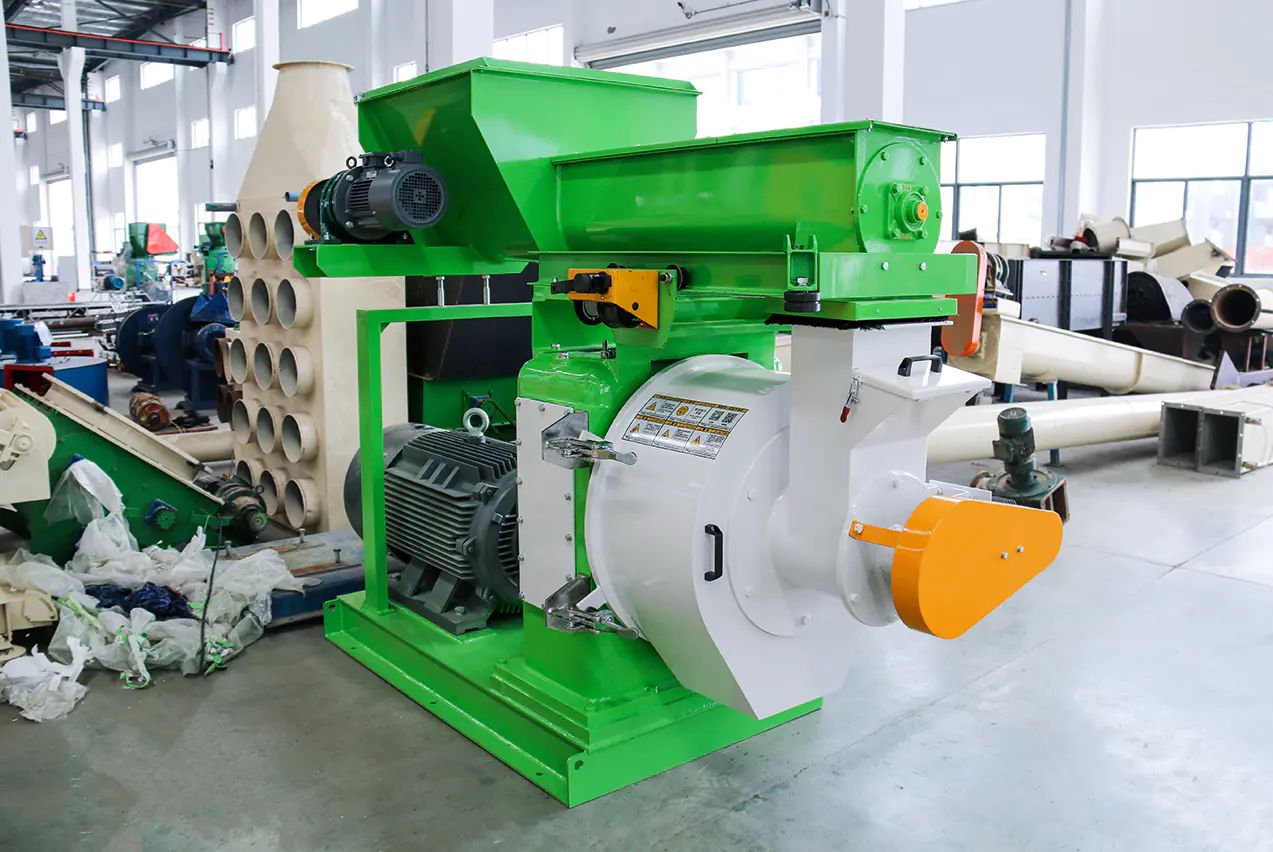
Biomass Pellet Machine Design: Green Performance vs. ROI
Kingwood · May 26, 2026
Why Environmental Performance and Economic Return Are Not in Conflict
A common assumption in industrial procurement is that tighter environmental specifications drive up capital and operating costs. In the design and manufacturing process of biomass pellet machines, this trade-off is largely a false dilemma—when environmental considerations are embedded at the engineering stage rather than bolted on afterward.
Kingwood’s engineering approach treats emissions control, energy efficiency, and material recovery not as compliance checkboxes but as performance parameters that directly affect throughput cost. A production line that generates excessive dust wastes raw material. A line that runs uncontrolled motor loads consumes more electricity per ton. A line with unenclosed transfer points creates regulatory exposure. Addressing each of these through design—rather than remediation—reduces total cost of ownership.
Kingwood biomass fuel produced on these lines achieves 4,800 kcal/kg calorific value, moisture below 15%, sulfur below 0.3%, and dioxin below 0.5 ng TEQ. Every indicator falls below China’s GB13271-2001 boiler emission standard and meets EU, US, Japanese, and ISO benchmarks simultaneously. Operators selling into multiple export markets do not need separate production configurations.
Engineering Levers: From Lifecycle Design to Intelligent Controls
Lifecycle material selection. Component specification begins with recyclability and operational durability. Ring die assemblies, for example, are the primary wear component in any pellet mill. Specifying die metallurgy for longer service intervals reduces both replacement frequency and scrap metal generation over a five-year operating horizon.
Intelligent process control. Automated control systems on Kingwood production lines monitor feed rate, die gap, moisture input, and motor current draw in real time. When any parameter drifts outside set tolerances, the system adjusts before product quality degrades or energy is wasted on reprocessing. This is not a premium add-on—it is standard on Kingwood’s Automated production lines under the Three-Standardization Framework.
Dust-Free enclosure. Kingwood’s Dust-Free production line configuration encloses all material transfer and grinding stages. Airborne particulate is captured at source through integrated dust removal rather than filtered at the exhaust end. The 2024 Guizhou installation demonstrates this approach at commercial scale, delivering a compliant workshop environment without external filtration infrastructure. See the Guizhou dust-free project case for engineering detail.
Wet-feed processing capability. High-moisture biomass—agricultural residue, fresh wood chip, bark—requires drying before pelletizing. Kingwood’s wet-feed production lines integrate drum drying, fine grinding, and pelletizing in a single enclosed sequence. Handling high-moisture feedstock in-line rather than pre-drying off-line eliminates a separate thermal process stage and the associated fugitive emissions.
Translating Environmental Specification Into Commercial Outcomes
Environmental performance creates measurable commercial value in three ways for biomass pellet producers.
Market access. Pellet fuel meeting EU moisture standards (below 15%) and ISO ash standards (below 20%) qualifies for industrial boiler and co-firing contracts in European and Asian markets. Producers operating lines that cannot consistently hit these specs are excluded from premium-price offtake agreements.
Operating cost reduction. Kingwood biomass fuel reduces fuel costs by 40–50% versus fossil fuel alternatives at the point of combustion. For industrial heat users, this margin is the primary procurement driver. For pellet producers, it is the commercial argument that closes customer contracts.
Documented payback. The 12 TPH Vietnam production line commissioned in 2024 recovered full capital investment within 23 months. The 24 TPH Vietnam line commissioned in 2023 demonstrates the same economics at larger scale. These are not projected figures—they are recorded project outcomes.
Institutional Support and Supply Chain Alignment
Individual equipment performance depends on supply chain and operational context. Kingwood’s position as a Deputy Director Member Unit of the China Biomass Energy Industry Alliance connects the company to policy development, feedstock standard-setting, and downstream market development simultaneously.
Government policy in China and across Southeast Asia increasingly ties industrial energy procurement to verified emission performance. Producers operating certified, documented production lines—with ISO 9001, ISO 14001, and CE credentials—are positioned ahead of incoming procurement requirements rather than reactive to them.
For engineering teams evaluating biomass pellet production line investment, the practical conclusion is straightforward: environmental performance specifications set at the design stage, executed through integrated and automated line architecture, reduce lifecycle operating cost while expanding addressable markets. The engineering and the economics point in the same direction.
Contact Kingwood’s project engineering team to review feedstock specifications and line configuration options for your production target.
FAQ
How does lifecycle design improve the environmental performance of a biomass pellet machine?
Lifecycle design addresses raw material selection, energy consumption during manufacturing, emissions during operation, and end-of-life recyclability. Starting at the design phase reduces costly retrofits and ensures compliance with standards such as GB13271-2001 from day one.
Does higher environmental compliance increase the capital cost of a biomass pellet production line?
Not necessarily. Kingwood's wet-feed pellet production lines integrate dust removal, enclosed processing, and automated controls into the base configuration. Operators avoid add-on compliance costs while achieving capacity up to 200,000 metric tons per year.
What role does automation play in reducing energy waste in pellet mill operations?
Intelligent control systems enable precise monitoring of feed rate, die temperature, and motor load. This eliminates unnecessary idle running and over-feeding, cutting specific energy consumption per ton of pellet produced.
How do Kingwood's biomass pellets meet international emission standards?
Kingwood biomass fuel achieves calorific value of 4,800 kcal/kg, moisture below 15%, sulfur below 0.3%, and dioxin below 0.5 ng TEQ—compliant with EU, US, Japanese, and ISO benchmarks, and all indicators below China's GB13271-2001 boiler emission standard.
What is the Three-Standardization Framework and how does it relate to environmental performance?
Kingwood's Three-Standardization Framework comprises Integrated, Dust-Free, and Automated production lines. Dust-Free lines eliminate airborne particulate at source; Automated lines minimize human intervention and process variance; Integrated lines reduce inter-process handling losses.
Can a biomass pellet production line deliver measurable cost savings over fossil fuels?
Yes. Kingwood biomass fuel reduces fuel costs by 40–50% compared to fossil fuel alternatives, supported by documented payback periods—one Vietnam installation recovered capital in 23 months.
What certifications validate Kingwood's environmental and quality claims?
Kingwood holds ISO 9001, ISO 14001, and CE certifications, and is recognized as a Jiangsu Provincial High-Tech Enterprise and Jiangsu Provincial Specialized & Innovative Niche Leader.
- Kingwood biomass fuel delivers a calorific value of 4,800 kcal/kg with sulfur content below 0.3% and dioxin below 0.5 ng TEQ—below the China GB13271-2001 boiler emission standard. (2025, Kingwood product specification sheet, Jiangsu Kingwood Industrial Co., Ltd.)
- A 12 TPH Kingwood wood pellet production line commissioned in Vietnam in 2024 achieved full capital payback within 23 months of operation. (2024, Kingwood project case record: vietnam-wood-pellet-line-12-tph-kingwood-payback)