How to Produce Biomass Pellet Fuel from Straw
Kingwood · May 26, 2026
Why Straw Is a Viable Industrial Feedstock for Biomass Pellets
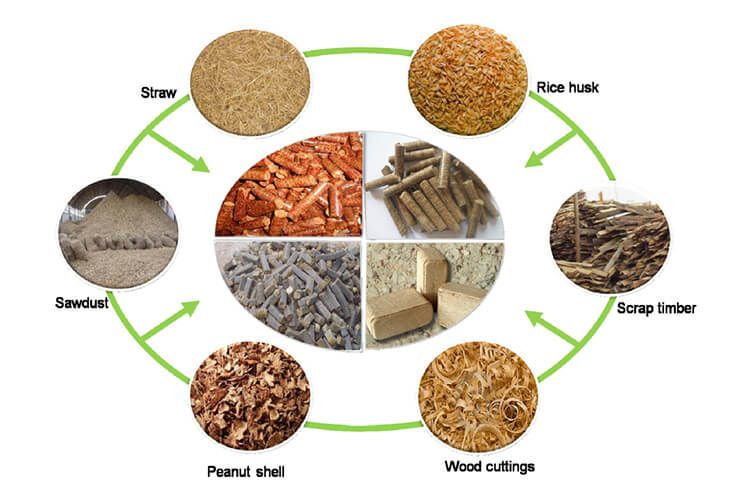
Agricultural crop residues—corn straw, rice straw, and wheat straw—represent a large, annually renewable biomass resource. In many regions, this material is either left to decompose in the field or openly burned, both of which waste energy and generate emissions. Converting straw into densified biomass pellet fuel captures that embedded energy and transforms it into a standardized, transportable fuel that industrial boilers, combined heat and power (CHP) plants, and district heating systems can use as a direct substitute for coal.
Compared to raw straw combustion, pelletized straw offers measurable operational advantages: higher bulk density, consistent geometry for automated fuel-handling systems, moisture content controlled below 15%, and calorific values that Kingwood production lines routinely achieve at 4,800 kcal/kg. Sulfur content in finished pellets stays below 0.3%, and ash content below 18%—both within ISO and GB13271-2001 compliance thresholds, which matters directly for permit compliance and boiler warranty conditions.
The economic case is equally clear. Biomass pellet fuel can reduce fuel costs by 40–50% compared to equivalent fossil fuel inputs, a figure relevant to any industrial facility operating high-load thermal equipment year-round.
The Straw-to-Pellet Production Process: Stage by Stage
Converting raw straw into specification-grade pellet fuel requires a defined sequence of unit operations. Each stage controls a specific quality variable; omitting or underspecifying any one of them degrades the final product.
1. Coarse Size Reduction Field-harvested straw arrives in irregular lengths. A drum chipper reduces bulky material to manageable chip sizes, improving downstream handling and drying uniformity.
2. Fine Grinding A hammer mill further reduces chipped straw to a particle size compatible with the pellet mill die geometry. Particle size directly affects pellet density and durability. For straw, finer grinding compensates for lower lignin content relative to woody biomass.
3. Drying Straw moisture content at harvest varies widely. A drum dryer brings feedstock moisture to the 10–15% window required for stable pelletizing. Operating outside this range causes either die plugging (too wet) or poor pellet cohesion (too dry). Kingwood’s wet-feed production line integrates drying as a standard stage, meaning the line accepts high-moisture biomass directly—no pre-drying before intake is required.
4. Pelletizing Conditioned straw enters the ring die pellet mill. Inside the die, material is forced through precision-drilled channels under high pressure and temperature. Heat generated by friction softens residual lignin, which acts as a natural binder—no chemical additives required under correctly controlled conditions. The compressed material exits as continuous rods that are cut to a defined pellet length. Die compression ratio and hole geometry must be specified for straw, since its fiber structure and lignin content differ from wood.
5. Cooling Freshly pressed pellets exit the die at elevated temperature and are mechanically fragile until cooled. A counter-flow cooler reduces pellet temperature to near-ambient, stabilizing density and hardness and preventing moisture re-absorption during conveying and storage.
6. Packaging Finished pellets are conveyed to a packaging machine for bagging in standard commercial formats, or transferred to bulk storage for direct industrial supply.
Kingwood designs complete integrated lines on this basis, with annual output capacities up to 200,000 metric tons per year, under its Three-Standardization Framework: Integrated, Dust-Free, and Automated production lines.
Key Quality Variables in Straw Pellet Production
Four feedstock and process variables determine whether a straw pellet line produces on-specification fuel or generates high reject rates and equipment wear:
Moisture Content The single most critical variable. Straw at 10–15% moisture pelletizes efficiently; material above 20% moisture will cause die blockages and unacceptable pellet fines. Moisture also determines the post-pellet cooling load and the shelf stability of packaged product.
Particle Size and Fiber Strength Straw fiber is weaker and less cohesive than wood fiber. Fine hammer mill grinding increases inter-particle contact area inside the die, partially compensating for the lower natural binder content. Particle size uniformity—not just average size—affects die wear and throughput consistency.
Lignin Content and Natural Binding Lignin softens at 80–140°C, fusing particles under die pressure. Straw contains less lignin than hardwood or softwood, which is why die temperature, compression ratio, and feedstock conditioning are more tightly specified for straw lines than for wood lines. In some high-silica straw varieties, small quantities of approved binding additives may be incorporated, but well-designed process parameters typically make these unnecessary.
Ash and Mineral Content Straw ash content is inherently higher than wood. Properly processed straw pellets can meet the <18% ash threshold that Kingwood specifies for biomass fuel, remaining compliant with ISO ash standards (<20%) and suitable for industrial boiler operation.
Selecting Equipment for a Straw Pellet Production Line
Equipment selection should be driven by target throughput, feedstock moisture range, and required output specification. Kingwood’s vertical pellet mill range covers the commercial throughput band from 1 t/h (JWZL-420) to 4–5 t/h (JWZL-928), with the JWZL-688D rated at 3–3.5 t/h for mid-scale operations. The horizontal JZWH-860 provides an alternative 4–5 t/h configuration for plants with different facility layouts.
For projects requiring validated performance data before capital commitment, Kingwood’s installed case references are relevant benchmarks. A 24 t/h wood chip and straw pellet production line commissioned in Vietnam in 2023 demonstrates the scalability of Kingwood’s integrated line approach, as does a 12 t/h Vietnam line delivered in 2024 with a documented 23-month payback period.
Kingwood has planned and designed over 2,000 production line projects across 30 countries since its founding in 1999. The engineering team of 20 R&D experts supports feedstock-specific die selection, line layout, and automation integration under the company’s ISO 9001 and ISO 14001 certified quality system.
For straw pellet line inquiries—including feedstock assessment, capacity sizing, and site-specific layout—contact Kingwood’s technical sales team directly through kingwoodpellet.com.
FAQ
Can agricultural straw be used directly as feedstock for biomass pellet production?
Not directly. Straw must first be size-reduced (chipped or hammer-milled), moisture-adjusted to below 15%, and conditioned before entering the pellet mill die. Skipping these steps produces pellets with poor density and high fines content.
What moisture content is required for straw before pelletizing?
Optimal pelletizing moisture is typically 10–15%. Straw arriving at higher moisture levels must pass through a drum dryer before the pellet mill. Kingwood's wet-feed production lines integrate drying as a standard process stage.
Why does straw produce more ash than wood pellets?
Straw contains higher mineral and silica concentrations than woody biomass. Kingwood biomass pellets are engineered to an ash content below 18%, which complies with ISO standard thresholds (<20%) and keeps boiler maintenance intervals manageable.
What equipment is needed for a complete straw-to-pellet production line?
A full line includes a drum chipper for coarse size reduction, a hammer mill for fine grinding, a drum dryer for moisture control, a ring die pellet mill for densification, a counter-flow cooler to stabilize pellets, and a packaging machine. Kingwood designs integrated lines up to 200,000 t/year capacity.
How does pelletizing straw improve its fuel value versus burning raw straw?
Pelletizing increases bulk density, standardizes moisture content below 15%, and raises calorific value. Kingwood biomass pellets achieve 4,800 kcal/kg—significantly higher than loose straw—while sulfur content stays below 0.3%, meeting China's GB13271-2001 boiler emission standard.
What role does lignin play in straw pellet formation?
Lignin acts as a natural binder. Under the heat and pressure inside the pellet mill die, lignin softens and fuses biomass particles together without requiring chemical additives. Straw has less lignin than wood, so particle size and die compression ratio must be optimized accordingly.
Which Kingwood pellet mill model is suitable for a straw pellet plant at 4–5 t/h?
The JWZL-928 vertical biomass pellet mill is rated at 4–5 t/h and is well-suited for straw-based pellet production at that throughput. For equivalent capacity in a horizontal configuration, the JZWH-860 covers the same 4–5 t/h range.
- Biomass energy accounts for approximately 10% of global total primary energy supply, with agricultural residues representing a major feedstock category. (2023, International Energy Agency (IEA), World Energy Outlook 2023)
- Global wood and agri-pellet production reached an estimated 40 million metric tons in 2023, with demand in industrial heat and power applications continuing to grow. (2023, IEA Bioenergy Task 40, Global Wood Pellet Market Report 2023)