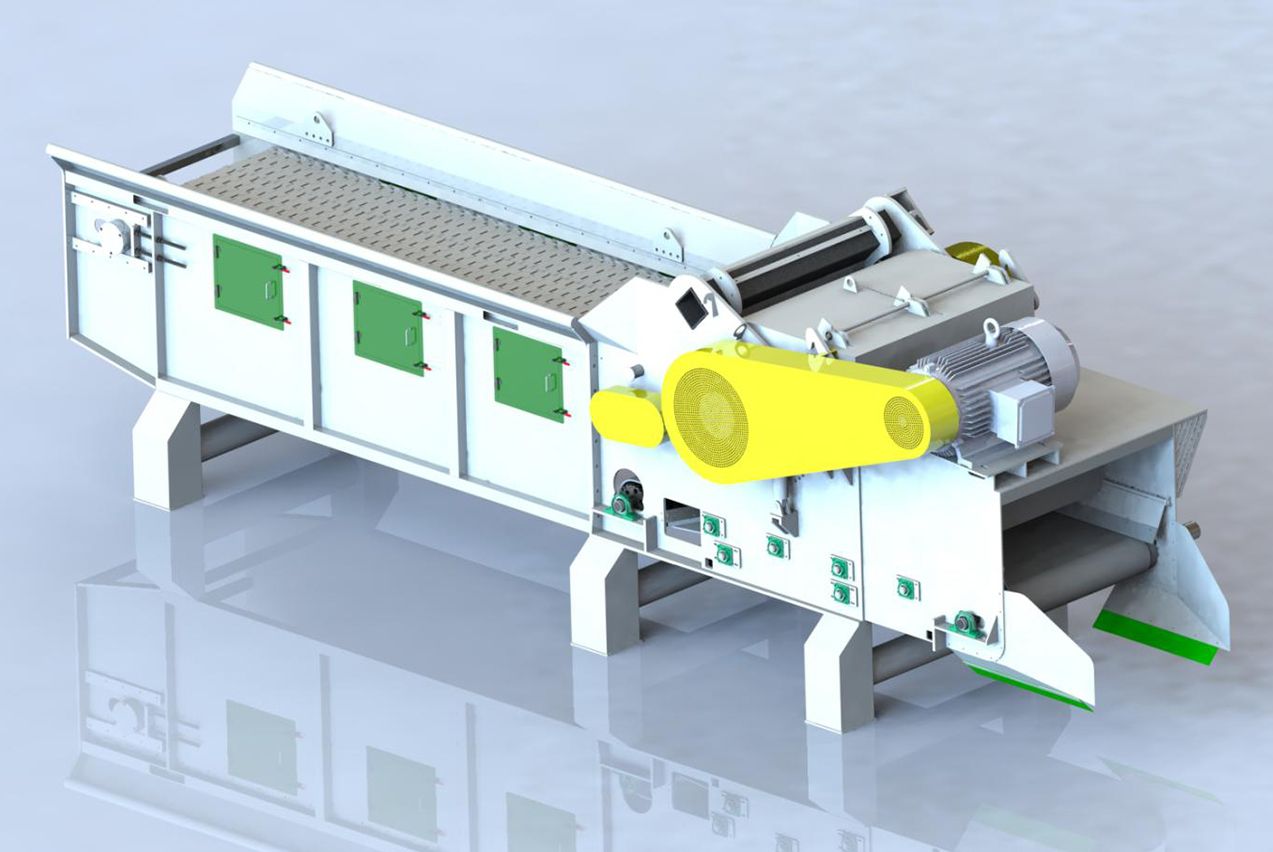
How to Use the Fan of a Wood Crusher Correctly
Kingwood · May 26, 2026
The Role of the Fan in a Wood Crusher
A wood crusher — also referred to as a hammer mill or biomass crusher in industrial contexts — consists of three primary subsystems: the crushing device, the chipping device, and the fan. Of these, the fan is frequently underestimated in maintenance planning despite being the component responsible for pneumatic material discharge.
After wood or other biomass feedstock is reduced to the required particle size inside the crushing chamber, the fan draws the material through the discharge duct and delivers it to the downstream collector. Without adequate airflow, fine material accumulates in the grinding zone, causing blockages, elevated motor load, and unplanned downtime. In a high-throughput biomass pellet production line, where crusher output feeds directly into drying and pelletizing stages, any interruption at the crushing stage creates cascading delays across the entire process.
Understanding the specific failure modes that affect wood crusher fans — and the corrective actions for each — is therefore a prerequisite for maintaining consistent production output.
Four Common Fan Failure Modes and Their Causes
1. Rotational Misalignment Between Fan and Motor Shaft
When the fan’s rotation center does not coincide with the centerline of the motor shaft, the two components rotate on different axes. This condition — commonly described as centrifugal eccentricity — means the fan and motor lose synchronized rotation from the first revolution. The practical consequences are immediate: the entire production line experiences abnormal vibration, elevated noise levels, and reduced effective throughput as energy is dissipated through mechanical shock rather than material conveyance.
Corrective action: Verify shaft alignment using a dial indicator or laser alignment tool before commissioning and after any bearing replacement. Permissible radial runout for industrial fan assemblies in this application class is typically within 0.05 mm; consult the equipment specification sheet for the applicable tolerance.
2. Blade Deformation from Extended Operation Without Maintenance
Fan blades in wood crusher applications are exposed to abrasive wood dust continuously. Over time, without scheduled inspection and reconditioning, blade profiles deform through erosion and mechanical fatigue. A deformed blade no longer maintains the designed clearance with the fan housing and adjacent components. When the machine runs under these conditions, the blades make contact with surrounding parts, generating impact loads that damage both the fan assembly and connected structural components.
Corrective action: Inspect blade geometry at defined maintenance intervals. Replace blades showing measurable erosion or geometric deviation. Do not continue operating a fan with visibly deformed blades — the secondary damage caused by component contact typically costs significantly more than a scheduled blade replacement.
3. Loose Fasteners on Fan Components
The fan assembly of a wood crusher incorporates several critical fastening points: anchor bolts securing the fan housing, impeller shaft disk bolts, and coupling bolts connecting the fan to the drive train. High-frequency vibration inherent in crushing operations gradually relaxes the clamping force on these fasteners. Once fasteners become loose, the clearances between mating components increase, resonance amplifies, and operating noise escalates from a low hum to intense, irregular impact noise. Left unaddressed, loose fasteners allow progressive movement of the impeller on its shaft, leading to sudden catastrophic failure.
Corrective action: Establish a torque-check schedule for all fan fasteners. Apply thread-locking compound where permitted by the manufacturer’s maintenance manual. Do not rely on auditory inspection alone — fasteners can lose significant preload before noise becomes detectable.
4. Dust Accumulation Causing Dynamic Imbalance
Fine wood dust generated during crushing does not distribute uniformly on fan blades. Particles adhere preferentially to blade surfaces based on airflow patterns, surface roughness, and electrostatic effects. Over time, this uneven accumulation adds asymmetric mass to the impeller. The resulting dynamic imbalance creates centrifugal forces that vary with rotational position, producing cyclic vibration loads on bearings and the fan housing. If left unaddressed, bearing fatigue life decreases substantially and the vibration propagates to connected machinery.
Corrective action: Clean fan blades at regular intervals — the cleaning frequency should be determined by the dust generation rate of the specific feedstock being processed. After cleaning, verify that blade mass distribution is uniform. If significant material has been removed unevenly through erosion, dynamic balancing of the impeller may be required before returning the fan to service.
Integrating Fan Maintenance into Biomass Production Line Management
Each of the four failure modes described above shares a common prevention mechanism: scheduled, documented maintenance with defined inspection criteria. In a professional biomass pellet production environment, fan maintenance should not be reactive — it should be built into the standard operating procedure for the crushing stage.
Kingwood’s complete wet-feed biomass pellet production lines integrate size-reduction equipment — including hammer mills and drum chippers — with downstream drying, fine grinding, pelletizing, and packaging stages in a fully enclosed, automated configuration. This architecture means that the operational reliability of each subsystem, including the crusher fan, directly determines the output capacity of the entire line. For reference, Kingwood has engineered complete lines for capacities up to 200,000 metric tons per year, with verified installations including a 24 t/h wood pellet production line in Vietnam and a 30 t/h line in Chongqing, China.
Establishing a preventive maintenance program for crusher fans — covering alignment verification, blade inspection, fastener torque checks, and dust removal — is one of the lowest-cost interventions available to biomass pellet producers seeking to protect equipment investment and maintain production targets.
For technical specifications on Kingwood’s crushing equipment and complete production line configurations, contact the Kingwood engineering team directly.
Media Contact I — Oliver Ge: +86 13120914095 Media Contact II — Henry: +86 18205276156
FAQ
What is the function of the fan inside a wood crusher?
The internal fan conveys ground material — wood powder or chips — pneumatically from the crushing chamber to the collector. Without a properly functioning fan, the discharge cycle breaks down and material accumulates inside the machine, halting production.
What causes centrifugal vibration in a wood crusher fan?
Centrifugal vibration occurs when the fan's rotation center is misaligned with the motor shaft center. This misalignment causes the fan and motor to rotate out of sync, generating shock loads and noise that reduce throughput and accelerate wear on bearings and housing.
How does blade deformation affect wood crusher performance?
Deformed fan blades create an uneven gap between the fan assembly and adjacent components. During operation, this leads to mechanical contact between parts, abnormal vibration, and — in severe cases — structural damage to the fan housing or impeller.
Why do fastener bolts on wood crusher fans loosen over time?
Continuous high-frequency vibration during crushing operations gradually loosens anchor bolts, impeller shaft disk bolts, and coupling bolts. Loose fasteners amplify resonance within the fan assembly, producing intense noise and increasing the risk of sudden component failure.
How does dust accumulation cause fan imbalance in a wood crusher?
Wood dust and fine particles settle unevenly on fan blades during operation. This creates a mass imbalance across the impeller, generating asymmetric centrifugal forces that cause vibration, abnormal bearing loads, and reduced fan efficiency.
How frequently should a wood crusher fan be inspected?
For continuous industrial operation, fan alignment should be verified at each scheduled maintenance interval — typically every 200–500 operating hours depending on material throughput. Blade condition, fastener torque, and dust buildup should be checked at each inspection.
What wood crusher models does Kingwood manufacture for biomass pellet lines?
Kingwood manufactures industrial hammer mills and drum chippers as primary size-reduction equipment upstream of pelletizing. These integrate directly into Kingwood's complete wet-feed biomass pellet production lines designed for capacities up to 200,000 metric tons per year.
- Global biomass power generation capacity reached approximately 143 GW in 2023, driving sustained demand for industrial wood crushing and pelletizing equipment worldwide. (2023, International Renewable Energy Agency (IRENA), Renewable Power Generation Costs 2023)
- Mechanical failures attributed to imbalance and misalignment account for an estimated 50% of rotating machinery downtime in industrial processing environments. (2023, Reliability Maintenance Institute / Machinery Failure Analysis and Troubleshooting, 4th Ed. (Bloch & Geitner))