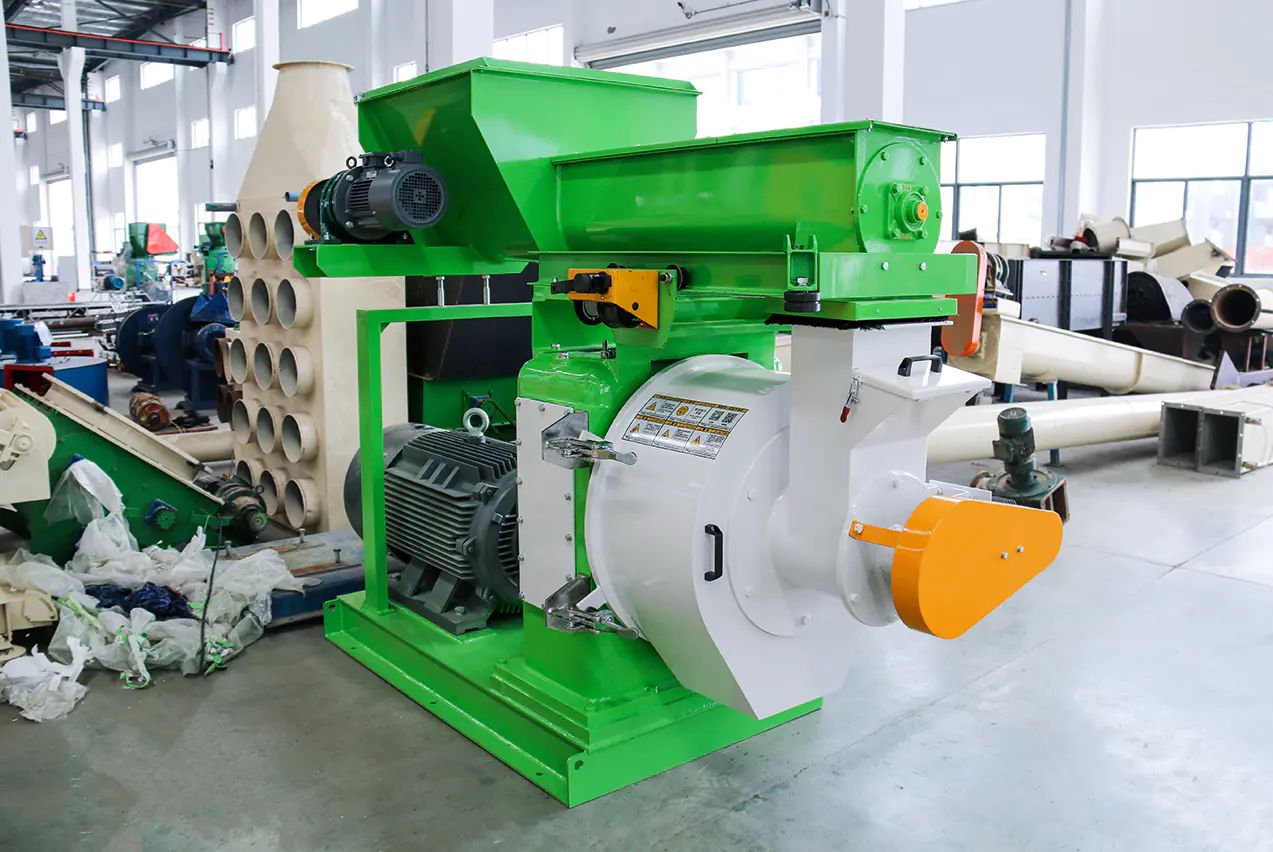
Hammer Mill for Wood Chips & Sawdust Pellet Production
Kingwood · May 26, 2026
Why Particle Size Reduction Determines Pellet Line Performance
In any industrial biomass pellet production line, the hammer mill occupies a position that controls quality downstream. Before wood chips or sawdust ever reach a ring die pellet mill, they must be reduced to a consistent particle size — typically sub-5 mm — that allows the die channels to compress material uniformly under high pressure. Feed that is too coarse produces pellets with voids and low mechanical durability. Feed that varies widely in particle size distribution causes uneven die wear and inconsistent bulk density across production batches.
Kingwood’s industrial hammer mill is engineered specifically for this duty within high-throughput biomass processing environments. The rotor assembly carries hardened steel hammers arranged in a balanced pattern to minimize vibration at continuous operating speeds. Interchangeable perforated screens — installed around the grinding chamber — define output particle diameter. Operators select screen aperture based on the die hole specification of the downstream pellet mill and the moisture-adjusted bulk density of the feedstock.
Key mechanical features relevant to industrial buyers:
- High reduction ratio: Capable of reducing 30–50 mm wood chips to sub-5 mm particles in a single pass, minimizing recirculation load.
- Adjustable screens: Multiple aperture sizes available; screen change-out is designed for rapid execution without full disassembly.
- Robust rotor construction: Heavy-duty shaft and bearing assembly rated for continuous-duty industrial cycles.
- Wide feedstock compatibility: Processes hardwood chips, softwood chips, sawdust, rice husk, corn stover, bagasse, and mixed agricultural residues without configuration changes beyond screen selection.
Hammer Mill Position Within a Complete Wet-Feed Pellet Production Line
Kingwood designs and supplies complete wet-feed pellet production lines with annual throughput capacities up to 200,000 metric tons. Within this line architecture, the hammer mill does not operate as a standalone unit — it functions as an integrated stage within a sequenced process chain.
The standard wet-feed line sequence is:
- Drum chipper — Primary size reduction of whole logs or large wood waste to chip dimensions
- Coarse hammer mill pass — Reduces chips to intermediate particle size; removes oversized material
- Drum dryer — Reduces feedstock moisture to the target range for pelletizing (typically below 15%)
- Fine hammer mill pass — Final particle size reduction on dried material to pellet mill specification
- Ring die pellet mill (JWZL or JZWH series) — Compresses prepared feedstock into densified pellets
- Counter-flow cooler — Reduces pellet temperature and finalizes moisture stabilization
- Packaging — Automated bagging or bulk loading
This two-pass hammer mill configuration is a deliberate design choice. Processing high-moisture green chips through a fine screen in a single pass is mechanically inefficient and accelerates screen wear. Drying material to below 15% moisture before fine grinding reduces specific energy consumption per ton and extends screen and hammer service life significantly.
For a detailed case study showing this line in operation at scale, see the 24 t/h Vietnam wood chip pellet production line commissioned by Kingwood in 2023.
Sawdust as a Direct Hammer Mill Feedstock
Sawdust occupies a different position in the feed preparation hierarchy compared to wood chips. Because sawdust arrives from sawmill or furniture manufacturing operations already at a fine particle size, it typically bypasses the drum chipper and the coarse grinding stage. However, sawdust often contains mixed particle fractions — including larger shavings or planer offcuts — that must be brought within specification before pelletizing.
Running sawdust through a hammer mill with a fine screen ensures that oversize fractions are reduced and that the bulk material achieves the homogeneous particle size distribution required for consistent ring die performance. Sawdust also commonly arrives at higher moisture levels from green timber operations, reinforcing the need for drying prior to fine grinding.
Kingwood’s equipment configurators assess incoming sawdust characteristics — moisture content, bulk density, species mix, and particle size distribution — before specifying screen sizes and dryer capacity. This application-specific approach avoids undersizing or oversizing equipment, which are both common causes of below-specification pellet output at new plants.
Operating Practices That Protect Throughput and Equipment Life
Operational discipline at the hammer mill stage has a direct and measurable impact on total line output and maintenance cost per ton. The following practices are standard in Kingwood-commissioned production lines:
Feed rate control: The hammer mill must receive a steady, controlled mass flow matched to its rated capacity. Surge feeding — caused by upstream storage hoppers discharging inconsistently — creates instantaneous motor overloads, accelerates hammer wear unevenly, and produces particle size spikes that degrade pellet quality. Screw conveyor or belt weigh-feeder systems ahead of the hammer mill are standard in Kingwood’s Automated production line design.
Feedstock moisture management: Hammer mills perform within specification at feedstock moisture levels that match their screen configuration. Wet material above 25–30% moisture tends to blind screens, reducing throughput and elevating specific energy consumption per ton. The wet-feed line architecture addresses this by positioning the drum dryer upstream of the fine grinding stage.
Hammer and screen inspection schedules: In industrial continuous operation, Kingwood recommends hammer condition inspection every 200–300 operating hours. Screens should be inspected at each shift changeover for blinding, cracking, or deformation. Running degraded screens widens particle size distribution and raises specific energy consumption — both of which reduce pellet mill ring die life.
Foreign object exclusion: Metal contamination from incoming wood waste streams is the primary cause of acute hammer mill damage. Overhead magnetic separators and in-line metal detectors positioned before the hammer mill inlet are included as standard in Kingwood’s integrated line designs.
Calibration verification: After any screen change or following maintenance that requires rotor reassembly, a particle size check of the output stream should confirm that the distribution meets the pellet mill’s feedstock specification. This is a five-minute quality gate that prevents hours of off-spec pellet production downstream.
Kingwood’s Three-Standardization Framework — built around Integrated, Dust-Free, and Automated production line principles — treats the hammer mill as a networked process node rather than a standalone machine. In automated line configurations, motor current draw, bearing temperature, and screen differential pressure are monitored continuously and feed into line-wide process control. This architecture supports the enclosed, dust-controlled operating environment that defines Kingwood’s Dust-Free production line standard — a critical factor for regulatory compliance in markets including the EU, Japan, and North America.
For specifications on Kingwood pellet mills that receive hammer mill output, see the JWZL-928 vertical pellet mill (4–5 t/h) and the JZWH-860 horizontal pellet mill (4–5 t/h) product pages.
FAQ
What materials can a Kingwood hammer mill process for pellet production?
Kingwood's hammer mill handles a broad range of lignocellulosic feedstocks including hardwood chips, softwood chips, sawdust, agricultural straws, and other biomass residues. Screen size selection determines output particle diameter to match downstream pellet mill specifications.
What particle size does a hammer mill produce before pelletizing?
For standard biomass pellet production, the hammer mill is configured to output particles typically under 5 mm in diameter. Interchangeable screens allow operators to dial in particle size based on the die specification of the downstream ring die pellet mill.
How does hammer mill output quality affect final pellet strength?
Uniform particle size distribution from the hammer mill directly determines pellet density and mechanical durability. Inconsistent particle sizing causes voids in the die channel, producing pellets with lower bulk density and higher breakage rates during transport.
Where does the hammer mill sit in a complete wet-feed pellet production line?
In Kingwood's wet-feed pellet production line, the hammer mill operates in two stages: coarse grinding immediately after the drum chipper, and fine grinding after the drum dryer. This two-pass approach ensures moisture-adjusted material reaches the pellet mill at the correct particle fineness.
What maintenance intervals apply to hammer mill hammers and screens?
Hammer wear rate depends on feedstock abrasiveness and hourly throughput. In continuous industrial operation, hammer inspection is recommended every 200–300 operating hours. Screen integrity should be checked at each shift changeover. Kingwood supplies matched replacement hammers and screens for all units.
Can the hammer mill be integrated with Kingwood's automated pellet production line?
Yes. Kingwood's Three-Standardization Framework — covering Integrated, Dust-Free, and Automated production lines — includes the hammer mill as a fully networked node. Feed rate, motor load, and screen differential pressure are monitored in the central automation system.
What is the difference between a hammer mill and a drum chipper in biomass processing?
A drum chipper performs primary size reduction on whole logs or large woody biomass, producing chips in the 20–50 mm range. The hammer mill is a secondary grinder that takes those chips — or raw sawdust — and reduces them to sub-5 mm particles suitable for pelletizing. Both pieces of equipment are supplied by Kingwood as part of a complete line.
- Global industrial wood pellet demand reached approximately 33 million metric tons in 2023, with feedstock preparation equipment representing a key capital expenditure in new plant construction. (2023, IEA Bioenergy Task 40 — Renewable Energy from Forests annual status report)
- Biomass pellets produced to ENplus A1 standard require feedstock particle size below 3.15 mm prior to pelletizing, making hammer mill calibration a direct quality-compliance factor. (2022, ENplus Handbook for Wood Pellet Quality Certification, European Pellet Council)