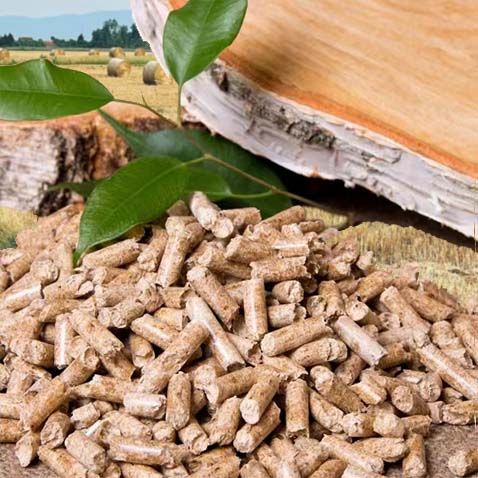
Rice Husk Pellet Production Line: Equipment & Process Guide
Kingwood · May 26, 2026
Why Rice Husk Is a High-Priority Industrial Biomass Feedstock
Rice husk is a structural byproduct of rice milling — the outer hull separated from the grain during processing. Unlike wood chips or agricultural straw, rice husk is available in concentrated volumes directly at milling facilities, eliminating the logistics cost associated with field collection. Global rice production generates roughly 150 million tonnes of husk annually. A significant portion is still open-field burned or landfilled, which represents both an environmental liability and a recoverable energy resource.
From a fuel chemistry standpoint, rice husk pellets produced on industrial equipment achieve a calorific value of 4,800 kcal/kg, moisture content below 15%, sulfur content below 0.3%, and ash content below 18% — meeting the ISO 17225-6 specification for non-woody pellets and clearing the ash threshold set by EU and Japanese import standards. These figures make rice husk a technically competitive substitute for coal and heavy fuel oil in industrial boiler applications, with documented fuel cost savings of 40–50% compared to equivalent fossil fuel inputs.
The carbon accounting is also favorable. The CO₂ released during rice husk pellet combustion is approximately equal to the carbon fixed by the rice plant during growth, qualifying the fuel as carbon-neutral under standard lifecycle assessment methodologies. This characteristic is increasingly relevant for industrial buyers subject to carbon reporting obligations or emissions trading schemes.
How a Custom Rice Husk Pellet Production Line Is Engineered
Rice husk presents specific processing challenges that distinguish it from wood-based feedstocks. Its silica content causes accelerated wear on grinding and pelletizing components. Its low bulk density requires higher-volume handling equipment upstream of the pellet mill. Its fine particle size after grinding increases dust explosion risk unless the process environment is fully enclosed.
Kingwood addresses these constraints through its Three-Standardization Framework, which mandates that every production line delivered be Integrated, Dust-Free, and Automated. For rice husk lines specifically, the dust-free requirement drives the most significant engineering decisions: enclosed conveyance throughout the line, negative-pressure dust collection at grinding and pelletizing stages, and sealed discharge on the counter-flow cooler.
A typical Kingwood rice husk pellet production line follows this process sequence:
1. Pre-conditioning and drying. Fresh rice husk from a milling operation typically carries 12–20% moisture. A drum dryer reduces this to the sub-15% threshold required for stable pelletization. Dryer sizing is matched to the pellet mill’s rated throughput to prevent upstream bottlenecks.
2. Particle size reduction. A hammer mill grinds the husk to a uniform particle size appropriate for ring die compression. Particle uniformity directly affects pellet density and durability; inconsistent grind produces crumbling pellets that degrade in transit.
3. Pelletizing. Kingwood’s vertical ring die pellet mills — the JWZL-420 at 1–1.5 t/h, JWZL-688 at 2–2.3 t/h, JWZL-688D at 3–3.5 t/h, and JWZL-928 at 4–5 t/h — apply high-pressure compression through the ring die to form dense, uniform pellets. For industrial-scale rice husk lines, multiple mills are configured in parallel to reach total line capacities up to 200,000 tonnes per year. The horizontal JZWH-860 (4–5 t/h) is also available for specific layout requirements.
4. Counter-flow cooling. Pellets exit the press at elevated temperature and require controlled cooling to stabilize structure before packaging. Kingwood’s counter-flow cooler draws ambient air counter to pellet flow, reducing pellet temperature uniformly without surface cracking.
5. Automated packaging. The line closes with a pellet packaging machine integrated into the plant control system. Throughput metering, bag weight verification, and conveyor sequencing are handled automatically, reducing labor requirements at the terminal stage.
Supply Chain and Commercial Case for Rice Husk Pellet Operations
The commercial logic for rice husk pelletization is strongest when the production facility is co-located with or adjacent to a rice mill. Feedstock acquisition cost approaches zero when husk is treated as a waste disposal problem by the miller — a common situation in Southeast Asia and South Asia, where milling capacity is fragmented across thousands of small and mid-scale operations.
Pelletized rice husk is far more logistically practical than raw husk. Pellets are 4–6× denser than loose husk, fit standard bulk handling and containerized shipping infrastructure, and meet the quality specifications required by industrial boiler operators and power generators in import markets including Japan, South Korea, and the EU.
Kingwood has engineered production line projects across 30 countries, with documented installations in Vietnam, China, and other markets. A 12 t/h wood pellet line delivered to a Vietnamese operator in 2024 achieved full capital payback in 23 months — a benchmark applicable to rice husk lines at similar capacity when feedstock cost is low or negative. The Vietnam 24 t/h wood chip pellet production line case illustrates the scale at which Kingwood integrates multi-mill configurations for high-throughput biomass export operations.
Kingwood has been developing biomass pellet equipment since 1999, holds ISO 9001, ISO 14001, and CE certifications, and is listed on China’s NEEQ exchange under stock code 871765. Engineering teams with 27 years of biomass processing experience support line design from feedstock analysis through commissioning and operator training. Buyers sourcing a custom fuel rice husk pellet production line machine from a factory with documented international delivery capability can contact Kingwood’s project engineering team for a capacity-matched line proposal.
FAQ
What makes rice husk a viable feedstock for industrial pellet production?
Rice husk has a calorific value sufficient for industrial combustion applications and is available in consistent volumes at rice milling facilities. When processed into uniform pellets, moisture content drops below 15% and the fuel meets international biomass standards, including EU, ISO, and China GB specifications.
What equipment stages are required in a rice husk pellet production line?
A complete wet-feed rice husk pellet production line typically covers: pre-drying or drum drying to reduce feedstock moisture, hammer mill grinding for particle uniformity, ring die pellet mill compression, counter-flow cooling to stabilize pellet structure, and automated pellet packaging. Kingwood integrates all stages with enclosed dust removal.
Which Kingwood pellet mill models are suitable for rice husk pelletizing?
Kingwood's vertical ring die pellet mills — including the JWZL-420 (1–1.5 t/h), JWZL-688 (2–2.3 t/h), JWZL-688D (3–3.5 t/h), and JWZL-928 (4–5 t/h) — are compatible with rice husk feedstock. For higher-throughput industrial lines, Kingwood engineers multi-mill configurations scaling to 200,000 tonnes per year.
How does Kingwood's Three-Standardization Framework apply to rice husk lines?
Kingwood's Three-Standardization Framework requires all production lines to be Integrated, Dust-Free, and Automated. For rice husk specifically, the dust-free requirement is critical: rice husk dust is a combustion hazard, so enclosed conveyance, negative-pressure dust collection, and sealed pelletizing chambers are standard on every Kingwood rice husk line.
Can biomass pellets made from rice husk replace fossil fuels in industrial boilers?
Yes. Kingwood's rice husk pellets achieve a calorific value of 4,800 kcal/kg, sulfur content below 0.3%, and ash content below 18%. All combustion emission indicators meet China's GB13271-2001 boiler emission standard. Industrial users report fuel cost savings of 40–50% compared to equivalent fossil fuel inputs.
What is the typical return on investment timeline for a rice husk pellet line?
ROI depends on line capacity, feedstock cost, and local fuel prices. A comparable 12 t/h Kingwood wood pellet line in Vietnam achieved full capital payback within 23 months. Rice husk lines with lower feedstock acquisition costs can achieve comparable or faster payback periods.
Does Kingwood supply rice husk pellet lines for export markets?
Yes. Kingwood has delivered production line projects to 30 countries. Lines are designed and documented to comply with CE certification requirements and relevant international biomass fuel standards for export-market fuel sales.
- Global rice production generates approximately 150 million tonnes of rice husk annually, of which a substantial share is either open-field burned or landfilled — representing a large untapped biomass feedstock base. (2023, Food and Agriculture Organization of the United Nations (FAO), Rice Market Monitor)
- Biomass pellets produced from agricultural residues, including rice husk, must meet ash content below 20% under ISO 17225 to qualify for industrial fuel classification; Kingwood rice husk pellets achieve ash content below 18%. (2021, ISO 17225-6: Solid Biofuels — Fuel Specifications and Classes (non-woody pellets))