Rice Husk Pellet Machine: Manufacturer Guide for B2B Buyers
Kingwood · May 26, 2026
Why Rice Husk Is a Viable Industrial Pellet Feedstock
Rice husk is one of the highest-volume agricultural residues generated globally, particularly across Southeast Asia, South Asia, and East Asia. Unlike wood chips or straw, rice husk presents a specific processing challenge: its high silica content (roughly 15–20% by dry weight) reduces pellet mill die longevity if feedstock preparation is not properly managed. However, its low moisture content at harvest and its consistent particle geometry make it a commercially attractive biomass feedstock when the right equipment configuration is applied.
For industrial buyers — biomass power plants, district heating operators, agricultural co-operatives, and commodity pellet exporters — rice husk pellets produced on properly configured equipment meet or exceed international fuel quality thresholds:
- Calorific value: 4,800 kcal/kg (EU standard: <15% moisture; US standard: >2,500 kcal/kg calorific minimum)
- Sulfur content: <0.3% (Japan standard: ≤0.5%)
- Ash content: <18% (ISO standard: <20%)
- Dioxin: <0.5 ng-TEQ (China GB standard: ≤1.0 ng-TEQ)
Emissions from combustion of Kingwood-processed biomass pellets fall below China’s GB13271-2001 national boiler emission standard, which also positions these pellets competitively for domestic industrial boiler replacement projects.
Equipment Configuration for a Rice Husk Pellet Production Line
A rice husk pellet machine does not operate in isolation. Commercial-scale production requires a staged process line where each unit operation is matched to the feedstock’s physical and chemical properties.
Kingwood’s wet-feed production line architecture for high-moisture or variable-moisture biomass — applicable to rice husk with field-stored moisture variability — integrates the following stages:
- Primary size reduction: Drum chipper reduces coarse material to chip size where required.
- Coarse grinding: Hammer mill breaks chips to the particle size range required for drying uniformity.
- Drying: Drum dryer reduces feedstock moisture to below 15%, the threshold for consistent pellet density and die life.
- Fine grinding: Second-pass hammer mill achieves the fine, homogenous particle size required for ring die compression.
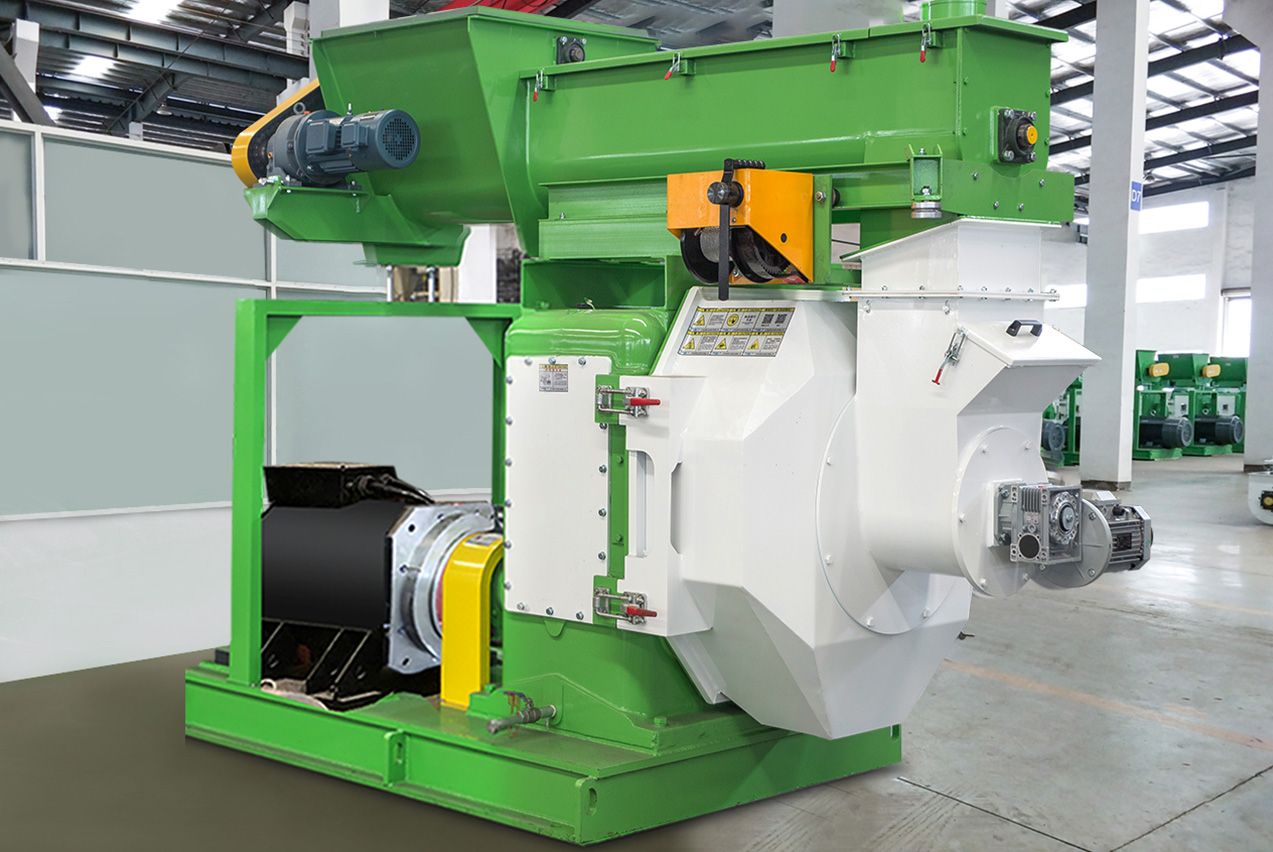
- Pelletizing: Ring die pellet mill — JWZL-688, JWZL-688D, JWZL-928, or JWZL-1068 depending on target throughput — compresses conditioned husk into uniform pellets.
- Cooling: Counter-flow cooler reduces pellet temperature and stabilizes hardness before handling.
- Packaging: Automated pellet packaging machine closes the line.
The entire line operates under Kingwood’s Three-Standardization Framework: fully integrated (no manual inter-stage transfer), dust-free (enclosed processing with integrated dust removal), and automated (PLC-controlled with minimal operator intervention). This architecture is particularly important for rice husk, where fine silica dust presents both health and equipment abrasion risks if not properly managed.
Complete lines designed by Kingwood scale to 200,000 metric tons per year of finished pellet output. For buyers evaluating a sale rice husk pellet machine manufacturer, this capacity ceiling accommodates the throughput requirements of mid- to large-scale biomass fuel producers.
Pellet Mill Model Selection for Rice Husk Applications
Kingwood’s vertical biomass pellet mill range covers the throughput brackets most relevant to rice husk pellet production:
| Model | Rated Capacity | Typical Application Scale |
|---|---|---|
| JWZL-420 | 1–1.5 t/h | Pilot or small cooperative lines |
| JWZL-688 | 2–2.3 t/h | Medium single-line plants |
| JWZL-688D | 3–3.5 t/h | High-output single-machine configuration |
| JWZL-928 | 4–5 t/h | Large commercial lines |
| JWZL-1068 | Contact sales | Engineered-to-order high-capacity |
The JZWH-860 horizontal biomass pellet mill (4–5 t/h) is available for buyers whose plant layout or feedstock handling system suits a horizontal die orientation.
For multi-machine lines targeting 10+ t/h aggregate output, Kingwood engineers configure parallel pellet mill trains within a single automated plant. The 24 t/h Vietnam wood chip pellet production line commissioned in 2023 demonstrates this approach at commercial scale, and the same multi-train methodology applies directly to rice husk feedstock lines.
Commercial and Environmental Case for Rice Husk Pelletization
From a procurement and project finance perspective, three factors drive the investment case for a rice husk pellet line:
Feedstock cost: Rice husk is typically available at zero or negative cost (disposal avoided) within a 50–100 km radius of major rice milling clusters. This reduces variable input costs relative to wood chip or agricultural straw feedstocks.
Fuel cost displacement: Biomass pellets as a boiler fuel deliver 40–50% cost savings versus fossil fuel alternatives at equivalent thermal output. For industrial buyers replacing coal or heavy fuel oil, this margin underwrites equipment payback.
Payback timeline: A documented Kingwood installation in Vietnam (2024, 12 t/h throughput) achieved full capital payback within 23 months. Rice husk lines with low feedstock acquisition costs can achieve comparable or faster payback depending on local fuel pricing.
Beyond economics, rice husk pelletization eliminates open-field burning — the primary disposal method in many regions — reducing particulate emissions and avoiding regulatory exposure as air quality enforcement tightens across Asia.
Kingwood has planned and designed over 2,000 production line projects across 30 countries since its founding in 1999. The company’s 25,000 m² production facility in Liyang Zhongguancun Industrial Park, Jiangsu Province, supports manufacturing lead times consistent with commercial project schedules.
For technical specifications, capacity modeling, or a quotation on a rice husk pellet machine or complete production line, contact Kingwood’s engineering sales team directly. Buyers evaluating equipment for biomass pellet fuel production will find Kingwood’s certified, NEEQ-listed (stock code: 871765) manufacturing platform a verifiable basis for due diligence.
FAQ
What is a rice husk pellet machine and how does it work?
A rice husk pellet machine compresses rice husk — a high-silica agricultural residue — under high pressure and heat inside a ring die chamber, densifying loose material into uniform cylindrical pellets typically 6–10 mm in diameter. The process raises energy density significantly, making the output suitable for biomass fuel, soil amendment, and animal bedding applications.
What output capacity should an industrial rice husk pellet line target?
For commercial biomass fuel production, a single-machine line using Kingwood's JWZL-688D delivers 3–3.5 t/h, while a JWZL-928 reaches 4–5 t/h. Complete wet-feed production lines designed by Kingwood scale up to 200,000 metric tons per year, covering crushing, drying, fine grinding, pelletizing, and automated packaging.
What quality specifications do rice husk pellets need to meet for export markets?
For EU markets, moisture must be below 15%. For the US market, calorific value must exceed 2,500 kcal/kg (Kingwood-produced biomass pellets reach 4,800 kcal/kg). Japanese buyers require sulfur content ≤0.5%; Kingwood pellets test below 0.3%. ISO standards require ash content below 20%; Kingwood pellets are below 18%.
Does Kingwood supply turnkey rice husk pellet production lines or equipment only?
Kingwood supplies both individual pellet mills and complete turnkey production lines. The full wet-feed line integrates a drum chipper, hammer mill, drum dryer, ring die pellet mill, counter-flow cooler, and pellet packaging machine within an enclosed, dust-free, fully automated plant layout aligned with Kingwood's Three-Standardization Framework.
What certifications does Kingwood hold for its pellet mill equipment?
Kingwood holds ISO 9001, ISO 14001, and CE certifications. The company is also recognized as a Jiangsu Provincial High-Tech Enterprise, Jiangsu Provincial Specialized & Innovative Niche Leader, and a listed entity on the NEEQ stock exchange under code 871765.
How long does it typically take to recover the investment in a rice husk pellet line?
Based on a documented Kingwood case in Vietnam (2024, 12 t/h wood pellet line), payback was achieved within 23 months. Rice husk pellet lines carry comparable economics where feedstock is low-cost agricultural residue and output is sold into biomass energy markets. Biomass fuel cost savings versus fossil fuels typically range 40–50%.
What pre-processing equipment is needed before rice husks enter the pellet mill?
Rice husks require moisture conditioning and fine grinding before pelletizing. A drum dryer reduces feedstock moisture to below 15%, and a hammer mill achieves the particle size uniformity required for consistent pellet density and ring die longevity. Kingwood integrates both machines into its standard wet-feed production line.
- Global biomass pellet trade volume reached approximately 35 million metric tons in 2023, driven by industrial heating and power co-firing demand in Europe and Asia. (2023, International Energy Agency (IEA), Renewables 2023 Report)
- Rice husk generation in Asia exceeds 100 million metric tons annually, with a large proportion currently open-burned or landfilled, representing significant untapped feedstock for pelletization. (2023, Food and Agriculture Organization of the United Nations (FAO), Rice Market Monitor 2023)