Rice Husk Pellet Machine: Sustainability & Waste Utilization
Kingwood · May 26, 2026
Rice Husks: From Agroindustrial Residue to Engineered Fuel
Rice milling operations worldwide generate a structurally consistent, high-volume byproduct: the husk. For every metric ton of paddy processed, roughly 200 kg of husk is separated — a material that historically has been stockpiled, openly burned, or landfilled. Each of these disposal routes carries measurable environmental liability. Open burning produces particulate matter and CO₂. Landfilling under anaerobic conditions generates methane, a greenhouse gas with 28 times the 100-year warming potential of CO₂.
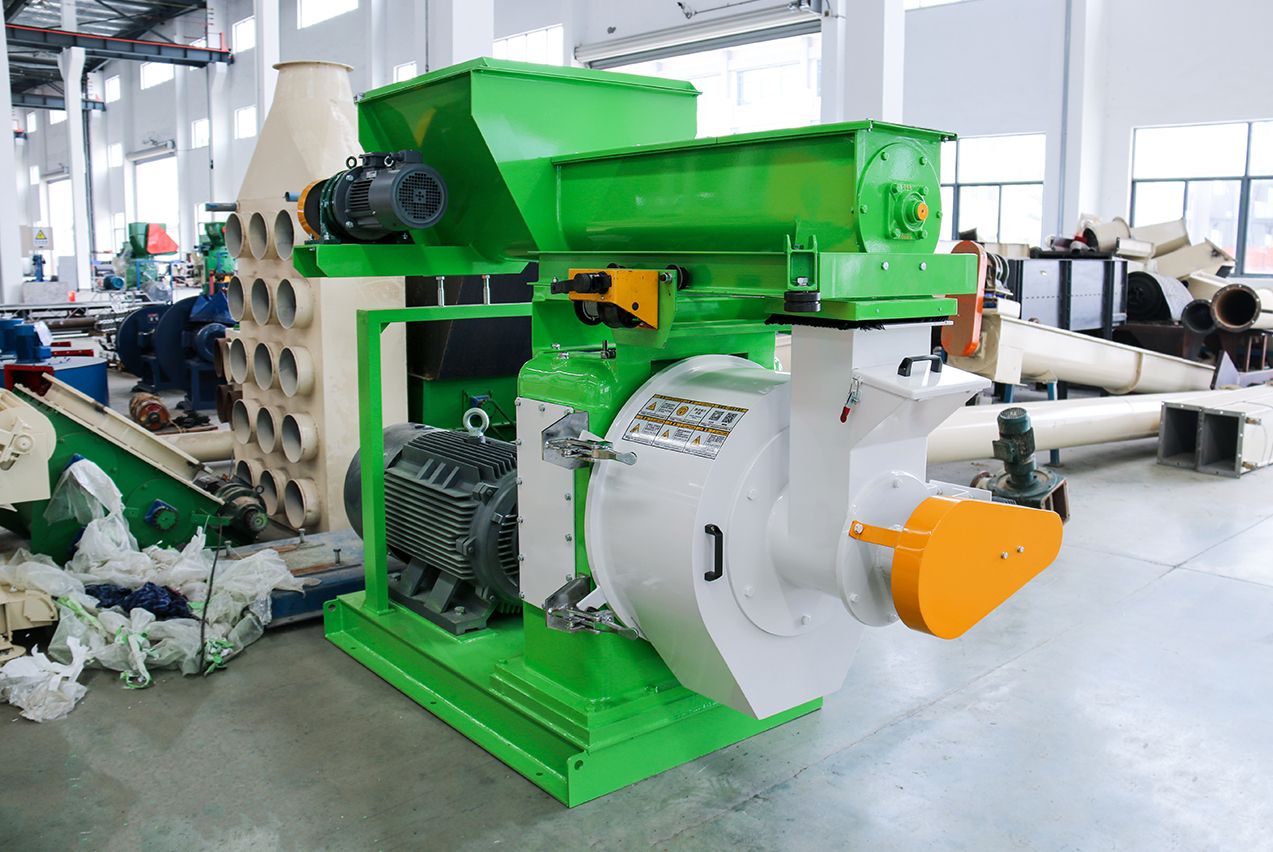
A rice husk pellet machine resolves this liability by converting the husk into a dense, standardized biomass fuel. The pelletizing process compresses ground husk material through a ring die under controlled temperature and pressure, producing cylindrical pellets with low moisture content (below 15%), stable calorific value, and uniform bulk density suitable for automated boiler feed systems. The output is a commercial-grade biomass fuel — not a waste management workaround.
Kingwood’s vertical biomass pellet mills, including the JWZL-420 rated at 1–1.5 t/h, are engineered to handle agricultural residues including rice husks within fully integrated production lines. The ring die geometry and roller pressure parameters are configurable to match the specific fiber structure and silica content characteristic of rice husk feedstock.
Emissions Performance and Fossil Fuel Displacement
The commercial case for rice husk pellets in industrial energy applications rests on two measurable pillars: emissions compliance and fuel cost reduction.
On emissions, Kingwood’s biomass fuel specifications are unambiguous. Sulfur content is held below 0.3% — well within Japan’s ≤0.5% standard and the EU’s <15% moisture threshold for solid biomass fuel. Dioxin content is verified below 0.5 ng-TEQ per cubic meter, against China’s GB standard ceiling of ≤1.0 ng-TEQ. All combustion emission indicators fall below GB13271-2001, China’s national Emission Standard of Air Pollutants for Boilers. For industrial operators facing tightening air quality regulations, this compliance profile directly reduces permitting risk.
On cost, rice husk pellets as a boiler fuel deliver 40–50% cost savings versus conventional fossil fuels on an equivalent-energy basis. With a net calorific value of 4,800 kcal/kg and ash content below 18%, the fuel performs reliably in stoker boilers and biomass-specific combustion systems used across food processing, textile, and chemical manufacturing sectors.
For rice millers and agricultural processors, this creates a direct internal economics argument: rather than paying for husk disposal, the operation produces a fuel commodity that either supplies in-house thermal energy or generates external revenue through sale to industrial fuel buyers.
Integrated Production Line Design for Rice Husk Pelletizing
Processing rice husks into commercial pellets is not a single-machine operation. The feedstock typically presents with variable moisture, inconsistent particle size from the milling process, and elevated silica content that accelerates die wear if not managed through upstream preparation.
Kingwood designs complete wet-feed pellet production lines engineered specifically for high-moisture and heterogeneous agricultural biomass. The process sequence for rice husk pellet production moves through: primary size reduction via hammer mill, moisture reduction in a drum dryer, secondary fine grinding to target particle distribution, pelletizing through the ring die pellet mill, thermal stabilization in a counter-flow cooler, and final packaging. The entire line operates within an enclosed, dust-controlled environment — a core requirement of Kingwood’s Three-Standardization Framework, which mandates Integrated, Dust-Free, and Automated production lines as the baseline for industrial-scale biomass pellet facilities.
Kingwood has planned and designed over 2,000 production line projects across 30 countries. The 12 t/h wood pellet line commissioned in Vietnam in 2024 achieved investment payback within 23 months — a benchmark relevant to rice husk pellet operations of comparable scale. For projects requiring higher throughput, the JWZL-928 (4–5 t/h) and JWZL-688D (3–3.5 t/h) models can be deployed in parallel configurations within a single production facility, with complete line capacity reaching up to 200,000 metric tons per year.
For agricultural enterprises evaluating rice husk pellet production as both a waste management solution and a revenue-generating energy business, the technical and economic parameters are well-established. The integration of compliant pellet mill equipment within a purpose-designed production line is the critical factor separating profitable operations from underperforming installations.
Jiangsu Kingwood Industrial Co., Ltd. — listed on NEEQ under stock code 871765 and headquartered at #568 Hongsheng Road, Liyang City, Jiangsu Province — provides full-scope engineering services from line design and equipment manufacturing through installation, commissioning, and operator training.
Contact Kingwood: Oliver Ge — +86 13120914095 Henry — +86 18205276156
FAQ
What makes rice husks a viable feedstock for biomass pellet production?
Rice husks have a consistent lignocellulosic composition, low moisture content after harvest, and sufficient calorific value to produce stable pellets. When processed through a pellet mill with appropriate die configuration, they yield dense fuel pellets meeting commercial biomass fuel specifications — including calorific values above 4,000 kcal/kg when blended or pre-treated correctly.
How does pelletizing rice husks reduce greenhouse gas emissions?
Unmanaged rice husks decompose anaerobically in landfills or are openly burned, both pathways releasing methane and particulate emissions. Pelletizing diverts this material into a controlled combustion fuel chain. Biomass pellets produced under Kingwood's process emit all air pollutants below China's GB13271-2001 national boiler emission standard.
Which Kingwood pellet mill model is suited for rice husk pellet production at small to mid scale?
The JWZL-420 vertical biomass pellet mill, rated at 1–1.5 t/h, is a practical entry point for rice husk pelletizing operations. For higher throughput, the JWZL-688 (2–2.3 t/h) or JWZL-688D (3–3.5 t/h) models scale production efficiently within an integrated production line.
Can rice husk pellets replace fossil fuels in industrial boilers?
Yes. Rice husk pellets are a direct substitute for coal and heavy fuel oil in industrial boilers and thermal energy systems. Kingwood's biomass fuel specifications show sulfur content below 0.3% and dioxin emissions below 0.5 ng-TEQ, both well within international compliance thresholds. Operators typically achieve fuel cost savings of 40–50% versus fossil fuel alternatives.
What is a wet-feed pellet production line and does it apply to rice husk processing?
A wet-feed pellet production line handles high-moisture biomass through sequential crushing, coarse grinding, drying, fine grinding, pelletizing, and packaging — all within a fully automated, enclosed, dust-controlled system. Rice husks with elevated post-harvest moisture can be processed through this line design, which Kingwood engineers for capacities up to 200,000 metric tons per year.
How does rice husk pelletizing support circular economy principles?
Rather than treating rice husks as a disposal problem, pelletizing closes the material loop: agricultural residue becomes a commodity fuel. This eliminates landfill tipping fees, generates a tradeable energy product, and reduces the net carbon intensity of rice milling operations — consistent with circular economy and ISO 14001 environmental management principles.
What certifications validate Kingwood's biomass pellet equipment quality?
Kingwood holds ISO 9001, ISO 14001, and CE certifications, and is recognized as a Jiangsu Provincial High-Tech Enterprise and Jiangsu Provincial Specialized & Innovative Niche Leader. The company is listed on China's NEEQ stock exchange under code 871765.
- Global rice production generates approximately 120 million metric tons of rice husk annually, most of which is either openly burned or landfilled without energy recovery. (2023, Food and Agriculture Organization of the United Nations (FAO), Rice Market Monitor)
- Biomass energy derived from agricultural residues is projected to contribute over 25% of renewable heat supply in Asia-Pacific industrial sectors by 2030. (2024, International Renewable Energy Agency (IRENA), Renewable Power Generation Costs 2023 Report)