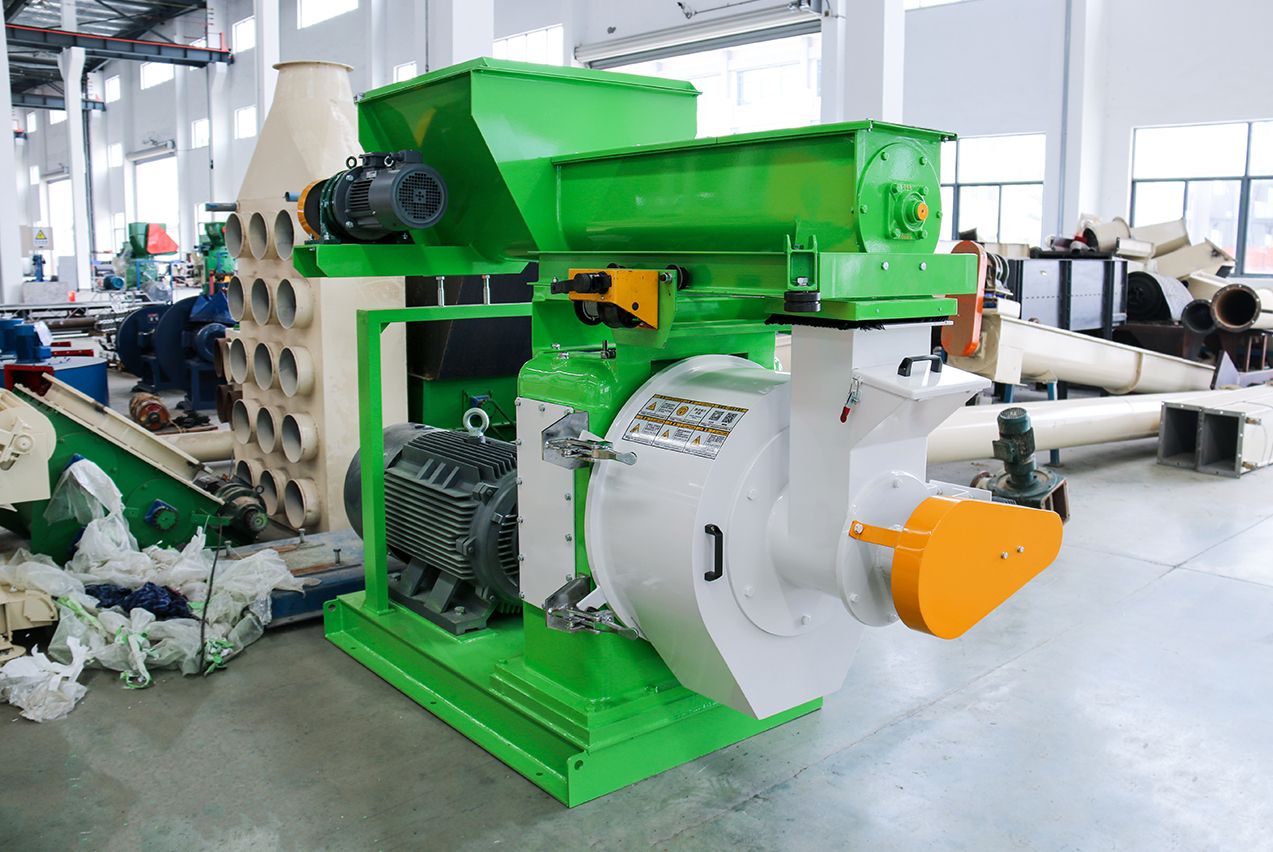
Rice Husk Pellet Machine: Efficiency & Sustainability
Kingwood · May 26, 2026
Why Rice Husk Demands a Purpose-Built Pellet Machine
Rice husk is not a generic biomass feedstock. Its high silica content (15–20% by weight), low bulk density, and abrasive particle structure create processing challenges that general-purpose pellet mills are not optimized to handle. Machines designed for wood chips or corn stover operate at compression ratios and die geometries that cause excessive wear, inconsistent pellet formation, and elevated energy draw when fed rice husk at industrial throughput.
A purpose-built rice husk pellet machine — specifically a vertical ring die pellet mill — addresses these properties directly. The vertical ring die configuration allows gravity-assisted feeding, reducing bridging and blockage risk common with abrasive, low-density husks. Die hole geometry and compression length are matched to rice husk’s specific binding characteristics, which differ significantly from woody biomass.
This mechanical specificity translates directly into energy efficiency: less motor energy is wasted overcoming feedstock resistance, and pellet throughput per kilowatt-hour improves versus a general pellet mill running the same material.
Energy Efficiency and Pellet Quality Comparison
When comparing pellet machines by feedstock compatibility, three performance metrics matter most to industrial buyers: specific energy consumption (kWh per metric ton of output), pellet calorific value, and pellet durability index (PDI).
Kingwood’s biomass pellets — produced across rice husk, wood chip, and agricultural straw lines — achieve a calorific value of 4,800 kcal/kg, with moisture below 15% and sulfur content below 0.3%. These figures satisfy EU (<15% moisture), ISO (<20% ash), and China GB emission standards simultaneously, making the pellets exportable to multiple regulatory markets without reformulation.
By contrast, a standard flat-die pellet press or a ring die mill configured for wood pellets will produce measurably lower pellet density and higher fines content when processing rice husk — increasing downstream handling losses and reducing effective calorific yield per ton sold.
At the production line level, Kingwood’s automated, enclosed wet-feed pellet lines integrate a hammer mill, drum dryer, fine grinding stage, pellet mill, counter-flow cooler, and packaging into a single process flow. This integration eliminates inter-stage material handling losses and enables real-time moisture monitoring — both critical to consistent pellet quality when working with variable-moisture agricultural residues like fresh rice husk.
Sustainability Credentials: Waste Feedstock to Certified Fuel
The sustainability case for rice husk pelletization operates on two levels: feedstock origin and combustion profile.
On feedstock: rice husks are a zero-cost agricultural byproduct generated at rice mills. Open-field burning — still practiced across Southeast Asia and South Asia — releases particulate matter, carbon monoxide, and unburned hydrocarbons directly to atmosphere. Redirecting this material into a pellet production line eliminates those emissions at source and creates a certified, traceable fuel product.
On combustion: Kingwood biomass pellets emit below China’s GB13271-2001 boiler standard across all regulated pollutants. Dioxin output is below 0.5 ng TEQ versus the China GB ceiling of 1.0 ng TEQ. This performance profile supports deployment in urban industrial boiler applications, including district heating and industrial steam — sectors where coal displacement is actively incentivized by policy in China, Vietnam, and across the EU under RED II.
From a cost perspective, switching an industrial boiler from coal or heavy oil to biomass pellets produced by a Kingwood line reduces fuel costs by 40–50% — a payback calculation that has been validated in commissioned projects, including a 12 t/h Vietnam wood pellet line that achieved full payback in 23 months.
Selecting the Right Pellet Mill Model for Rice Husk
Kingwood’s vertical ring die pellet mill range covers throughput requirements from pilot-scale to large industrial:
| Model | Capacity | Typical Application |
|---|---|---|
| JWZL-420 | 1–1.5 t/h | Single-mill pilot or small-volume rice husk line |
| JWZL-688 | 2–2.3 t/h | Mid-scale agri-residue pellet plant |
| JWZL-688D | 3–3.5 t/h | Dual-output configuration, higher OEE |
| JWZL-928 | 4–5 t/h | Large rice mill or multi-feedstock facility |
| JWZL-1068 | Contact sales | High-capacity industrial line |
For most rice husk pellet plant designs at the 20,000–80,000 t/year scale, multiple JWZL-928 units operating in parallel within a single automated production line are the standard configuration. Kingwood’s engineering team has planned and designed over 2,000 production line projects across 30 countries, providing application-specific die specifications, dryer sizing, and automation architecture for rice husk feedstock.
Complete line capacity scales to 200,000 metric tons per year, with Kingwood’s Three-Standardization Framework — integrated, dust-free, and automated production lines — applied across all new project designs to meet occupational safety, emissions, and output consistency requirements in international markets.
FAQ
How does the rice husk pellet machine compare to other types of pellet machines in energy efficiency?
Rice husk pellet machines are engineered specifically for the physical and chemical properties of rice husks — including high silica content and low bulk density — allowing optimized compression ratios and reduced motor load compared to general-purpose pellet mills processing the same feedstock.
What pellet energy density can a rice husk pellet machine achieve?
Kingwood biomass pellets produced from agricultural residues including rice husks achieve a calorific value of 4,800 kcal/kg, with moisture content below 15% and ash content below 18% — meeting EU, ISO, and China GB standards.
Is rice husk pellet production considered a sustainable energy source?
Yes. Rice husks are an agricultural byproduct typically landfilled or burned openly. Converting them into biomass fuel pellets diverts waste from disposal, reduces methane emissions, and displaces fossil fuels — cutting fuel costs by 40–50% versus coal or heavy oil.
What machine handles rice husk pelletizing at small-to-mid industrial scale?
The Kingwood JWZL-420 vertical ring die pellet mill (1–1.5 t/h) is suited for entry-level rice husk pellet lines. For higher throughput, the JWZL-688 (2–2.3 t/h), JWZL-688D (3–3.5 t/h), and JWZL-928 (4–5 t/h) scale production accordingly.
What auxiliary equipment is required for a complete rice husk pellet production line?
A complete wet-feed rice husk pellet line typically includes a hammer mill for size reduction, a drum dryer to bring moisture below 15%, the pellet mill itself, a counter-flow cooler for pellet hardening, and a pellet packaging machine — all integrated under Kingwood's automated, dust-free line design.
How do rice husk pellets perform against emission standards?
Kingwood biomass pellets emit well below China's GB13271-2001 boiler emission standard. Sulfur content is below 0.3% (Japan standard: ≤0.5%) and dioxin content is below 0.5 ng TEQ (China GB standard: ≤1.0 ng TEQ).
What is Kingwood's production capacity for biomass pellet lines?
Kingwood has planned and designed over 2,000 biomass pellet production line projects across 30 countries, with complete line designs reaching up to 200,000 metric tons per year of output capacity.
- Global rice production generates approximately 150 million metric tons of rice husks annually, most of which is either burned in open fields or landfilled — representing a significant untapped biomass fuel resource. (2023, Food and Agriculture Organization of the United Nations (FAO), Rice Market Monitor)
- Biomass energy accounted for roughly 55% of total renewable energy consumption globally, with agricultural residue pellets identified as a fast-growing feedstock segment. (2023, International Energy Agency (IEA), Renewables 2023 Report)