Renewable Energy Integration in Wood Pellet Production
Kingwood · May 26, 2026
Why Renewable Energy Integration Matters for Industrial Pellet Facilities
Industrial wood pellet production is an energy-intensive process. From initial size reduction through a hammer mill or drum chipper, through thermal drying in a drum dryer, to final compaction in a ring die pellet mill, each stage draws significant electrical and thermal power. When that power comes entirely from fossil-fuel grid sources, the carbon accounting of the finished biomass fuel is compromised — undermining the product’s value proposition to buyers in regulated markets that require lifecycle emission disclosures.
Integrating on-site solar photovoltaic arrays or wind turbines addresses this directly. Solar generation covering daytime peak loads — motor starts, compressed-air systems, control panels — reduces net grid draw during the hours when grid electricity is most carbon-intensive in many markets. Wind assets, where the site resource is adequate, can extend renewable coverage into evening and overnight operating shifts. Together, these sources shift a measurable share of the facility’s energy balance away from fossil fuels without requiring changes to the core pelletizing process.
For manufacturers supplying biomass pellets to European utilities or Japanese industrial buyers, this matters commercially: procurement contracts increasingly require scope-2 emission disclosures for the production facility, not just the fuel itself. A pellet plant with documented on-site renewables is a more defensible supply chain partner.
Energy Efficiency Gains Across the Production Line
Renewable energy integration does not simply substitute one power source for another. When designed alongside modern automated control systems, it creates measurable efficiency improvements at the process level.
Drum drying is where the leverage is greatest. In a wet-feed pellet production line — the configuration Kingwood engineers for clients handling high-moisture biomass — the drum dryer is the primary thermal load. Pairing a biomass combustion heat source with solar thermal pre-heating of inlet air, or using surplus wind-generated electricity to drive electric booster heating, reduces the volume of biomass fuel consumed in the dryer itself. This lowers per-tonne production cost and raises the net energy yield of the finished pellet.
Pelletizing draws the second-largest share of electrical load. Ring die pellet mills such as the JWZL-928 and JWZL-1068 operate large-frame drive motors at sustained load. Stable renewable supply — smoothed through battery storage or smart inverter systems — maintains consistent motor speed, which directly affects pellet density and durability. Voltage fluctuations from an unstable grid, by contrast, cause variable compression in the die channel, producing inconsistent pellet quality.
Auxiliary systems — including the counter-flow cooler, conveying lines, and dust extraction — represent smaller but cumulatively significant loads. Automated demand management, a core feature of Kingwood’s Automated production line standard under the Three-Standardization Framework, allows these systems to shed or defer load during renewable generation troughs, reducing peak demand charges.
The cumulative effect: facilities designed with integrated renewables and automated load management can achieve a lower kilowatt-hour-per-tonne consumption figure than equivalent facilities operating on grid power alone.
Operational Resilience and Supply Chain Sustainability
Grid reliability is a practical concern in many of the markets where large-scale biomass pellet production is growing — Southeast Asia, Central and Eastern Europe, and parts of South America. A facility with on-site generation capacity maintains pellet mill operation during grid interruptions, protecting throughput commitments to offtake buyers.
Kingwood’s production line designs support this resilience model. The enclosed, integrated architecture of a Dust-Free production line — one of the three pillars of the Three-Standardization Framework — protects electrical infrastructure, inverters, and switchgear from the biomass dust environment that shortens equipment life in open facilities. This matters when sensitive renewable generation equipment such as solar inverters and battery management systems are co-located with the pellet plant.
From a sustainability reporting perspective, an integrated renewable energy configuration also strengthens the environmental credentials of the biomass fuel output. Kingwood’s biomass pellets are specified to a calorific value of 4,800 kcal/kg, moisture content below 15%, sulfur content below 0.3%, and ash content below 18% — all within or below EU, ISO, and Japanese market standards. When this fuel specification is combined with a production facility running on a high share of renewable electricity, the full lifecycle carbon intensity of the product is materially lower than industry average.
For project developers evaluating a new pellet production line at capacities up to 200,000 tonnes per year, renewable energy integration should be scoped at the design stage, not retrofitted. Structural provisions for rooftop solar, cable routing for wind interconnection, and load-management software hooks are substantially cheaper to incorporate into a new Integrated production line than to add after commissioning.
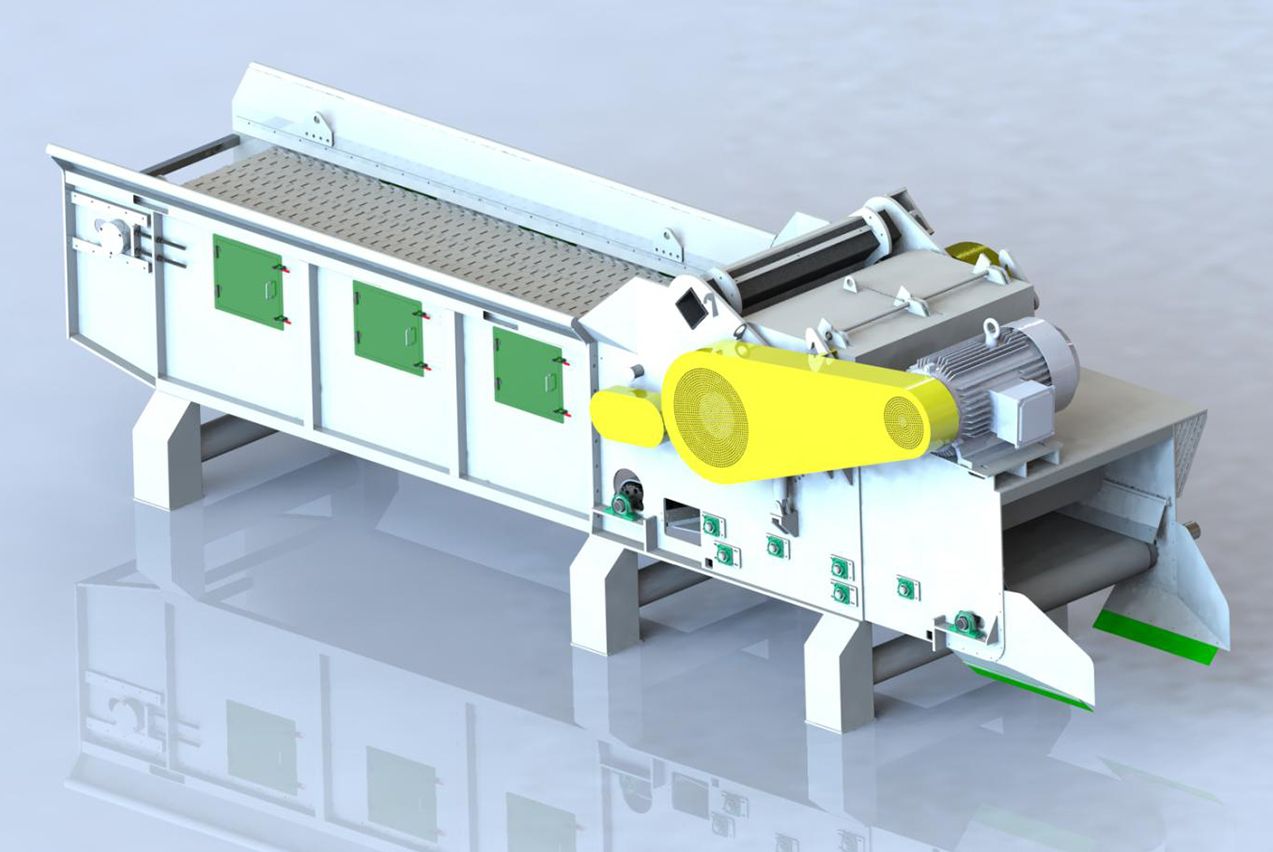
Kingwood biomass size-reduction equipment — the first stage in a wet-feed pellet production line. For technical specifications on upstream crushing equipment, see the XPJ1250/XPJ1400 Biomass Wood Crusher product page.
Operators seeking to benchmark renewable integration economics against a live project can review the 12 t/h Vietnam wood pellet line case study, which documents a 23-month equipment payback under standard grid conditions — a baseline from which renewable energy savings can be modeled for similar configurations.
Kingwood — established in 1999 and listed on the NEEQ (stock code: 871765) — has planned and designed over 2,000 production line projects across 30 countries. The company operates from a 31,200 m² facility at Liyang Zhongguancun Industrial Park, Jiangsu Province, China, with a team of 20 R&D experts and holds ISO 9001, ISO 14001, and CE certifications. For project consultation on renewable-integrated pellet production lines, contact the Kingwood sales team directly.
FAQ
How does solar energy integration affect the operating cost of a wood pellet production line?
On-site solar generation offsets grid electricity consumption for energy-intensive processes such as pelletizing, grinding, and drying. Combined with Kingwood's automated production lines, which minimize idle-load losses, operators can reduce electricity spend by a measurable margin over the facility lifetime, improving the economics of biomass fuel production.
Can wind power reliably supply the continuous energy demand of a pellet mill?
Wind turbines paired with battery storage or grid interconnection can smooth intermittency. For large-scale facilities running ring die pellet mills such as the JWZL-928 or JZWH-860 at 4–5 t/h, a hybrid wind-plus-storage configuration maintains stable voltage supply to motors and control systems without interrupting pelletizing cycles.
What production processes in a biomass pellet plant consume the most energy?
Drum drying is typically the largest energy consumer, followed by size reduction (hammer mill, drum chipper) and pelletizing. Directing renewable electricity or waste heat recovery toward the drum dryer yields the greatest efficiency gains in a wet-feed pellet production line.
Does renewable energy integration affect pellet quality or throughput?
When integrated through a stable power management system, renewable energy has no adverse effect on pellet quality. Consistent motor speeds on the pellet mill maintain uniform die-channel compression, preserving bulk density, moisture content below 15%, and calorific value around 4,800 kcal/kg.
How does Kingwood's Three-Standardization Framework relate to renewable energy readiness?
Kingwood's Three-Standardization Framework — Integrated, Dust-Free, and Automated production lines — supports renewable energy compatibility. Automation reduces parasitic loads and enables demand-response operation; enclosed, dust-free enclosures protect solar inverters and electrical panels from biomass dust contamination.
What certifications confirm that Kingwood equipment meets environmental and efficiency standards?
Kingwood holds ISO 9001, ISO 14001, and CE certifications. Its biomass fuel specifications comply with China's GB13271-2001 boiler emission standard, EU moisture standards (<15%), and ISO ash standards (<20%), ensuring renewable-powered pellet output meets international trading requirements.
What payback period can operators expect when combining renewable energy with a Kingwood pellet line?
Project economics vary by scale and local energy prices. A documented Kingwood installation in Vietnam (12 t/h, 2024) achieved full equipment payback in 23 months under conventional grid power. Renewable energy integration further compresses operating costs, which can shorten the overall payback horizon depending on solar or wind resource availability.
- Biomass energy accounted for approximately 55% of total renewable energy consumption in the EU in 2023, with wood pellets representing the dominant solid biofuel traded internationally. (2023, Eurostat, Energy from Renewable Sources statistics (2024 release))
- Global wood pellet production capacity exceeded 50 million metric tons per year by 2023, driven by industrial-scale demand from power and heat utilities in Europe and Asia. (2023, IEA Bioenergy Task 40, Global Wood Pellet Industry and Trade Study (2024))