How Raw Material Choice Affects Wood Pellet Mill Performance
Kingwood · May 26, 2026
Raw material selection is not a pre-production formality—it is a core engineering variable. The species of wood, its moisture level, its particle size distribution, and its contaminant load collectively determine ring die pressure requirements, throughput stability, pellet mechanical durability, and calorific output. Understanding these relationships allows plant engineers and procurement teams to make decisions that protect equipment and maximize fuel quality.
Wood Species: Density, Lignin Content, and Compression Force
The physical and chemical properties of a given wood species set the baseline parameters for every downstream process in a wood pellet mill system.
Hardwoods (oak, beech, maple) have higher bulk density and greater lignin concentration. Lignin acts as a natural binder during thermal compression—heat generated by friction in the die channel softens lignin, which then re-solidifies as the pellet cools, creating structural integrity. However, the same density that improves pellet quality also demands higher compression force at the ring die. Drive motors and die geometry must be selected to accommodate hardwood feed without overloading or premature wear. The output: denser pellets with higher energy content, well-suited to industrial boiler and power generation applications.
Softwoods (pine, fir, spruce) compress more easily due to lower density, reducing instantaneous load on the die. The trade-off is a lower energy density in the finished pellet and, in some softwood species, elevated resin content that can cause die channel fouling if process temperatures are not managed. Softwood pellets are widely used for residential heating and small commercial boiler applications where energy density requirements are less stringent.
Mixed feedstocks—common in industrial-scale operations sourcing from multiple suppliers or using forest residues—introduce variability in compression behavior. Consistent species profiling in raw material intake is good practice, particularly at throughputs of 4 t/h and above.
Moisture Content and Particle Size: The Two Controllable Variables
Of all raw material preparation parameters, moisture content and particle size have the most direct and measurable impact on pellet mill operation.
Moisture content must be brought below 15% before the feedstock enters the pellet mill—the threshold specified in EU biomass fuel standards and reflected in Kingwood’s own pellet fuel specifications. At moisture levels above this threshold, steam generation inside the die channel disrupts pellet formation, reduces bulk density, and causes surface cracking. Energy consumption per metric ton of output rises, and effective throughput drops. Feed that is over-dried (below approximately 8%) loses the plasticity needed for cohesive pellet formation and accelerates die and roller wear.
For operations processing green or freshly harvested wood, a drum dryer upstream of the pelletizing stage is not optional—it is a process requirement. Kingwood’s complete wet-feed production lines integrate drum drying as a core stage, enabling direct processing of high-moisture biomass without pre-drying at source.
Particle size determines how uniformly material flows into and through the die channel. Oversized particles bridge at the die entrance, causing pressure spikes and uneven fill. Undersized fines pack too densely and impede airflow during drying. The target particle size distribution for most ring die pellet mills is a top size of 6–8 mm with minimal fines below 0.5 mm. A correctly configured hammer mill upstream achieves this distribution reliably. For large-format feedstock such as logs or thick branches, a drum chipper provides the initial size reduction stage before fine grinding.
Contaminant Control and Its Role in Die Longevity
Contaminants—stones, metal pieces, sand, soil, and dense bark inclusions—cause damage disproportionate to their volume. A single piece of metal passing through a ring die can score the die bore surface, alter compression geometry, and generate metal fines that contaminate the finished product. Repeated stone contact accelerates roller surface wear and increases maintenance frequency.
Standard upstream protection includes:
- Magnetic separators to capture ferrous metal introduced during harvesting, transport, or handling
- Vibrating screens to remove oversize material and dense foreign objects
- Destoners where mineral contamination risk is elevated (e.g., ground-contact agricultural residues)
In Kingwood’s dust-free, enclosed production line design—part of the Three-Standardization Framework—material handling between process stages is fully enclosed, which reduces the opportunity for secondary contamination after the initial cleaning stage. This design principle is documented in the Guizhou dust-free biomass pellet mill workshop project, where enclosed processing was implemented as a primary facility standard.
Matching Raw Material Profile to Equipment Selection
The interaction between raw material properties and equipment specification is direct. A facility processing hardwood at 4–5 t/h requires a different die specification and drive configuration than one processing mixed softwood residues at the same nominal throughput. For reference:
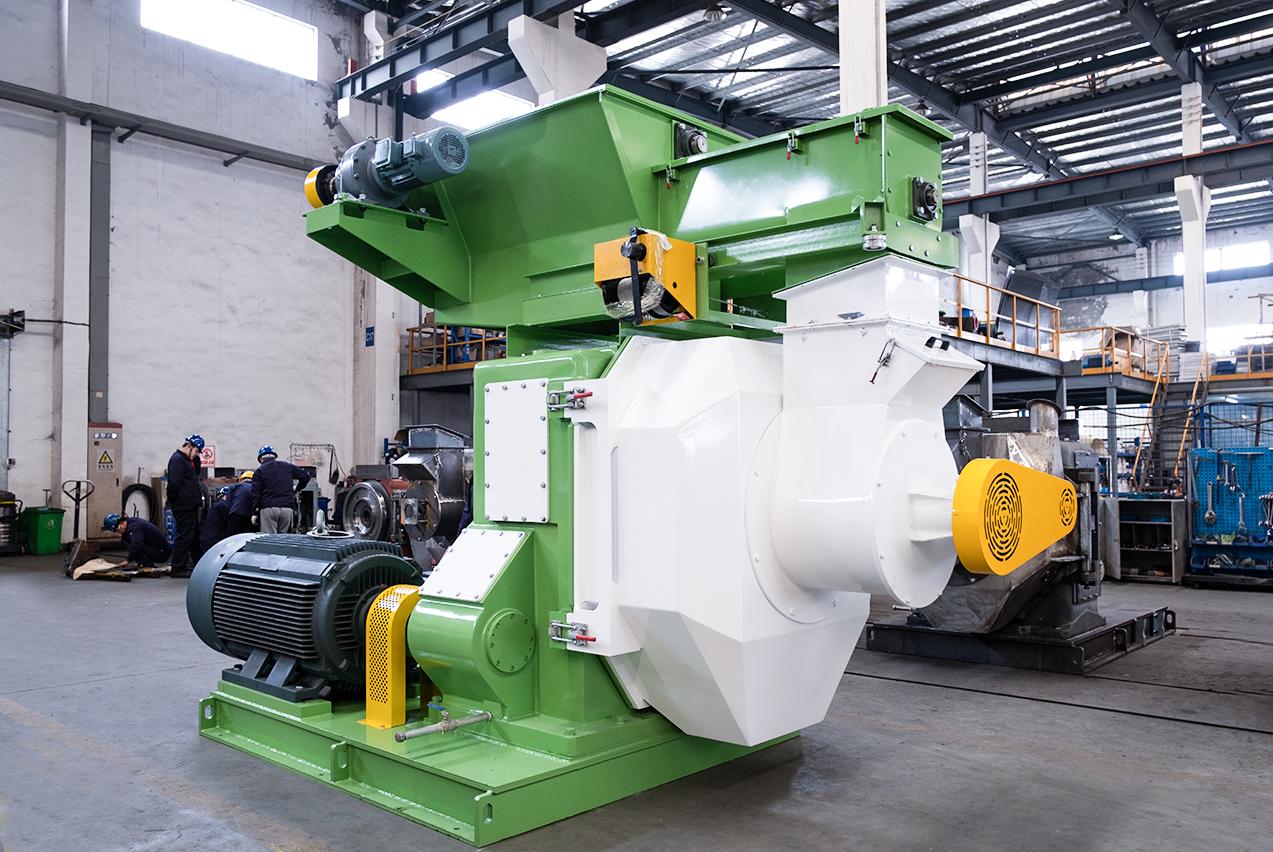
- The JZWH-860 horizontal biomass pellet mill delivers 4–5 t/h and is designed for robust compression demands including hardwood-dominant feedstocks.
- The JWZL-928 vertical pellet mill also operates at 4–5 t/h and is suited to lines where vertical material feed geometry offers layout advantages.
For operations planning new production lines or upgrading existing facilities, Kingwood’s engineering team conducts raw material analysis as part of the line design process. With more than 2,000 production line projects planned and designed across 30 countries, this input-output mapping across species, moisture, and throughput targets is well-established practice.
The JZWH-860 biomass wood pellet mill represents one configurable option within a broader equipment portfolio that spans 1 t/h to multi-line installations exceeding 200,000 metric tons per year annual capacity.
Selecting the right equipment begins with an accurate characterization of the raw material—not the other way around.
FAQ
How does wood species selection affect pellet mill compression requirements?
Hardwoods such as oak and beech have higher density and energy content, requiring greater compression force and more robust drive systems. Softwoods like pine compress more easily but yield lower-density pellets with reduced calorific value—typically suited to residential heating rather than industrial fuel applications.
What moisture content is optimal for wood pellet production?
Raw material moisture should be reduced to below 15% before pelletizing. Kingwood biomass pellets comply with this threshold, which aligns with EU moisture standards. Excess moisture reduces pellet density and durability, increases energy consumption, and lowers throughput. Over-dried material increases brittleness and die wear.
Why does particle size uniformity matter in a pellet compression system?
Consistent particle size ensures even material flow into the die channel, reducing bridging and uneven compression. Irregular particles create voids within the pellet matrix, lowering mechanical durability and bulk density. A hammer mill or drum chipper upstream of the pellet mill is standard practice for achieving target particle distribution.
What contaminants must be removed before wood enters a pellet mill?
Stones, metal fragments, sand, and bark inclusions must be screened out before compression. Metal and stone particles accelerate ring die wear and can cause catastrophic die damage. Magnetic separators and vibrating screens are standard upstream components in a complete pellet production line.
Does raw material type affect the calorific value of the finished pellet?
Yes. Hardwood pellets typically achieve higher calorific values due to greater lignin and carbon content. Kingwood biomass pellets deliver a calorific value of 4,800 kcal/kg, with sulfur content below 0.3% and ash content below 18%, meeting or exceeding GB13271-2001 emission standards.
How does raw material preparation differ between wet-feed and dry-feed pellet lines?
A wet-feed pellet production line—such as those designed by Kingwood with capacity up to 200,000 metric tons per year—handles high-moisture biomass through an integrated sequence: coarse chipping, drying, fine grinding, pelletizing, cooling, and packaging. This eliminates the need for pre-dried feedstock and broadens acceptable raw material ranges.
What equipment handles particle size reduction before pelletizing?
Kingwood's auxiliary equipment lineup includes a drum chipper for initial size reduction of logs and branches, followed by a hammer mill for fine grinding to target particle size. Both are integrated into automated, enclosed production lines under Kingwood's Three-Standardization Framework.
- Global wood pellet production reached approximately 45 million metric tons in 2023, with industrial-grade pellets accounting for the majority of demand growth driven by coal co-firing and dedicated biomass power generation. (2024, IEA Bioenergy — Bioenergy Policies and Status of Implementation Report 2024)
- Moisture content above 20% in biomass feedstock has been shown to reduce pellet mill throughput by up to 30% and increase specific energy consumption by 15–25% compared to feedstock dried to below 15%. (2023, USDA Forest Service — Forest Products Laboratory, General Technical Report FPL-GTR-281)