Industrial Wood Pellet Mill vs. Fossil Fuels: Cost & Efficiency
Kingwood · May 26, 2026
Why Industrial Wood Pellet Mills Are Displacing Fossil Fuels in B2B Energy Planning
Energy procurement managers and industrial plant operators are under sustained pressure to cut fuel costs while meeting tightening emissions mandates. Industrial wood pellet mill machines address both constraints simultaneously—converting low-cost forestry residues into a standardized, high-energy-density fuel that burns cleanly in existing boiler infrastructure.
The economic case is direct: Kingwood biomass pellets reduce fuel costs by 40–50% compared to coal, oil, and natural gas equivalents. That margin is structural, not cyclical. Feedstock—sawdust, wood chips, bark, agricultural straw—is sourced from residue streams that often carry negative cost (disposal avoided). Processing cost is controlled by the efficiency of the pellet mill itself. And unlike crude-linked fuels, wood pellet pricing does not move with OPEC decisions or LNG shipping bottlenecks.
Technical Comparison: Pellet Mill Output vs. Fossil Fuel Performance
Calorific Value and Energy Density
Kingwood biomass pellets achieve a calorific value of 4,800 kcal/kg—well above raw biomass and comparable to lower-grade coals. Because pellets are compressed to a consistent density, they store and transport more energy per cubic meter than loose chips or straw, reducing logistics cost per unit of heat delivered.
Moisture content is held below 15%, which directly protects combustion efficiency. Raw biomass at 40–50% moisture consumes a significant share of its own combustion energy evaporating water before useful heat is released. Pellets eliminate that loss.
Emission Profile vs. Coal and Oil
| Parameter | Kingwood Biomass Pellet | China GB Limit | Coal (typical) |
|---|---|---|---|
| Sulfur content | < 0.3% | — | 0.5–3%+ |
| Ash content | < 18% | < 20% (ISO) | 10–30% |
| Dioxin | < 0.5 ng TEQ/m³ | ≤ 1.0 ng TEQ/m³ | Variable |
| Moisture | < 15% | < 15% (EU) | 5–15% |
All Kingwood biomass fuel emission indicators comply with GB13271-2001, China’s national Emission Standard of Air Pollutants for Boilers. Sulfur output is an order of magnitude lower than high-sulfur coal, eliminating the need for flue-gas desulfurization systems that add capital and operating cost to coal-fired installations.
Price Stability as an Operational Advantage
Oil and natural gas prices are subject to supply disruptions, seasonal demand spikes, and currency exposure on import-dependent markets. Wood pellet feedstock is typically sourced within a regional radius of the production facility, making pricing largely insulated from international commodity cycles. For industrial energy buyers managing multi-year budgets, that predictability has quantifiable value.
How Kingwood Equipment Converts Residue into Certified Industrial Fuel
Kingwood has designed and planned over 2,000 production line projects across 30 countries since 1999, with combined annual biomass fuel capacity exceeding 10 million metric tons. That operational dataset underpins every equipment specification.
Pellet Mill Models for Industrial Scale
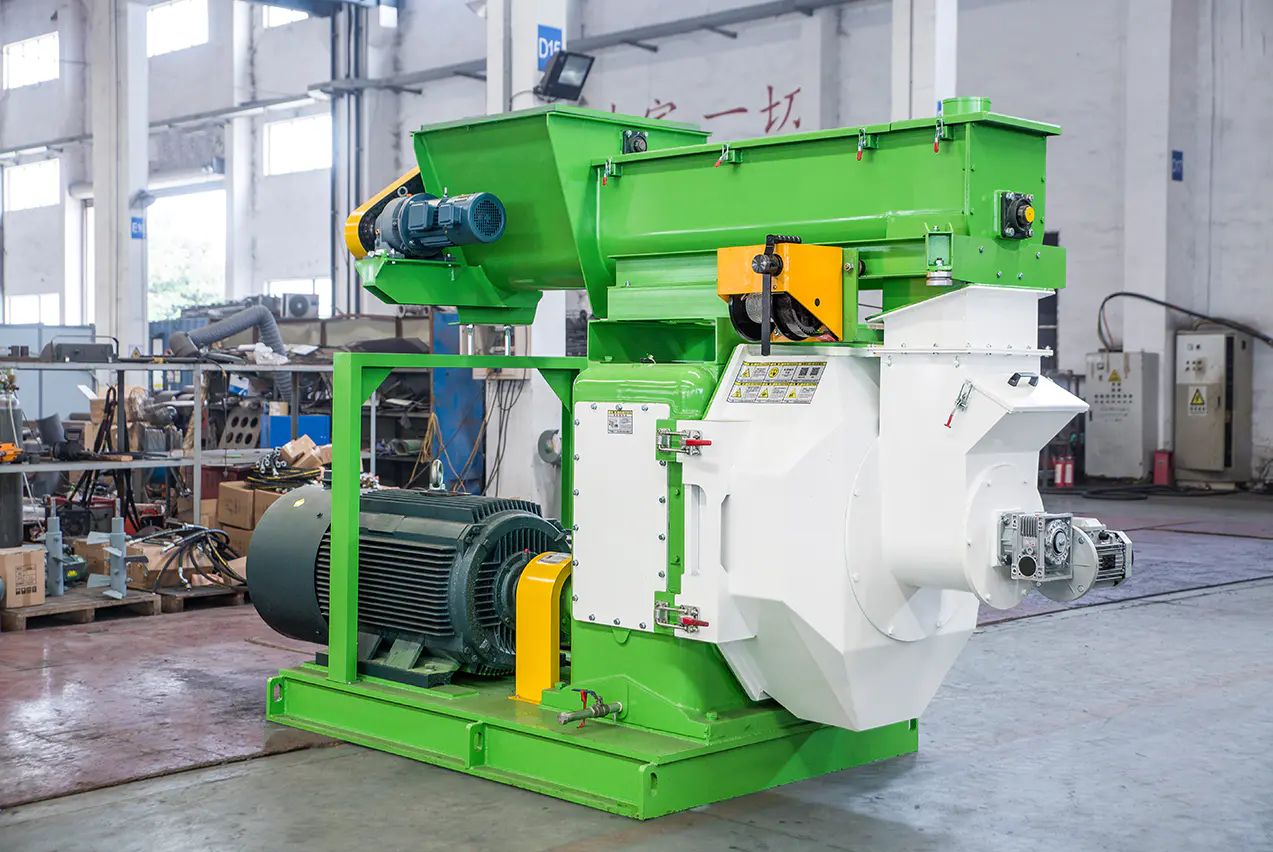
The core of any production line is the pellet mill. Kingwood’s current vertical ring die range:
- JWZL-420: 1–1.5 t/h — suitable for smaller facilities or satellite lines
- JWZL-688: 2–2.3 t/h
- JWZL-688D: 3–3.5 t/h — dual-chamber configuration for higher throughput
- JWZL-928: 4–5 t/h
- JWZL-1068: capacity on application — contact Kingwood sales
For operations requiring horizontal configuration, the JZWH-860 delivers equivalent 4–5 t/h output. Complete lines scale to 200,000 metric tons per year.
Wet-Feed Line Architecture
When feedstock arrives at high moisture—fresh wood chips, green agricultural residues—a wet-feed pellet production line is required. Kingwood’s complete lines process material through six sequential stages: crushing → coarse grinding → drum drying → fine grinding → pelletizing → packaging. The entire process is enclosed, with integrated dust removal at each transfer point, consistent with Kingwood’s Three-Standardization Framework (Integrated, Dust-Free, and Automated production lines).
Auxiliary equipment—hammer mills, drum chippers, drum dryers, and counter-flow coolers—is engineered and sourced within the same supply chain, ensuring interface compatibility and single-vendor accountability for the complete line.
For a documented example of this architecture operating at commercial scale, see the 24 t/h Vietnam wood chip pellet production line case.
Environmental and Regulatory Positioning
Wood pellets are classified as carbon-neutral under international accounting frameworks: CO₂ released during combustion is offset by CO₂ sequestered during the biomass growth cycle. This is a fundamental distinction from fossil fuels, where combustion releases carbon stored over geological timescales with no equivalent reabsorption pathway on any policy-relevant timeline.
For industrial operators in jurisdictions with carbon pricing, emissions trading schemes, or mandatory renewable energy quotas, this classification has direct financial implications—either as avoided carbon cost or as compliance with renewable energy mandates.
Kingwood holds ISO 9001 and ISO 14001 certifications, CE marking, and is listed on China’s NEEQ (stock code: 871765) as Jiangsu Kingwood Industrial Co., Ltd. The company is also a Deputy Director Member Unit of the China Biomass Energy Industry Alliance, and carries Jiangsu Provincial High-Tech Enterprise and Jiangsu Provincial Gazelle Enterprise designations.
Procurement Considerations for Industrial Buyers
Selecting a wholesale industrial wood pellet mill machine supplier involves more than unit price. Key evaluation criteria include:
- Feedstock flexibility: Can the mill handle the specific moisture content, particle size, and species mix available at your facility?
- Line integration: Is auxiliary equipment—chipping, drying, cooling, packaging—engineered as a matched system or assembled from unrelated vendors?
- Automation level: Fully automated lines reduce labor requirements and cut unplanned stops caused by manual process variation.
- After-sales infrastructure: With projects in 30 countries, Kingwood maintains the technical support capacity for international installations.
- Payback timeline: The Vietnam 12 t/h pellet line case documents a 23-month payback period—a concrete reference point for ROI modeling.
For technical specifications, capacity matching, or line design consultation, contact Kingwood’s engineering team directly.
FAQ
How does the fuel cost of wood pellets compare to coal or natural gas?
Biomass pellets produced by industrial wood pellet mills can reduce fuel costs by 40–50% compared to conventional fossil fuels, according to Kingwood operational data. The primary driver is raw material cost: sawdust, wood chips, and forestry residues are low-cost or zero-cost feedstocks that would otherwise require disposal.
What is the calorific value of biomass pellets produced by Kingwood equipment?
Kingwood biomass pellets achieve a calorific value of 4,800 kcal/kg, with moisture content below 15%, sulfur content below 0.3%, and ash content below 18%. These figures meet or exceed EU, US, Japanese, and ISO pellet quality standards.
Are wood pellets carbon-neutral compared to fossil fuels?
Wood pellets are classified as carbon-neutral because CO₂ released during combustion is offset by CO₂ sequestered during tree growth. In contrast, fossil fuel combustion releases carbon that has been sequestered for millions of years, with no equivalent natural offset cycle.
What emission standards do Kingwood biomass pellets meet?
All emission indicators for Kingwood biomass fuel fall below GB13271-2001, China's national Emission Standard of Air Pollutants for Boilers. Dioxin content is below 0.5 ng TEQ/m³, against the China GB standard limit of ≤1.0 ng TEQ/m³.
What production capacities are available for industrial wood pellet mill machines from Kingwood?
Kingwood's vertical pellet mill range covers 1 t/h (JWZL-420) through 4–5 t/h (JWZL-928), with the horizontal JZWH-860 also rated at 4–5 t/h. Complete wet-feed production lines scale up to 200,000 metric tons per year.
Why is wood pellet pricing more stable than oil or natural gas?
Wood pellet feedstock is sourced from domestic forestry residues and agricultural by-products, insulating it from the geopolitical and supply-chain disruptions that drive volatility in crude oil and natural gas markets. This makes long-term energy budgeting more reliable for industrial operators.
What is a wet-feed pellet production line and when is it needed?
A wet-feed pellet production line handles high-moisture biomass through a sequential process: crushing, coarse grinding, drying, fine grinding, pelletizing, and packaging. It is required when feedstock moisture exceeds the direct-pelletizing threshold. Kingwood's complete lines are fully automated and enclosed, with integrated dust removal throughout.
- Biomass pellets produced on Kingwood equipment deliver a calorific value of 4,800 kcal/kg and reduce industrial fuel costs by 40–50% versus fossil fuel equivalents. (2025, Kingwood product technical datasheet, Jiangsu Kingwood Industrial Co., Ltd.)
- Global biomass energy capacity additions reached 9.9 GW in 2023, bringing total installed biomass power capacity to approximately 154 GW worldwide. (2024, International Renewable Energy Agency (IRENA), Renewable Capacity Statistics 2024)