How Biomass Pellet Mill Granulators Drive Industry Sustainability
Kingwood · May 26, 2026
The Mechanical Case for Pelletization
Raw biomass — sawdust, rice husks, wood chips, agricultural straw — is bulky, inconsistent in moisture, and low in energy density. Left in that state, it is expensive to transport, difficult to combust cleanly, and prone to decomposition that releases methane and CO₂ with no energy return. Biomass pellet mill granulators solve all three problems in a single continuous process.
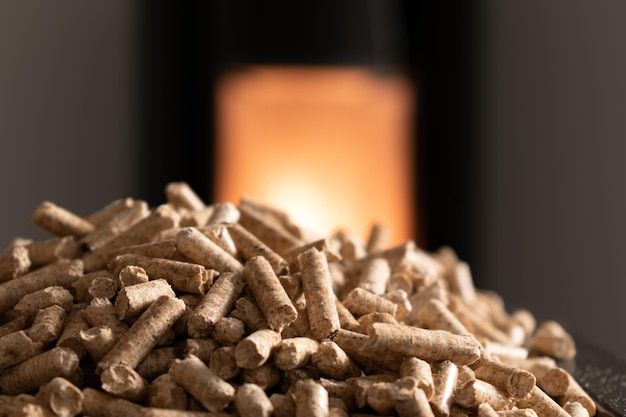
The core mechanism is compression. A ring die pellet mill forces conditioned biomass through precision-machined die holes under roller pressure, generating enough heat and mechanical force to activate the lignin naturally present in plant cell walls. That activated lignin acts as a binder, producing a dense, uniform pellet without chemical additives. The result is a fuel with a calorific value of 4,800 kcal/kg, moisture content below 15%, sulfur below 0.3%, and ash below 18% — parameters that meet or exceed the EU, US, Japanese, and Chinese national biomass fuel standards simultaneously.
Higher energy density means fewer truckloads per megajoule delivered, lower warehouse footprint, and more stable combustion in industrial boilers. These are not secondary benefits; they are the economic foundation that makes large-scale renewable energy substitution commercially viable for industrial buyers.
Greenhouse Gas Reduction: Two Mechanisms Working Together
Biomass pellet mill granulators reduce greenhouse gas emissions through two distinct and additive pathways.
Pathway 1 — Waste interception. Agricultural and forestry residues that go unpelletized typically decompose in the field or in landfill. Decomposition is an anaerobic process that generates methane, a greenhouse gas with a global warming potential 25–80 times that of CO₂ over a 20-year horizon depending on the accounting methodology used. Converting that material into pellets and combusting it in a controlled boiler environment substitutes a carbon-neutral thermal process for an uncontrolled high-GWP emission event.
Pathway 2 — Fossil fuel displacement. Biomass is part of the contemporary carbon cycle: the CO₂ released during pellet combustion was fixed from the atmosphere by the source plant within years or decades, not millions of years. When biomass pellets replace coal in an industrial boiler, the net long-cycle carbon addition to the atmosphere approaches zero. Kingwood’s project data shows that customers switching from coal to biomass pellets consistently achieve fuel cost reductions of 40–50%, making the economics of decarbonization self-funding rather than subsidy-dependent.
All emission indicators for pellets produced on Kingwood equipment fall below China’s GB13271-2001 national Emission Standard of Air Pollutants for Boilers — a benchmark that is stricter than many regional standards in Southeast Asia and Central Asia, the two fastest-growing markets for industrial pellet consumption.
Waste Valorization and the Circular Economy
The sustainability argument for pellet mill granulators extends beyond combustion chemistry into supply chain economics. Industries that generate biomass by-products — sawmills, rice mills, sugarcane processors, palm oil producers, municipal green-waste handlers — historically paid to dispose of those materials. A pellet mill converts that liability into a revenue stream or a fuel input that displaces purchased energy.
Kingwood’s wet-feed pellet production lines are specifically engineered for this reality. The line architecture sequences crushing, coarse grinding, drying, fine grinding, pelletizing, and packaging in a fully enclosed, automated workflow. High-moisture feedstocks that would be unprocessable on a conventional dry-feed mill are handled natively. The integrated dust-removal system, a mandatory element of Kingwood’s Three-Standardization Framework, ensures that the pellet plant itself does not become a local air quality problem — a compliance consideration that is increasingly determinative for industrial permits in China, Vietnam, and the EU.
Kingwood has applied this architecture across more than 2,000 planned and designed production line projects in over 30 countries. A 24 t/h wood chip pellet line in Vietnam commissioned in 2023 and a 30 t/h line in Chongqing, China, commissioned in 2021 both demonstrate that wet-feed integrated design scales reliably to industrial throughput without compromising the circular-economy feedstock flexibility that makes biomass economics work.
Equipment Selection for Sustainable Operations
Sustainability performance is not uniform across pellet mill designs. The following equipment parameters directly affect the environmental and economic profile of a pellet production operation:
Die specification. Compression ratio (die hole depth-to-diameter) must be matched to feedstock lignin content and moisture. Incorrect specification causes either pellet crumbling — which destroys energy density gains — or excessive die wear, increasing metal consumption and maintenance downtime.
Drive efficiency. Kingwood’s vertical pellet mills use direct-drive configurations that minimize mechanical transmission losses. The JWZL-928, for example, delivers 4–5 t/h in a vertical-axis ring die configuration. The horizontal JZWH-860 covers the same capacity range for operators who prefer horizontal-axis geometry for their feed handling layout.
The JZWH-860 horizontal biomass pellet mill, rated at 4–5 t/h. For full technical specifications, see the JZWH-860 product page.
Upstream conditioning. A pellet mill operating on incorrectly sized or excessively moist feedstock consumes disproportionate energy per ton of output and produces inconsistent pellet quality. Integrating a hammer mill, drum chipper, and drum dryer upstream — as Kingwood does in its complete-line designs — is not upselling; it is the technical prerequisite for achieving the fuel specification numbers cited above.
Downstream cooling. A counter-flow cooler removes the heat and residual moisture introduced during die compression. Pellets that leave the line above target moisture content or temperature have shorter shelf life and higher risk of spontaneous combustion in bulk storage — a logistics and safety issue with direct sustainability cost implications.
Complete Kingwood production lines are designed for output up to 200,000 metric tons per year, scalable to the throughput requirements of utility-grade biomass fuel operations. For project-specific capacity planning and feedstock assessment, contact Kingwood’s engineering team directly.
Jiangsu Kingwood Industrial Co., Ltd. — NEEQ listed (stock code: 871765), founded 1999, headquartered at #568 Hongsheng Road, Liyang City, Jiangsu Province, China. ISO 9001 · ISO 14001 · CE certified.
FAQ
How do biomass pellet mill granulators improve energy efficiency?
By mechanically compressing raw biomass under high pressure, granulators increase volumetric energy density significantly, reducing the mass of material required per unit of energy output. This translates directly to lower transport, handling, and storage costs per megajoule delivered.
What greenhouse gas benefits come from pelletizing biomass instead of leaving it to decompose?
Decomposing biomass releases both CO₂ and methane — a greenhouse gas roughly 25–80× more potent than CO₂ over a 20-year horizon. Converting that material into biomass pellets and using it as a combustion fuel prevents uncontrolled methane release and displaces fossil-fuel emissions simultaneously.
What feedstocks can a biomass pellet mill process?
Industrial pellet mills handle wood waste, sawdust, agricultural residues (rice husks, corn stover, sugarcane bagasse), forestry thinnings, and food-industry by-products. Kingwood's wet-feed production lines are specifically engineered for high-moisture feedstocks that require integrated drying before pelletization.
What emission standards do Kingwood biomass pellets meet?
Kingwood biomass pellets carry a calorific value of 4,800 kcal/kg, moisture content below 15%, sulfur below 0.3%, and ash below 18%. All emission indicators fall below China's GB13271-2001 national boiler air pollutant standard, and the fuel also complies with EU moisture (<15%), US calorific (>2,500 kcal/kg), and Japan sulfur (≤0.5%) benchmarks.
How much can biomass pellets reduce fuel costs compared with fossil fuels?
Switching from coal or heavy fuel oil to biomass pellets typically cuts fuel costs by 40–50%, based on Kingwood project data, while simultaneously lowering carbon-related regulatory exposure.
What is Kingwood's Three-Standardization Framework and how does it relate to sustainability?
Kingwood's Three-Standardization Framework mandates that every production line be Integrated, Dust-Free, and Automated. The Dust-Free pillar eliminates fugitive particulate emissions at the plant level; the Automated pillar minimizes energy waste through precise process control — both directly reducing the environmental footprint of pellet manufacturing itself.
What production capacities are available in Kingwood's pellet mill range?
Kingwood's vertical pellet mills span 1–5 t/h: JWZL-420 (1–1.5 t/h), JWZL-688 (2–2.3 t/h), JWZL-688D (3–3.5 t/h), JWZL-928 (4–5 t/h), and JWZL-1068 (contact sales). The horizontal JZWH-860 also delivers 4–5 t/h. Complete integrated lines are designed up to 200,000 metric tons per year.
- Kingwood has planned and designed over 2,000 biomass pellet production line projects serving customers in 30+ countries, with aggregate annual biomass fuel output capacity exceeding 10 million metric tons. (2025, Jiangsu Kingwood Industrial Co., Ltd. — company operations data)
- A 12 t/h wood pellet line commissioned by Kingwood in Vietnam in 2024 achieved full capital payback within 23 months of production startup. (2024, Kingwood case study: vietnam-wood-pellet-line-12-tph-kingwood-payback)