Optimizing Wood Pelletizer Maintenance for Maximum Output
Kingwood · May 26, 2026
Wood pelletizers are capital-intensive assets at the center of any biomass fuel operation. Unplanned downtime, inconsistent pellet quality, or accelerated component wear directly erode margin. Businesses that treat maintenance as a reactive task rather than a scheduled discipline consistently underperform on throughput and operating cost. The following framework covers the key engineering and operational levers that determine whether a pellet mill runs at nameplate capacity — or significantly below it.
Scheduled Maintenance: The Foundation of Consistent Throughput
A documented preventive maintenance schedule is the single most impactful operational decision a pellet plant manager can make. Without it, wear on the ring die, press rollers, and main bearings accumulates undetected until a failure forces a production halt.
Ring die and roller inspection should occur at defined tonnage intervals, not just calendar dates, because wear rate is a function of material abrasiveness and throughput — not time. At each inspection:
- Measure die hole wear using a calibrated gauge; replace when hole diameter has expanded beyond tolerance.
- Check roller surface profile for flat spots or grooving that reduce nip efficiency.
- Inspect bearing play on roller shafts; excess play accelerates die face wear.
Bearing lubrication is the most commonly neglected task in smaller operations. Automatic lubrication systems eliminate human error here. Where manual greasing is used, strict interval compliance is non-negotiable — a single dry-running event on a main shaft bearing can cause thousands of dollars in secondary damage.
Fastener torque checks on die clamp rings and roller adjustment hardware should be part of every scheduled shutdown. Vibration loosens fasteners progressively; loose clamping directly affects pellet density uniformity.
Process Control: Moisture, Temperature, and Feedstock Specification
Pellet mill performance is highly sensitive to the physical condition of the incoming feedstock. Two variables dominate: moisture content and particle size distribution.
Moisture control is non-negotiable. Feedstock entering the pellet mill should be at or below 15% moisture content. Material significantly above this threshold produces soft, low-density pellets that crumble during handling, and it overloads the die by requiring excess compression force. Kingwood’s wet-feed biomass pellet production lines integrate drum dryer stages upstream of the pellet mill precisely to handle high-moisture raw biomass — wood chips, agricultural residues, or fresh sawdust — and bring it to specification before pelletizing begins.
Particle size uniformity is equally important. Inconsistent particle size creates uneven flow through the die holes, resulting in variable pellet length and density. Hammer mills and chippers upstream of the pellet mill should be set to deliver a consistent particle size envelope matched to the die specification.
Temperature management within the die chamber affects both pellet durability and die service life. Excessive friction heat without adequate moisture can cause pellets to crack and die holes to score prematurely. Operators should monitor main motor amperage as a proxy for die loading — a sudden current spike often signals a moisture or feedstock issue before it becomes a die failure.
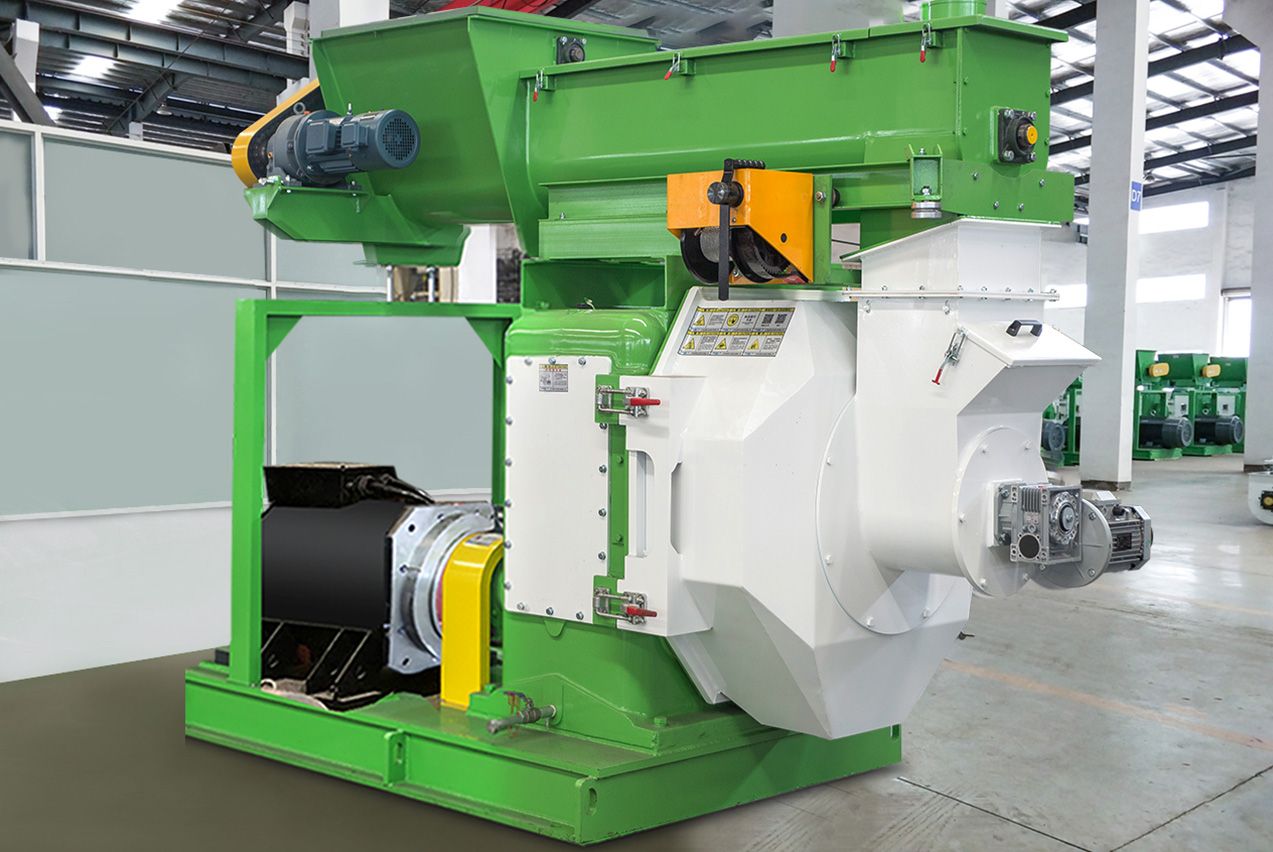
The JWZL-688D vertical biomass pellet mill, rated at 3–3.5 t/h, illustrates how a properly specified machine with matched upstream drying and size-reduction equipment can sustain output at nameplate capacity. See the full specification for die configuration and motor sizing details.
Operational Upgrades: Automation, Data, and Operator Capability
Modern pellet mills designed for industrial-scale production incorporate control features that fundamentally change the maintenance burden compared to older mechanical designs.
Real-time monitoring systems log main motor current, die temperature, pellet discharge rate, and vibration signatures continuously. This data enables two practical advantages: immediate anomaly detection during a shift, and historical trend analysis to predict component replacement intervals. A bearing showing a gradual increase in vibration amplitude over three weeks is far less damaging — and far cheaper to address — than one that fails during a production run.
Automation of feedstock flow — including variable-speed screw conveyors feeding the pellet mill — prevents surge loading that accelerates die and roller wear. Consistent, controlled feed rate is one of the most effective ways to extend ring die service life.
Operator training has a direct, measurable impact on equipment performance. Operators who can read motor load curves, recognize abnormal sound signatures, and correctly adjust the die gap for different feedstock densities prevent the majority of avoidable damage events. Structured training tied to specific machine models — not generic pellet mill theory — yields the fastest competency gains.
Waste and byproduct management within the production line also affects overall plant efficiency. Dust extraction systems, fines return circuits, and proper pellet cooler operation using counter-flow cooler technology all contribute to consistent product quality and a cleaner operating environment that supports better maintenance visibility.
Selecting the Right Equipment Configuration
Maintenance optimization begins at the equipment selection stage. A machine undersized for the feedstock abrasiveness, or a production line without integrated dust control, will generate higher maintenance costs regardless of how well the maintenance program is executed.
Kingwood’s Three-Standardization Framework — covering integrated, dust-free, and automated production lines — directly addresses this. A dust-free, enclosed production line reduces housekeeping burden, improves air quality for maintenance personnel, and prevents fine particle accumulation in drive components. The Guizhou dust-free biomass pellet mill project (2024) demonstrates the practical application of this design philosophy at an operational plant.
For operations targeting annual output in the range of tens of thousands of metric tons, a complete engineered production line — integrating crushing, drying, fine grinding, pelletizing, cooling, and packaging in a single automated sequence — provides better total cost of ownership than assembling disparate equipment from multiple vendors.
Contact Kingwood to discuss pellet mill specifications, production line design, or maintenance program support for your biomass fuel operation.
FAQ
What is the most critical maintenance task for a wood pelletizer?
Regular inspection and cleaning of the ring die, rollers, and bearings is the highest-priority maintenance task. Worn or contaminated dies and rollers cause uneven pellet density, increased energy consumption, and accelerated equipment degradation.
How does die-roller alignment affect pellet mill performance?
Misalignment between the die and rollers creates uneven surface contact, causing localized wear, inconsistent pellet geometry, and elevated power draw. Periodic alignment checks — ideally after every major feedstock change or scheduled shutdown — keep output consistent and extend component life.
What moisture content should biomass feedstock be before pelletizing?
For stable pellet formation, feedstock moisture should generally be below 15% at the pelletizing stage. Kingwood's wet-feed production lines integrate drum dryers upstream of the pellet mill to bring high-moisture biomass to the required specification before it enters the die.
How does automated lubrication improve pelletizer uptime?
Automatic lubrication systems deliver precisely metered grease to bearings and roller assemblies at set intervals, eliminating manual error, preventing dry-running events, and reducing bearing replacement frequency. This is a standard feature consideration when specifying modern industrial pellet mills.
What production capacity can a single Kingwood pellet mill deliver?
Kingwood's vertical pellet mill range spans 1 t/h (JWZL-420) up to 4–5 t/h (JWZL-928), while the horizontal JZWH-860 also delivers 4–5 t/h. Complete integrated production lines can be engineered up to 200,000 metric tons per year of biomass pellet output.
Why is operator training critical to pelletizer performance?
Operators who understand die gap adjustment, temperature set points, and early fault indicators resolve issues before they escalate into unplanned downtime. Structured training programs directly reduce mean time to repair and improve overall equipment effectiveness (OEE).
How does real-time data monitoring support pellet production optimization?
Continuous monitoring of parameters such as main motor current draw, die temperature, and pellet discharge rate enables production teams to detect deviations early, correlate settings with output quality, and build predictive maintenance schedules based on actual operating data rather than fixed time intervals.
- Biomass pellets produced under optimized moisture and temperature conditions can achieve a calorific value of 4,800 kcal/kg while keeping sulfur content below 0.3% — meeting or exceeding EU, US, Japan, and ISO quality benchmarks. (2025, Kingwood product specification data, verified against GB13271-2001 (China National Emission Standard of Air Pollutants for Boilers))
- A 12 t/h Kingwood wood pellet production line installed in Vietnam in 2024 achieved full capital payback within 23 months of commissioning. (2024, Kingwood verified project case: vietnam-wood-pellet-line-12-tph-kingwood-payback)