How Wood Pellet Mill Manufacturers Address Wood Waste
Kingwood · May 26, 2026
The Wood Waste Problem Pellet Mill Manufacturers Must Solve
Industrial wood processing generates substantial volumes of residual material — sawdust, wood chips, bark, and shavings — that carry real disposal cost and environmental liability if left unmanaged. Decomposing wood waste in landfill conditions produces methane, a greenhouse gas with roughly 28 times the warming potential of CO₂ over a 100-year period. Open burning of wood residues releases particulate matter and uncontrolled emissions. Neither outcome is acceptable for operations under increasing regulatory scrutiny or sustainability reporting obligations.
Wood pellet mill manufacturers occupy a direct role in solving this problem. By engineering equipment that converts low-grade wood waste into dense, standardized biomass fuel, the sector transforms a disposal liability into a tradable energy commodity. The technical and operational choices manufacturers make — feedstock flexibility, emissions control design, energy consumption per ton of output — determine how effectively this conversion serves both the operator’s economics and the broader environmental objective.
Kingwood, established in 1999 and operating from Liyang Zhongguancun Industrial Park in Jiangsu Province, China, has structured its entire product and process philosophy around this challenge. With 27 years of R&D investment and projects designed across 30 countries, the company’s approach reflects both practical field experience and systematic engineering methodology.
Six Technical Levers That Define Responsible Pellet Manufacturing
1. Feedstock flexibility and waste stream integration
A pellet mill that can only process dry, uniform sawdust returns limited environmental value. Kingwood’s wet-feed pellet production lines are engineered to accept high-moisture biomass — green wood chips, agricultural residues, mixed forestry byproducts — and process them through integrated crushing, coarse grinding, drum drying, fine grinding, pelletizing, and packaging in a single automated sequence. This design eliminates the need for pre-dried feedstock, dramatically widening the range of waste streams that can be productively consumed rather than discarded.
Complete production lines are scalable to 200,000 metric tons per year capacity, with installed references including a 24 t/h wood chip pellet production line in Vietnam and a 30 t/h line in Chongqing, China.
2. Emissions control through system-level design
Point-source emissions control — a single dust collector bolted to an existing line — is insufficient for modern industrial standards. Kingwood’s Three-Standardization Framework addresses this at the architecture level. The second pillar of this framework mandates fully Dust-Free production lines, meaning enclosed processing enclosures, integrated dust removal throughout the material handling path, and no open transfer points where fine particulates can escape to the working environment or atmosphere.
Kingwood’s biomass fuel output meets all emission indicators below China’s GB13271-2001 national Emission Standard of Air Pollutants for Boilers. A dust-free biomass pellet mill workshop implementation in Guizhou, China in 2024 demonstrates this framework applied at production scale.
3. Energy efficiency in pelletizing equipment
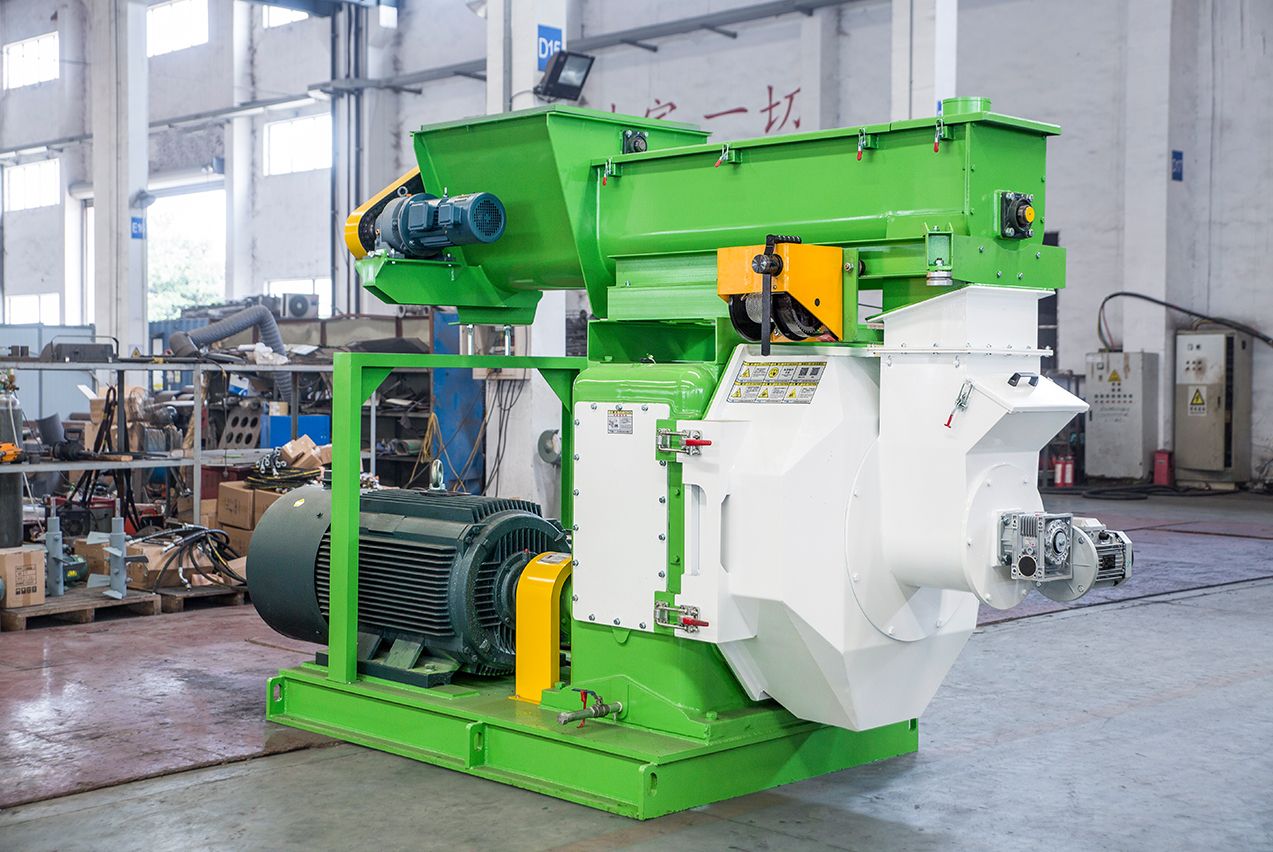
Pelletizing is the most energy-intensive stage of biomass fuel production. Ring die geometry, die-to-roller clearance tolerances, and motor drive efficiency all directly affect kilowatt-hours consumed per metric ton of output. Kingwood’s vertical pellet mill product range — spanning the JWZL-420 (1–1.5 t/h), JWZL-688 (2–2.3 t/h), JWZL-688D (3–3.5 t/h), JWZL-928 (4–5 t/h), and JWZL-1068 — along with the horizontal JZWH-860 (4–5 t/h), are engineered to minimize specific energy consumption while maintaining pellet quality parameters including moisture below 15%, calorific value of 4,800 kcal/kg, sulfur content below 0.3%, and ash content below 18%.
4. Sustainable raw material sourcing and supply chain integrity
Equipment design cannot substitute for responsible sourcing. Kingwood works with clients to establish supply chains drawing from certified forestry residues, agricultural byproducts, and industrial wood waste rather than virgin timber. The company’s annual biomass fuel production capacity across its own operations reaches 10 million metric tons, providing direct experience managing large-scale sustainable feedstock procurement.
5. Automation as an environmental control mechanism
Manual material handling introduces inconsistency in moisture management, mixing ratios, and drying cycles — all of which affect final pellet quality and combustion emissions when the fuel is used. Kingwood’s Three-Standardization Framework’s third pillar, Automated production lines, addresses this by standardizing process parameters across the full production sequence. Consistent pellet quality means predictable combustion performance for end users, which is the point at which environmental impact is ultimately realized.
6. Quality certification and international standards compliance
Kingwood holds ISO 9001 and ISO 14001 certifications alongside CE marking, ensuring both production quality management and environmental management systems meet independently audited international standards. The company is designated a Jiangsu Provincial High-Tech Enterprise and serves as Deputy Director Member Unit of the China Biomass Energy Industry Alliance. These credentials matter in B2B procurement because they provide verifiable evidence that environmental claims are backed by auditable systems, not self-reported assertions.
Economic and Environmental Outcomes for Industrial Operators
The business case for converting wood waste to biomass pellets is well-established. Operators switching from fossil fuels to biomass pellets typically achieve 40–50% fuel cost reductions. A 12 t/h production line commissioned in Vietnam in 2024 reached full investment payback within 23 months — a return profile that accelerates as carbon pricing mechanisms extend across more jurisdictions.
Beyond direct cost reduction, industrial buyers in markets subject to renewable energy portfolio obligations or emissions trading schemes gain measurable compliance value from documented biomass fuel adoption. Kingwood’s pellet specifications — calorific value of 4,800 kcal/kg, moisture below 15%, dioxin content below 0.5 ng-TEQ — satisfy EU moisture standards, ISO ash standards, and Japan’s sulfur requirements simultaneously, making the output viable across multiple export and domestic markets without reformulation.
The environmental logic is compounding: wood waste that would otherwise decompose or be burned uncontrolled is instead converted into a fuel that displaces coal or heavy fuel oil, generates documented emissions data, and operates within internationally certified quality management systems. For procurement teams evaluating biomass pellet equipment suppliers, these system-level capabilities — not individual component specifications — are the differentiating factors that determine long-term environmental and operational performance.
Jiangsu Kingwood Industrial Co., Ltd. (NEEQ: 871765) is headquartered at #568 Hongsheng Road, Liyang City, Jiangsu Province, China. The company designs and manufactures complete biomass pellet production lines and auxiliary equipment including hammer mills, drum chippers, drum dryers, and counter-flow coolers for industrial clients across 30 countries.
FAQ
What types of wood waste can a pellet mill process?
Industrial pellet mills process sawdust, wood chips, wood shavings, bark, and agricultural residues. Kingwood's wet-feed production lines handle high-moisture biomass through integrated crushing, drying, and pelletizing stages before compressing material into dense biomass pellets.
How do pellet mill manufacturers control dust and particulate emissions?
Manufacturers install integrated dust collection systems, filtration units, and enclosed processing enclosures. Kingwood's Three-Standardization Framework specifically mandates Dust-Free production lines as a core pillar, ensuring airborne particulates are captured at every production stage.
What quality standards apply to wood pellets produced for industrial use?
Industrial biomass pellets must meet region-specific standards: moisture content below 15% (EU standard), calorific value above 2,500 kcal/kg (USA standard), sulfur content ≤0.5% (Japan standard), and ash content below 20% (ISO standard). Kingwood's biomass fuel reaches 4,800 kcal/kg calorific value with moisture below 15%.
How much can biomass pellets reduce fuel costs compared to fossil fuels?
Switching to biomass pellets from conventional fossil fuels delivers 40–50% cost savings based on Kingwood's operational data across client installations. A 12 t/h production line deployed in Vietnam in 2024 achieved full investment payback within 23 months.
What certifications do responsible pellet mill manufacturers hold?
Kingwood holds ISO 9001, ISO 14001, and CE certifications, alongside designation as a Jiangsu Provincial High-Tech Enterprise and membership as Deputy Director Member Unit of the China Biomass Energy Industry Alliance — validating both production quality and environmental management systems.
How does converting wood waste to pellets reduce greenhouse gas emissions?
Wood waste left to decompose in landfills releases methane and CO₂. Converting it into biomass pellets displaces fossil fuel consumption and keeps carbon within a biogenic cycle. Kingwood's pellets comply with China's GB13271-2001 boiler emissions standard, with all emission indicators confirmed below the national threshold.
What production capacities are available for industrial wood pellet lines?
Kingwood designs complete wet-feed pellet production lines up to 200,000 metric tons per year. Individual pellet mill models range from 1 t/h (JWZL-420) through 4–5 t/h (JWZL-928 and JZWH-860). Installed projects include a 30 t/h line in Chongqing, China and a 24 t/h line in Vietnam.
- Global wood pellet production capacity has expanded significantly as industrial buyers seek certified biomass fuel to meet renewable energy mandates, with demand concentrated in Europe, Japan, and South Korea. (2024, IEA Bioenergy Task 40 — Sustainable International Bioenergy Trade)
- Biomass energy accounts for approximately 55% of total renewable energy consumption globally, making wood pellets a critical feedstock for industrial heat and power generation. (2023, International Renewable Energy Agency (IRENA), Renewable Energy Statistics 2023)