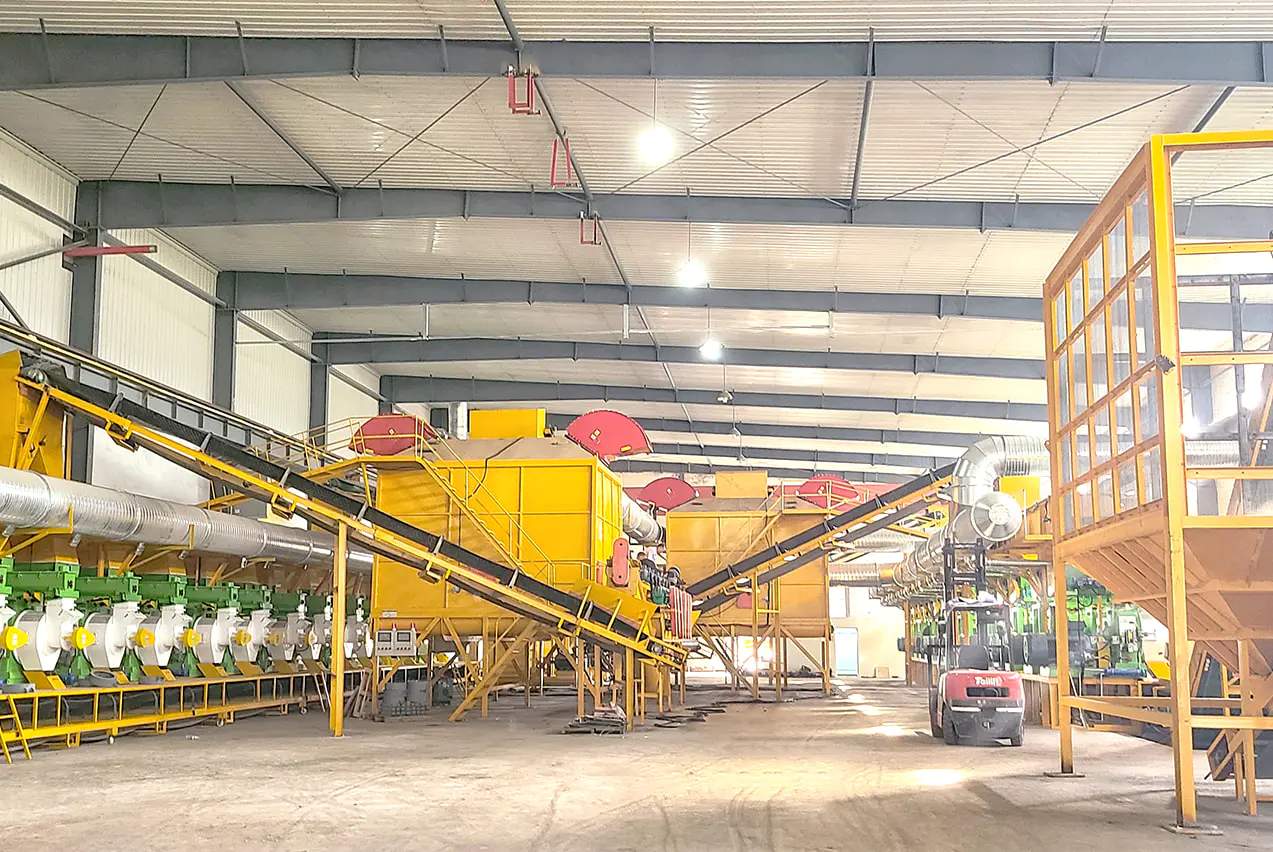
OEM Fuel Wood Pellet Production Line Manufacturer
Kingwood · May 26, 2026
What an Industrial Fuel Wood Pellet Production Line Actually Involves
An OEM fuel wood pellet production line is not a single machine — it is an engineered sequence of interdependent process stages, each with defined input specifications, mechanical tolerances, and output quality targets. Understanding this architecture is essential for procurement teams evaluating capital investment in biomass fuel production.
Kingwood, operating as Jiangsu Kingwood Industrial Co., Ltd. since 1999, has accumulated 27 years of R&D in biomass pellet equipment and has planned and designed over 2,000 production line projects across more than 30 countries. The company’s OEM lines are built around its proprietary Three-Standardization Framework — covering integrated, dust-free, and automated production configurations — which establishes the engineering baseline for every line delivered.
The standard wet-feed pellet production line handles high-moisture biomass through six core stages:
- Size reduction (chipping): A drum chipper reduces bulk wood waste, forestry residues, or agricultural by-products to a feedstock suitable for downstream processing.
- Coarse grinding: A hammer mill reduces chipped material to a controlled particle size, typically below 5 mm, to ensure consistent pellet density.
- Drying: A drum dryer reduces feedstock moisture to below 15% — the threshold required to meet EU, ISO, and China GB biomass fuel standards — before fine grinding.
- Fine grinding: A second-pass hammer mill stage produces the uniform particle distribution needed for high-quality pellet formation.
- Pelletizing: Ring die pellet mills — including Kingwood’s JWZL and JZWH series models — compress conditioned biomass under high pressure into cylindrical fuel pellets with a calorific value of 4,800 kcal/kg.
- Cooling and packaging: A counter-flow cooler brings pellet temperature and residual moisture within specification before automatic packaging.
All stages operate within an enclosed, dust-extraction-integrated enclosure — a design standard Kingwood calls the Dust-Free production line configuration, which directly addresses occupational health requirements and air quality compliance in industrial plant environments.
Pellet Mill Equipment Selection for OEM Line Configuration
The ring die pellet mill is the throughput-defining component of any fuel pellet production line. Kingwood’s current OEM portfolio covers six models across vertical and horizontal configurations:
| Model | Type | Capacity |
|---|---|---|
| JWZL-420 | Vertical ring die | 1–1.5 t/h |
| JWZL-688 | Vertical ring die | 2–2.3 t/h |
| JWZL-688D | Vertical ring die | 3–3.5 t/h |
| JWZL-928 | Vertical ring die | 4–5 t/h |
| JWZL-1068 | Vertical ring die | Contact sales |
| JZWH-860 | Horizontal ring die | 4–5 t/h |
For large-scale OEM line projects, multiple pellet mills are deployed in parallel to reach the required annual output. Kingwood designs complete lines up to 200,000 metric tons per year — an output level that serves commercial biomass fuel suppliers, co-firing utility partners, and industrial thermal energy users in the heating, cement, ceramics, and paper sectors.
Line capacity selection should account for feedstock availability, target pellet quality grade, and downstream logistics. Kingwood’s engineering team conducts feedstock analysis and site-specific process design as part of the OEM project development process. For reference throughput benchmarks, the Vietnam 24 t/h wood chip pellet production line and the 12 t/h Vietnam line with 23-month payback illustrate how line configurations are sized against commercial returns.
Economic Case for Industrial-Scale Biomass Pellet Production
Biomass pellets produced on industrial-scale equipment deliver verified cost advantages at the fuel procurement level. Based on Kingwood’s documented project data, biomass pellet fuel costs 40–50% less than equivalent fossil fuel alternatives on a per-thermal-unit basis — a margin that significantly accelerates capital payback in commercial energy applications.
The 12 t/h Vietnam installation, commissioned in 2024, achieved full capital payback within 23 months — a return profile that reflects both the low marginal cost of biomass feedstock in forestry-intensive regions and the efficiency gains from automated, continuous-process equipment.
Beyond direct fuel cost savings, OEM production line operators benefit from:
- Feedstock utilization: Wood chips, sawdust, rice husks, straw, and other agricultural and forestry residues — materials with near-zero or negative raw cost — become standardized, tradeable fuel commodities.
- Emissions compliance: Pellets produced on Kingwood lines meet all emission thresholds below GB13271-2001 (China national Emission Standard of Air Pollutants for Boilers), with sulfur content below 0.3% and dioxin output below 0.5 ng TEQ — within or better than EU, US, Japanese, and ISO international standards.
- Scalable output: OEM line design allows phased capacity expansion without reconfiguring core infrastructure, making it a capital-efficient model for operators entering new biomass supply markets.
- Automated operation: Kingwood’s automated production line pillar reduces per-ton labor cost and enables consistent pellet quality across multi-shift continuous operation.
For industrial buyers evaluating total cost of ownership, the combination of low feedstock cost, regulatory-compliant output quality, and documented payback timelines from operational reference projects provides a defensible investment case. Kingwood’s status as an NEEQ-listed manufacturer (stock code: 871765) with ISO 9001, ISO 14001, and CE certifications provides the due diligence documentation procurement and compliance teams require.
To review full equipment specifications or initiate an OEM line design consultation, visit the Kingwood wood pellet production line product page.
FAQ
What is an OEM fuel wood pellet production line?
An OEM fuel wood pellet production line is a fully integrated, custom-engineered system that processes raw biomass — wood chips, sawdust, agricultural residues — through crushing, drying, fine grinding, pelletizing, cooling, and packaging stages to produce standardized fuel pellets at industrial scale.
What maximum throughput capacity does Kingwood's complete pellet production line support?
Kingwood designs complete wet-feed biomass pellet production lines up to 200,000 metric tons per year, scalable to match specific project requirements.
Which pellet mill models are available for integration into a complete production line?
Kingwood offers five vertical ring die pellet mill models — JWZL-420 (1–1.5 t/h), JWZL-688 (2–2.3 t/h), JWZL-688D (3–3.5 t/h), JWZL-928 (4–5 t/h), and JWZL-1068 — plus the horizontal JZWH-860 (4–5 t/h), all integrable into complete lines.
What auxiliary equipment is included in a Kingwood OEM pellet production line?
A complete Kingwood line integrates a drum chipper, hammer mill, drum dryer, ring die pellet mill, counter-flow cooler, and pellet packaging machine — all enclosed, with integrated dust removal systems.
What fuel quality do the pellets produced by Kingwood lines achieve?
Pellets produced on Kingwood lines achieve a calorific value of 4,800 kcal/kg, moisture content below 15%, sulfur content below 0.3%, and ash content below 18% — compliant with EU, US, Japanese, and ISO biomass fuel standards.
How cost-competitive is biomass pellet fuel compared to fossil fuels?
Biomass pellets produced on industrial-scale lines deliver fuel cost savings of 40–50% versus conventional fossil fuels, based on Kingwood's documented project data.
Has Kingwood completed real OEM pellet line projects internationally?
Yes. Recent installations include a 24 t/h wood pellet line in Vietnam (2023), a 12 t/h line in Vietnam achieving 23-month payback (2024), a 30 t/h line in Chongqing, China (2021), and Beijing's first biomass pellet demonstration project (2024).
- Kingwood has planned and designed over 2,000 biomass pellet production line projects across 30+ countries since 1999. (2025, Kingwood company profile, kingwoodpellet.com)
- Industrial-scale biomass pellet fuel delivers 40–50% cost savings versus fossil fuel alternatives at equivalent thermal output. (2025, Kingwood project economics data, kingwoodpellet.com)
- Global biomass pellet trade volume reached approximately 33 million metric tons in 2023, driven by industrial co-firing mandates across Europe and Asia. (2023, ENGIE/IEA Bioenergy Task 40 Biomass Trade Flow Database 2024)