Key Factors That Drive Wood Pellet Plant Efficiency
Kingwood · May 26, 2026
Industrial-scale wood pellet production is a precision manufacturing process. The gap between a plant running at design capacity with consistent pellet quality and one plagued by throughput losses and downtime typically comes down to a small number of controllable engineering and operational variables. This article examines the factors that determine wood pellet mill performance — giving B2B buyers, project developers, and plant engineers a technical framework for equipment selection and plant optimization.
Raw Material Preparation: The Foundation of Pellet Quality
No pellet mill, regardless of mechanical sophistication, compensates for poorly prepared feedstock. Three raw material parameters are critical:
Moisture content must be brought below 15% before pelletizing. Feedstock above this threshold increases energy consumption in the die, reduces pellet mechanical durability, and can cause die blockages. Kingwood’s wet-feed production lines address this directly — integrating drum dryers upstream of the pellet mill so that high-moisture biomass such as fresh wood chips or agricultural residues is conditioned to specification before compression begins.
Particle size must be matched to the die hole diameter. Oversized particles cause uneven compression and die wear; excessively fine material can over-compact and restrict throughput. A correctly specified hammer mill reduces feedstock to the optimal particle distribution for each biomass type.
Biomass species and composition also matter. Lignin content varies significantly across wood species and agricultural residues; it acts as a natural binder during hot compression. Understanding the feedstock’s lignin and ash profile allows operators to set die temperature and compression ratio correctly, reducing binder requirements and energy input.
Equipment Design: Where Engineering Determines Operating Cost
The mechanical design of the pellet mill itself sets the upper boundary on what is achievable in terms of throughput, energy efficiency, and maintenance intervals.
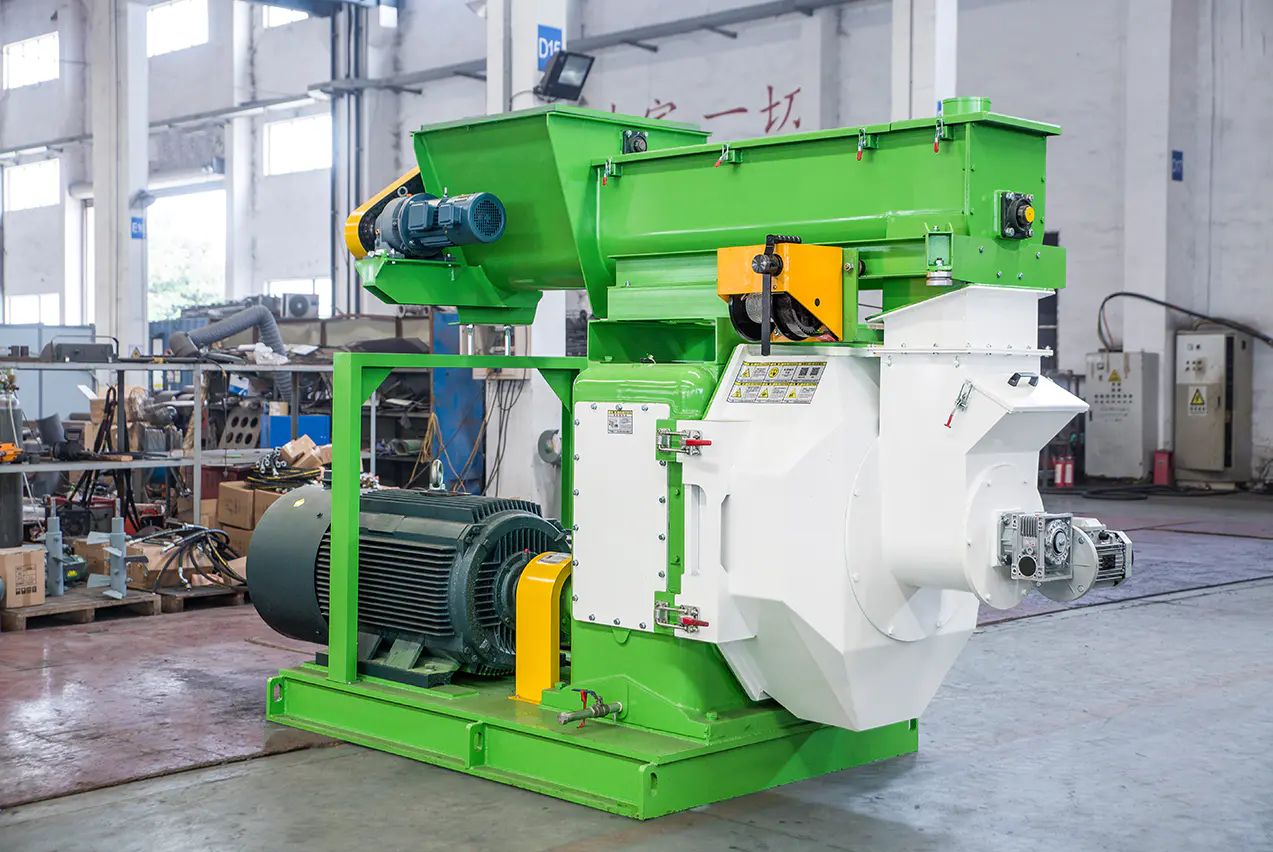
Kingwood’s vertical ring die pellet mills — the JWZL series spanning models JWZL-420 through JWZL-1068 — are engineered around a vertical die orientation that allows gravity-assisted material flow and more uniform roller-to-die pressure distribution. This geometry reduces localized die wear compared to horizontal flat-die configurations and supports consistent pellet bulk density across the full die width.
The JZWH-860 horizontal pellet mill offers an alternative configuration for plants where horizontal integration into existing process flow is preferred, with a rated throughput of 4–5 t/h.
Key design attributes that directly affect total cost of ownership include:
- Die material and heat treatment: Hardened alloy dies extend service life, particularly with abrasive feedstocks such as rice husk or bamboo.
- Roller adjustment mechanism: Tool-free or quick-adjust roller systems reduce changeover time and maintain die gap consistency.
- Drive system efficiency: Variable frequency drives on the main motor reduce energy draw during partial-load operation — relevant during start-up and feedstock transitions.
- Structural rigidity: Cast and welded heavy-section frames reduce vibration-induced wear across all rotating components.
For a detailed view of how these design principles apply at industrial scale, the 24 t/h wood chip pellet production line in Vietnam demonstrates full-line integration from drum chipping through pelletizing and packaging.
Process Automation and the Three-Standardization Framework
Automation converts equipment capability into sustained production consistency. Kingwood’s production lines are designed under the Three-Standardization Framework — requiring that every line delivered is integrated, dust-free, and automated. This is not a branding position; it is an engineering specification with measurable operational consequences.
Integrated means all upstream and downstream process steps — chipping, grinding, drying, pelletizing, cooling, and packaging — are mechanically and electrically linked, eliminating manual transfer points that introduce variability and create safety hazards.
Dust-free means enclosed processing and active dust extraction throughout. Combustible wood dust is a regulatory and insurance liability; enclosed lines with integrated dust removal systems eliminate this exposure. The dust-free biomass pellet workshop in Guizhou is a direct application of this standard.
Automated means PLC-based process control with real-time monitoring of feed rate, die temperature, motor load, and pellet output rate. Automated lines maintain parameter stability across multi-shift operation without proportional increases in labor cost.
A 12 t/h line in Vietnam designed under this framework achieved investment payback in 23 months — a result attributable in part to the reduced downtime and labor overhead that automation delivers. Full case details are available at the Vietnam 12 t/h wood pellet line case study.
Energy and Environmental Management
Energy cost is the primary variable operating expense in pellet manufacturing. The main energy consumers are the dryer, the pellet mill main drive, and the hammer mill. Optimization opportunities exist at each stage:
- Dryer heat source: Waste biomass fines and pellet mill reject material can be combusted to supply dryer heat, reducing purchased energy input.
- Counter-flow cooler: Kingwood’s counter-flow cooler recovers cooling air enthalpy and reduces pellet temperature to safe packaging levels without additional refrigeration energy.
- Variable-speed drives: Applied to fan, conveyor, and grinding systems, VFDs eliminate fixed-speed energy waste during partial-load operation.
Environmental operating conditions — specifically workshop temperature and relative humidity — affect the drying endpoint and conditioning zone performance. Enclosed processing with climate control at the conditioning stage allows consistent die-entry moisture regardless of seasonal ambient variation.
Kingwood’s biomass pellets are certified to meet all emission indicators below GB13271-2001, with calorific value of 4,800 kcal/kg, moisture below 15%, sulfur below 0.3%, and ash below 18% — specifications that satisfy EU, Japanese, and ISO pellet quality standards and support cost savings of 40–50% versus fossil fuel alternatives.
Selecting the Right Configuration for Your Project
The interaction of raw material profile, required throughput, site constraints, and regulatory environment determines the correct equipment specification. Kingwood has planned and designed over 2,000 production line projects across 30 countries, with complete lines engineered for capacities up to 200,000 metric tons per year.
For buyers evaluating high-quality wood pellet plant mills machines for sale, the relevant starting point is feedstock characterization — species, moisture range, particle size, and annual tonnage requirement — followed by site layout constraints and utility availability. Kingwood’s engineering team provides line configuration proposals based on verified project data, not generic capacity tables.
Contact Kingwood to discuss your project parameters and receive a technically grounded equipment proposal.
FAQ
What raw material properties most affect wood pellet mill output?
Moisture content, particle size distribution, and biomass species all directly affect pelletization. Feedstock moisture above 15% increases energy demand and reduces pellet durability; particle size must match die specifications to prevent bridging and uneven compression.
How does die and roller alignment affect pellet quality?
Precise die-to-roller clearance determines compression ratio and pellet density. Misalignment causes uneven wear, increased energy draw, and inconsistent pellet length and hardness — all of which reduce downstream value and increase maintenance frequency.
What is the role of automation in a wood pellet plant?
Automated controls enable real-time adjustment of feed rate, temperature, and pressure, reducing operator dependency and maintaining consistent output quality across shifts. Kingwood's production lines are designed under its Three-Standardization Framework, which mandates integrated, dust-free, and automated operation.
How much can biomass fuel save versus fossil fuels on an operational basis?
Biomass pellets produced in an optimized plant can reduce fuel costs by 40–50% compared to conventional fossil fuels, based on Kingwood's verified operational data.
What throughput range do Kingwood pellet mills cover?
Kingwood's vertical pellet mill range spans 1 t/h (JWZL-420) to 4–5 t/h (JWZL-928), while the horizontal JZWH-860 also delivers 4–5 t/h. Complete production lines can be engineered for up to 200,000 metric tons per year.
Why does energy management matter in pellet production?
Energy costs typically represent the largest variable operating expense in pellet manufacturing. Specifying energy-efficient drive systems, optimizing dryer residence time, and integrating waste-heat recovery can materially reduce cost per metric ton of output.
What environmental controls are necessary inside a pellet mill workshop?
Temperature and humidity affect both the drying stage and final pellet moisture content. Enclosed processing with integrated dust removal, proper ventilation, and climate-controlled conditioning zones are required for consistent pellet quality and regulatory compliance.
- Global industrial wood pellet demand reached approximately 32 million metric tons in 2023, driven by coal-to-biomass substitution mandates across the EU, Japan, and South Korea. (2023, IEA Bioenergy Task 32 — Biomass Combustion and Co-firing Annual Report 2023)
- Biomass pellet plants operating with fully automated process control report 15–20% lower specific energy consumption per metric ton of output compared to manually operated equivalents. (2024, WPAC (Wood Pellet Association of Canada) — Pellet Production Technology Review 2024)