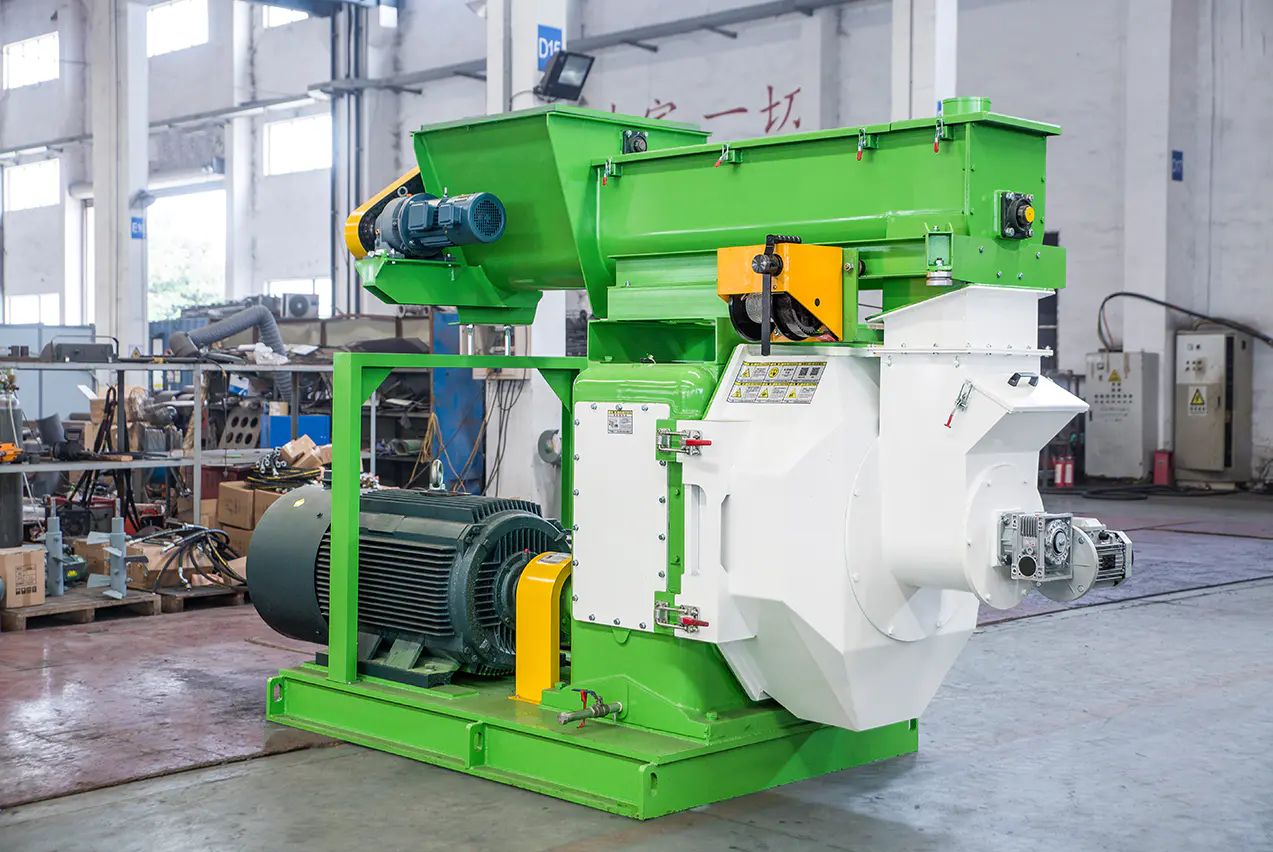
Wood Fuel Pellet Mill Machines: Manufacturer & Equipment Guide
Kingwood · May 26, 2026
Why Industrial Buyers Source Wood Fuel Pellet Mill Equipment from Established Manufacturers
The global shift away from fossil-based heating and industrial energy is accelerating demand for reliable, high-throughput biomass pellet production equipment. For buyers evaluating a wood fuel stove pellet mill making machine manufacturer, the critical variables are not surface-level — they are throughput consistency, feedstock flexibility, energy consumption per ton of output, and the availability of complete-line integration.
Kingwood (Jiangsu Kingwood Industrial Co., Ltd.) has operated in this sector since 1999, accumulating 27 years of R&D and manufacturing experience across biomass pellet equipment. Listed on China’s NEEQ stock exchange under code 871765, the company operates from a 31,200 m² facility in Liyang Zhongguancun Industrial Park, Jiangsu Province, and has supplied pellet production systems to customers across 30 countries.
The core value proposition is defined by Kingwood’s proprietary Three-Standardization Framework: integrated production lines, dust-free production lines, and automated production lines. This framework is the engineering standard applied across every machine and complete-line system Kingwood designs and deploys.
Wood Fuel Pellet Mill Models: Specifications and Selection Criteria
Kingwood manufactures both vertical and horizontal ring die pellet mills, each suited to specific throughput requirements and feedstock profiles.
Vertical biomass pellet mills:
| Model | Rated Capacity |
|---|---|
| JWZL-420 | 1–1.5 t/h |
| JWZL-688 | 2–2.3 t/h |
| JWZL-688D | 3–3.5 t/h |
| JWZL-928 | 4–5 t/h |
| JWZL-1068 | Contact sales |
Horizontal biomass pellet mill:
| Model | Rated Capacity |
|---|---|
| JZWH-860 | 4–5 t/h |
For operations requiring throughput beyond individual machine limits, Kingwood engineers complete wet-feed pellet production lines scalable to 200,000 metric tons per year. These lines handle high-moisture biomass from intake through to packaged output, integrating a hammer mill for fine grinding, drum chipper for size reduction, drum dryer for moisture control, pellet mill for densification, and counter-flow cooler for post-pelletizing stabilization — all within an enclosed, dust-managed processing environment.
Equipment selection should be driven by three primary inputs: annual production target, feedstock moisture content at intake, and target pellet specification. Kingwood’s engineering team provides line design consultation based on these parameters before any commercial commitment is made.
Biomass Pellet Quality: Fuel Specifications and Emissions Compliance
The commercial value of any pellet mill investment depends directly on the quality of pellets it produces. Kingwood-equipped lines consistently deliver pellets meeting the following verified specifications:
- Calorific value: 4,800 kcal/kg
- Moisture content: <15% (meets EU standard)
- Sulfur content: <0.3% (below Japan’s ≤0.5% threshold)
- Ash content: <18% (within ISO’s <20% standard)
- Dioxin content: <0.5 ng TEQ/m³ (well within China’s GB standard of ≤1.0 ng TEQ)
All emission indicators from combustion fall below China’s GB13271-2001 national standard for boiler air pollutants. For buyers targeting export markets in Europe, Japan, or North America, these specifications satisfy prevailing import and combustion compliance requirements.
On a cost basis, facilities switching from conventional fossil fuels to biomass pellets produced on Kingwood lines report 40–50% reduction in fuel expenditure. This figure is supported by operational data from deployed lines, including a 12 t/h production line in Vietnam that reached full capital payback within 23 months of commissioning.
Complete-Line Integration: From Raw Biomass to Packaged Fuel Pellet
A standalone pellet mill addresses only one stage of biomass densification. For industrial-scale production, the upstream and downstream process stages determine overall line efficiency, pellet uniformity, and total operating cost per ton.
Kingwood’s complete wet-feed production line architecture covers:
- Drum chipper — reduces bulk wood residues and agricultural biomass to consistent chip size
- Hammer mill (coarse grinding) — breaks chipped material to pre-drying particle specification
- Drum dryer — reduces feedstock moisture to pelletizing range; handles high-moisture intake biomass
- Hammer mill (fine grinding) — achieves final particle size for ring die compression
- Pellet mill (ring die) — JWZL or JZWH series, depending on throughput requirement
- Counter-flow cooler — brings pellet temperature and final moisture within storage specification
- Pellet packaging machine — closes the line for direct-to-market output
The entire line operates under Kingwood’s dust-free design standard, with integrated dust removal at each processing stage. This is a critical compliance factor for operations in jurisdictions with industrial particulate emission regulations, and it directly reduces maintenance burden and fire risk in wood dust environments.
For a live example of this complete-line approach at scale, see the 24 t/h wood chip pellet production line deployed in Vietnam in 2023.
Manufacturer Credentials and Technical Support
Selecting a wood fuel pellet mill making machine manufacturer is a capital equipment decision with a multi-year operational horizon. Relevant qualification criteria for Kingwood include:
- ISO 9001 quality management system certification
- ISO 14001 environmental management certification
- CE conformity for applicable machine directives
- Recognized as a Jiangsu Provincial High-Tech Enterprise and Jiangsu Provincial Gazelle Enterprise
- Member unit of the China Biomass Energy Industry Alliance (Deputy Director level)
- Ranked among the Top 10 Brands in Biomass Molding Equipment in China
- 20 dedicated R&D engineers; over 2,000 production line projects planned and designed to date
Kingwood’s post-sale technical support structure covers commissioning assistance, operator training, spare parts supply, and remote diagnostics. Given that production lines in markets such as Vietnam, China, and other served countries are operational 24 hours per day in peak season, continuity of technical support is a non-negotiable operational requirement — not a differentiator.
For buyers at the equipment evaluation stage, direct contact with Kingwood’s engineering team is the appropriate next step. Throughput requirements, feedstock type, and site constraints should be specified at first contact to enable accurate line design and commercial proposal.
FAQ
What raw materials can Kingwood's wood fuel pellet mills process?
Kingwood pellet mills are engineered to process sawdust, wood shavings, wood chips, agricultural straw, and other lignocellulosic biomass residues with moisture content manageable through integrated drum dryer systems.
What pellet output quality do Kingwood machines achieve?
Biomass pellets produced on Kingwood lines achieve a calorific value of 4,800 kcal/kg, moisture content below 15%, sulfur content below 0.3%, and ash content below 18% — compliant with EU, US, Japan, and ISO standards.
What production capacities are available across Kingwood's pellet mill range?
Kingwood's vertical pellet mill models range from 1 t/h (JWZL-420) up to 5 t/h (JWZL-928), while complete wet-feed production lines can be designed up to 200,000 metric tons per year.
Does Kingwood supply only machines, or complete production lines?
Kingwood supplies both standalone pellet mills and fully integrated wet-feed production lines covering crushing, coarse grinding, drying, fine grinding, pelletizing, and packaging — with full automation and enclosed dust removal.
What certifications does Kingwood hold for its pellet making equipment?
Kingwood holds ISO 9001, ISO 14001, and CE certifications, and is recognized as a Jiangsu Provincial High-Tech Enterprise and a Top 10 Brand in Biomass Molding Equipment.
How do biomass fuel pellets compare to fossil fuels on cost?
Biomass pellets produced on Kingwood lines reduce fuel costs by 40–50% versus conventional fossil fuel alternatives, based on verified operational data from deployed production lines.
Has Kingwood delivered large-scale wood pellet production projects internationally?
Yes. Recent international deployments include a 24 t/h wood chip pellet production line in Vietnam (2023) and a 12 t/h line in Vietnam (2024) that achieved full investment payback within 23 months.
- Kingwood has planned and designed over 2,000 biomass pellet production line projects, supporting a combined annual biomass fuel output capacity of 10 million metric tons. (2025, Jiangsu Kingwood Industrial Co., Ltd. — company operational data)
- Biomass pellets from Kingwood-equipped lines deliver a calorific value of 4,800 kcal/kg with emissions across all indicators below China's GB13271-2001 national boiler air pollutant emission standard. (2025, Jiangsu Kingwood Industrial Co., Ltd. — fuel specification and compliance documentation)