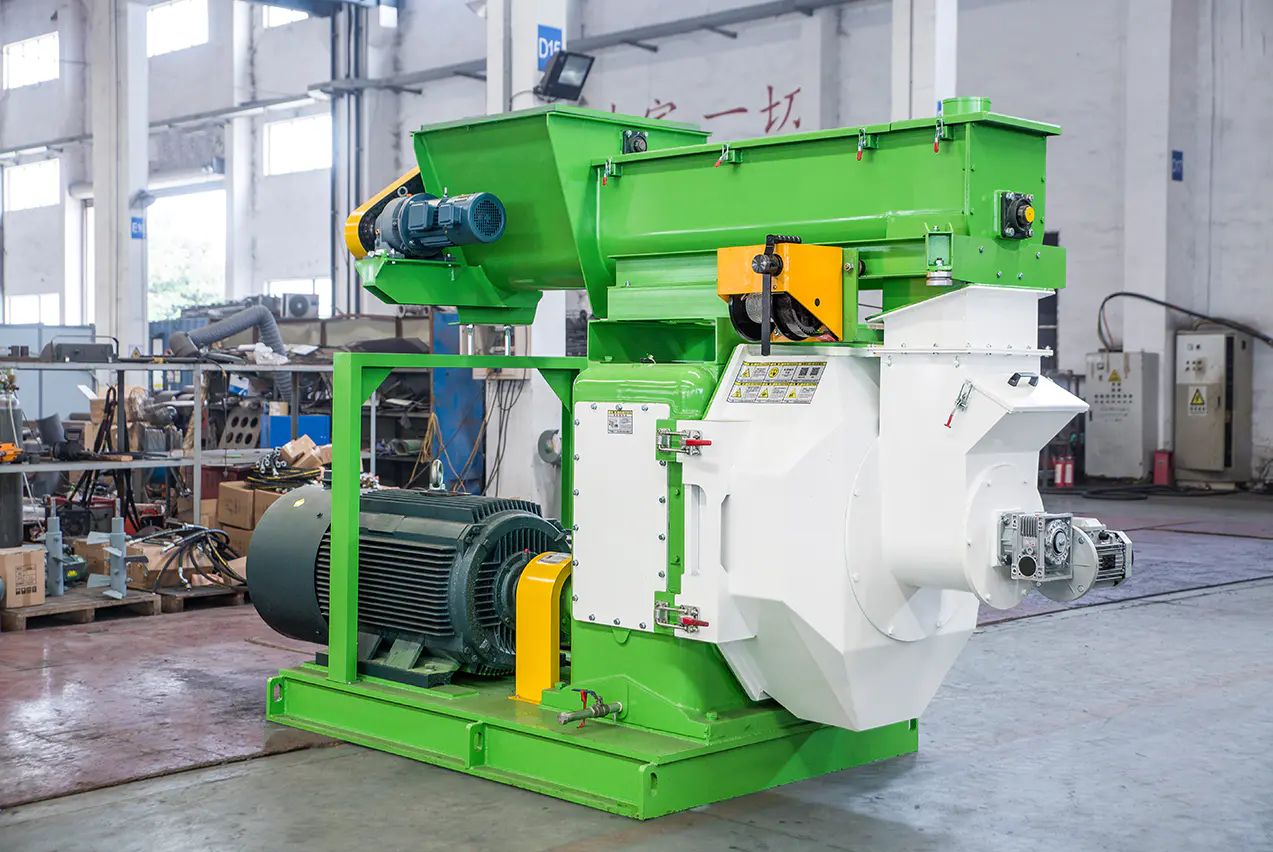
Straw & Agro Biomass Briquette Machines: Industrial Guide
Kingwood · May 26, 2026
Agricultural residues—wheat straw, rice straw, corn stalks, sugarcane bagasse—accumulate in enormous volumes each harvest cycle. For industrial operators and energy producers, this feedstock represents a cost-effective, low-carbon fuel source provided the right densification equipment is in place. Kingwood, established in 1999 and publicly listed on NEEQ (stock code: 871765), engineers complete biomass briquette and pellet production systems that convert loose agricultural waste into specification-grade solid fuel for power generation, industrial heating, and kiln applications.
Why Straw and Agro Biomass Require Purpose-Built Equipment
Raw agricultural residues present processing challenges that standard equipment cannot reliably address: high initial moisture content (often 30–55%), fibrous and abrasive material properties, and wide variation in bulk density between crop types. A machine optimized for dry wood sawdust will underperform or fail prematurely when fed with wet rice straw or corn stover.
Kingwood’s wet-feed biomass production line is engineered specifically for these conditions. The process sequence runs as follows:
- Drum chipping — oversized stalks and cobs are reduced to a manageable chip size by the drum chipper
- Coarse grinding — the hammer mill breaks material down to a workable particle distribution
- Drum drying — a rotary drum dryer reduces feedstock moisture to the target range below 15%
- Fine grinding — a second hammer mill pass achieves the particle fineness required for dense briquette or pellet formation
- Densification — ring die pellet mills or briquette presses compress the conditioned material under high pressure
- Cooling and packaging — the counter-flow cooler brings product temperature and residual moisture to storage-safe levels before automated packaging
The entire line operates within an enclosed, dust-controlled enclosure with integrated dust removal systems—a direct application of Kingwood’s Dust-Free production line standard, one of three pillars in the company’s Three-Standardization Framework alongside Integrated and Automated line configurations.
Technical Performance and Fuel Quality
Biomass briquettes and pellets produced on Kingwood lines meet the following verified fuel specifications:
| Parameter | Kingwood Output | Reference Standard |
|---|---|---|
| Calorific value | 4,800 kcal/kg | Exceeds US standard (>2,500 kcal/kg) |
| Moisture content | <15% | EU & ISO standard |
| Sulfur content | <0.3% | Within Japan standard (≤0.5%) |
| Ash content | <18% | Below ISO limit (<20%) |
| Dioxin content | <0.5 ng TEQ | Below China GB limit (≤1.0 ng TEQ) |
All combustion emission indicators comply with GB13271-2001, China’s national air pollutant emission standard for boilers. For industrial buyers procuring fuel or equipment for regulated boiler applications, this compliance record is a material procurement consideration.
Fuel cost benchmarking from Kingwood project data shows operators replacing coal or heavy fuel oil with biomass briquettes or pellets typically reduce fuel expenditure by 40–50%.
Equipment Models and Line Capacities
Kingwood’s pellet mill range spans five vertical-axis models and one horizontal configuration:
- JWZL-420: 1–1.5 t/h — suitable for small-scale farm or cooperative installations
- JWZL-688: 2–2.3 t/h — mid-range single-unit output
- JWZL-688D: 3–3.5 t/h — dual-roller configuration for higher throughput
- JWZL-928: 4–5 t/h — large-scale vertical ring die pellet mill
- JWZL-1068: contact sales for capacity specification
- JZWH-860: 4–5 t/h horizontal ring die pellet mill
For industrial-scale operations, Kingwood engineers complete integrated lines up to 200,000 metric tons per year output capacity. The company has planned and designed over 2,000 production line projects across 30 countries, providing the engineering reference base required to size and configure lines accurately for specific feedstock profiles and output targets.
For buyers evaluating specific throughput requirements, the JWZL-928 vertical pellet mill and the JZWH-860 horizontal configuration represent the current top-capacity single-unit options, with multi-unit parallel configurations available for larger sites.
Industrial Applications and Verified Deployments
Straw and agro biomass briquettes and pellets serve several distinct industrial fuel markets:
Industrial boilers and thermal energy: Cement plants, textile factories, food processing facilities, and district heating operators use biomass briquettes as a direct coal substitute in existing boiler infrastructure. The high calorific value and consistent geometry of machine-made briquettes support reliable combustion and feed control.
Power generation: Dedicated biomass power stations and co-firing installations require consistent fuel quality—moisture, ash content, and particle size—which industrial densification equipment provides reliably.
Brick and ceramic kilns: These applications require sustained high-temperature combustion. Briquettes with calorific values above 4,000 kcal/kg are viable substitutes for coal in tunnel kiln applications.
Agricultural cooperative and farm-level heating: Smaller JWZL-420 or JWZL-688 units allow farming cooperatives to process on-site residues and supply local heating markets.
Kingwood’s verified project record includes a 24 t/h wood chip pellet production line in Vietnam (2023) and a 12 t/h Vietnam installation (2024) that returned capital investment within 23 months—figures that provide a credible payback benchmark for prospective buyers evaluating agro biomass projects at comparable scale.
Jiangsu Kingwood Industrial Co., Ltd. is headquartered at #568 Hongsheng Road, Liyang City, Jiangsu Province, China, within the Liyang Zhongguancun Industrial Park. The company operates a 25,000 m² production facility and maintains a team of 20 dedicated R&D engineers with 27 years of accumulated biomass equipment development experience. For project scoping, feedstock assessment, or line quotation, contact the Kingwood technical sales team directly.
FAQ
What raw materials can Kingwood's agro bio briquette machines process?
Kingwood equipment handles a broad range of agricultural and forestry residues, including wheat straw, rice straw, corn stalks, sawdust, wood chips, and other lignocellulosic biomass with high moisture content.
What calorific value do biomass briquettes or pellets reach using Kingwood equipment?
Biomass fuel produced on Kingwood lines achieves a calorific value of 4,800 kcal/kg, with moisture content below 15% and sulfur content below 0.3%—meeting EU, ISO, and China GB standards.
How does a wet-feed biomass production line handle high-moisture straw?
Kingwood's wet-feed production line sequences the process as follows: drum chipping, coarse hammer milling, drum drying, fine grinding, pelletizing or briquetting, and automated packaging—all within an enclosed, dust-controlled environment.
What output capacity does Kingwood's complete agro biomass line support?
Complete line configurations scale from small single-unit installations up to 200,000 metric tons per year. Individual pellet mills range from 1 t/h (JWZL-420) to 5 t/h (JWZL-928 or JZWH-860).
How much can industrial operators save by switching from fossil fuels to biomass briquettes or pellets?
Operators switching from coal or heavy oil to biomass fuel typically achieve fuel cost savings of 40–50%, based on Kingwood project data. A 12 t/h Vietnam installation recovered capital within 23 months.
Does Kingwood supply only machines or full production line engineering?
Kingwood provides both individual machines and fully integrated production lines, covering process design, equipment supply, installation, commissioning, and automation—with over 2,000 production line projects planned and executed.
What certifications apply to Kingwood biomass briquette and pellet equipment?
Kingwood holds ISO 9001, ISO 14001, and CE certifications, and is recognized as a Jiangsu Provincial High-Tech Enterprise and Jiangsu Provincial Specialized & Innovative Niche Leader, among other designations.
- Global agricultural residue generation exceeds 5 billion metric tons annually, with straw and crop stalks representing the largest share of unutilized biomass feedstock. (2023, Food and Agriculture Organization of the United Nations (FAO), FAOSTAT)
- Biomass accounted for approximately 55% of total renewable energy consumption worldwide, with solid biomass fuels—including briquettes and pellets—remaining the dominant form. (2023, International Energy Agency (IEA), Renewables 2023 Report)