Drum Wood Crushers: Essential Equipment for Biomass Processing
Kingwood · May 26, 2026
How Drum Wood Crushers Work in Industrial Wood Processing
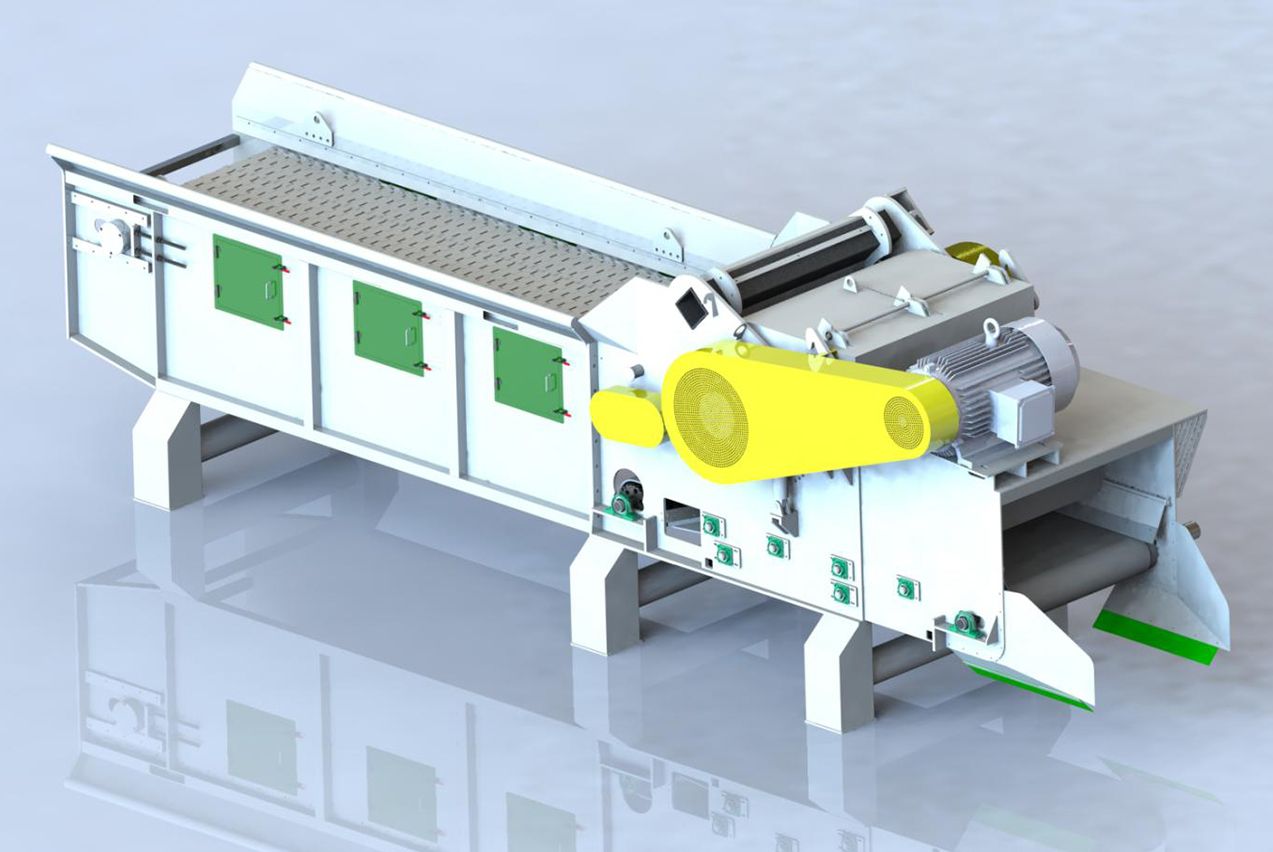
A drum wood crusher—also referred to as a drum chipper in configurations designed for log and branch input—is a high-throughput size-reduction machine built around a rotating drum fitted with hardened blades or swing hammers. Material enters through a gravity-fed hopper or belt conveyor; the drum’s rotational force pulls wood across the cutting edges and reduces it to chips in a single pass. Output particle size is governed by interchangeable bottom screens, allowing operators to calibrate chip geometry for downstream processes.
The key engineering advantage over disc chippers or hammer mills is continuous throughput: the drum accepts irregular feed geometry—crooked branches, slab trim, board ends—without the stalling risk common in machines that demand pre-sorted input. This makes drum wood crushers a practical front-end solution for operations processing mixed wood waste streams.
In industrial biomass applications, chip uniformity is not cosmetic. Downstream dryers achieve consistent moisture reduction only when particle size distribution is controlled; fine grinding mills operate within rated capacity when feed chips fall within a defined size window. Specifying the correct drum crusher configuration is therefore a line-level engineering decision, not simply a procurement choice.
Integration into a Complete Biomass Pellet Production Line
Drum wood crushers are an essential tool for wood processing businesses that intend to progress from raw waste to finished biomass fuel. Standalone chipping addresses disposal, but integrating the crusher as the first stage of a fully automated line unlocks significantly greater value.
Kingwood designs and supplies complete wet-feed biomass pellet production lines that incorporate the drum chipper as the primary size-reduction stage. The processing sequence runs as follows:
- Primary crushing — drum chipper reduces raw wood to coarse chips (typically 30–50 mm)
- Drum drying — high-moisture chips pass through a rotary drum dryer to reach the target moisture threshold of below 15%
- Fine grinding — a hammer mill reduces dried chips to the particle size required for pelletizing
- Pelletizing — ring die pellet mills (e.g., JWZL-688D at 3–3.5 t/h, JWZL-928 at 4–5 t/h) compress ground material into dense cylindrical pellets
- Cooling — a counter-flow cooler brings pellet temperature and residual moisture within specification
- Packaging — automated bagging or bulk loading for dispatch
This integrated workflow is enclosed and dust-suppressed in line with Kingwood’s Three-Standardization Framework, which mandates integrated, dust-free, and automated production lines as baseline design requirements. The framework eliminates the fragmented, multi-vendor configurations that historically produced inconsistent pellet quality and high maintenance overhead.
For a real-world throughput reference, Kingwood’s 24 t/h wood chip pellet production line in Vietnam demonstrates how primary crushing through to pellet output is managed at commercial scale.
Operational Considerations: Maintenance, Versatility, and ROI
Material versatility. Drum wood crushers process both softwood and hardwood species without mechanical reconfiguration. Mixed inputs—pine offcuts, hardwood branches, bamboo residue, agricultural stalks—are handled within the same machine cycle. For operations sourcing biomass from multiple supply chains, this eliminates the cost and footprint of dedicated machines per feedstock type.
Waste volume reduction. Shredding loose wood waste to uniform chips achieves volume reductions of 3:1 to 5:1 depending on input bulk density. Lower waste volume reduces haulage frequency, tipping costs, and on-site storage footprint. Where chips are directed to pellet production rather than disposal, the feedstock carries a positive value: Kingwood-specification pellets deliver a calorific value of 4,800 kcal/kg, and operators using biomass fuel in place of coal or heavy oil report energy cost reductions of 40–50%.
Maintenance discipline. Drum crusher longevity depends on systematic maintenance rather than reactive repair. Critical checkpoints include blade or hammer condition (measured against wear-limit tolerances, not visual inspection alone), drum bearing temperature monitoring, screen integrity after processing abrasive material, and conveyor drive alignment. Kingwood recommends establishing a maintenance interval schedule based on annual operating hours and feedstock abrasivity, and using OEM-specification replacement blades to preserve cutting geometry and balance.
Line-level ROI. A Kingwood-supplied 12 t/h pellet line in Vietnam reached full investment payback in 23 months—a performance that reflects both the efficiency of integrated equipment and the fuel cost economics of biomass versus fossil alternatives. Complete lines designed by Kingwood scale to 200,000 metric tons per year, accommodating growth without requiring a facility redesign.
Specifying the Right Drum Crusher Configuration
Selecting drum wood crusher specifications requires matching machine parameters to three operational variables: maximum input dimension (branch diameter or slab thickness), required output chip size, and target hourly throughput. These variables determine drum diameter, blade count, screen aperture, and motor sizing.
For facilities planning to commission a complete pellet production line, crusher specification should be coordinated with downstream equipment design from the outset. Oversized chips reaching the dryer reduce thermal efficiency; undersized chips increase hammer mill energy consumption unnecessarily. Kingwood’s engineering team works from raw material analysis through to line commissioning, ensuring that crusher output aligns with the full process chain rather than being specified in isolation.
Jiangsu Kingwood Industrial Co., Ltd. has operated from Liyang Zhongguancun Industrial Park since 1999, accumulating 27 years of R&D in biomass processing equipment. With over 2,000 production line projects planned and designed across 30 countries, Kingwood holds ISO 9001, ISO 14001, and CE certifications, and is publicly listed on the NEEQ exchange under stock code 871765.
FAQ
What is a drum wood crusher and how does it work?
A drum wood crusher is an industrial machine featuring a rotating drum fitted with hardened blades or hammers. Wood waste is fed via hopper or conveyor; the rotating drum shreds material into small, uniform chips. Output size is controlled by screen selection, making the machine suitable for both coarse chipping and finer biomass feedstock preparation.
What materials can a drum wood crusher process?
Drum wood crushers handle a broad range of lignocellulosic inputs: softwood and hardwood branches, tree stumps, slab wood, board trim, sawdust agglomerates, and agricultural stalk bundles. This multi-material capability reduces the need for separate machines across different waste streams.
How does a drum wood crusher fit into a biomass pellet production line?
In a wet-feed biomass pellet production line, the drum wood crusher or drum chipper handles primary size reduction before material enters the drying and fine-grinding stages. Kingwood's complete lines integrate crushing, drying, fine grinding, pelletizing, cooling, and packaging into a single automated, dust-free workflow.
What maintenance does a drum wood crusher require?
Routine maintenance includes blade or hammer inspection and replacement on wear schedule, drum bearing lubrication, screen integrity checks, and conveyor belt tension adjustment. Following OEM torque specifications during blade changes and maintaining a maintenance log are best practices for minimizing unplanned downtime.
What are the cost benefits of using a drum wood crusher for waste wood?
Volume reduction of wood waste lowers hauling and tipping fees. Processed chips become a saleable or internally usable feedstock for biomass pellets, which can cut fuel costs by 40–50% versus fossil fuels. For industrial operators, converting waste to pellet feedstock shortens payback periods significantly.
Can drum wood crushers be integrated with pellet mills?
Yes. Drum wood crushers and drum chippers are standard upstream components in Kingwood's integrated production lines. They feed directly into drum dryers and hammer mills before material reaches the ring die pellet mill, enabling continuous, high-capacity throughput without manual intervention.
What capacity range do Kingwood's biomass processing lines support?
Kingwood has planned and designed over 2,000 production line projects and supports complete line capacities up to 200,000 metric tons per year. Individual pellet mill models—such as the JWZL-928—deliver 4–5 t/h, while multi-machine configurations scale throughput to project requirements.
- Biomass pellets produced by Kingwood-equipped lines achieve a calorific value of 4,800 kcal/kg with moisture content below 15%, meeting EU, US, and ISO quality benchmarks. (2025, Kingwood product specification documentation, kingwoodpellet.com)
- A 12 t/h wood pellet line in Vietnam supplied by Kingwood achieved full investment payback in 23 months, demonstrating the commercial viability of biomass fuel conversion from waste wood. (2024, Kingwood case study: Vietnam 12 t/h wood pellet line, kingwoodpellet.com)