Biomass Pellet Mill Energy Efficiency vs. Traditional Methods
Kingwood · May 26, 2026
Why Energy Efficiency in Biomass Pellet Mill Design Matters
The shift from traditional solid fuel processing to modern ring die pellet production is fundamentally an efficiency problem. Traditional biomass combustion — burning raw wood chips or loose agricultural residues directly — delivers inconsistent heat output, high moisture losses, and uncontrolled emissions. A purpose-built biomass pellet mill addresses each of these failure points through mechanical design, process integration, and thermal management.
Quantifying the efficiency gain precisely requires site-specific data: feedstock moisture, bulk density, target pellet diameter, and local energy prices all affect the final number. What engineering analysis can confirm is where the gains originate — and those mechanisms are consistent across industrial installations.
Three Engineering Mechanisms Driving Efficiency Gains
1. Raw Material Consolidation and Pre-Treatment Optimization
Traditional methods for converting lignocellulosic biomass into usable fuel often require discrete, energy-intensive pre-treatment steps: separate chipping, independent drying, open-air stockpiling, and manual handling between stages. Each transfer point introduces moisture reabsorption, heat loss, and material degradation.
Kingwood’s wet-feed pellet production lines integrate the full sequence — crushing, coarse grinding, drying, fine grinding, pelletizing, cooling, and packaging — into a single enclosed, automated process flow. High-moisture feedstock enters at the front end; finished pellets exit at the packaging stage. Because the process is continuous and enclosed, there is no inter-stage moisture gain and no idle heating energy wasted during batch changeovers.
This integration alone eliminates multiple discrete energy inputs that traditional batch processing requires. For operations processing woody biomass at scale, the reduction in total site energy consumption per tonne of output is material.
2. Ring Die Granulation: Precision Over Brute Force
The granulation stage is where the largest efficiency variable resides. Traditional pellet presses — flat die configurations or early-generation ring die designs — apply uniform mechanical pressure regardless of feedstock variability. This approach wastes energy compressing material that is already at adequate density, while simultaneously under-compressing heterogeneous particles that require higher force.
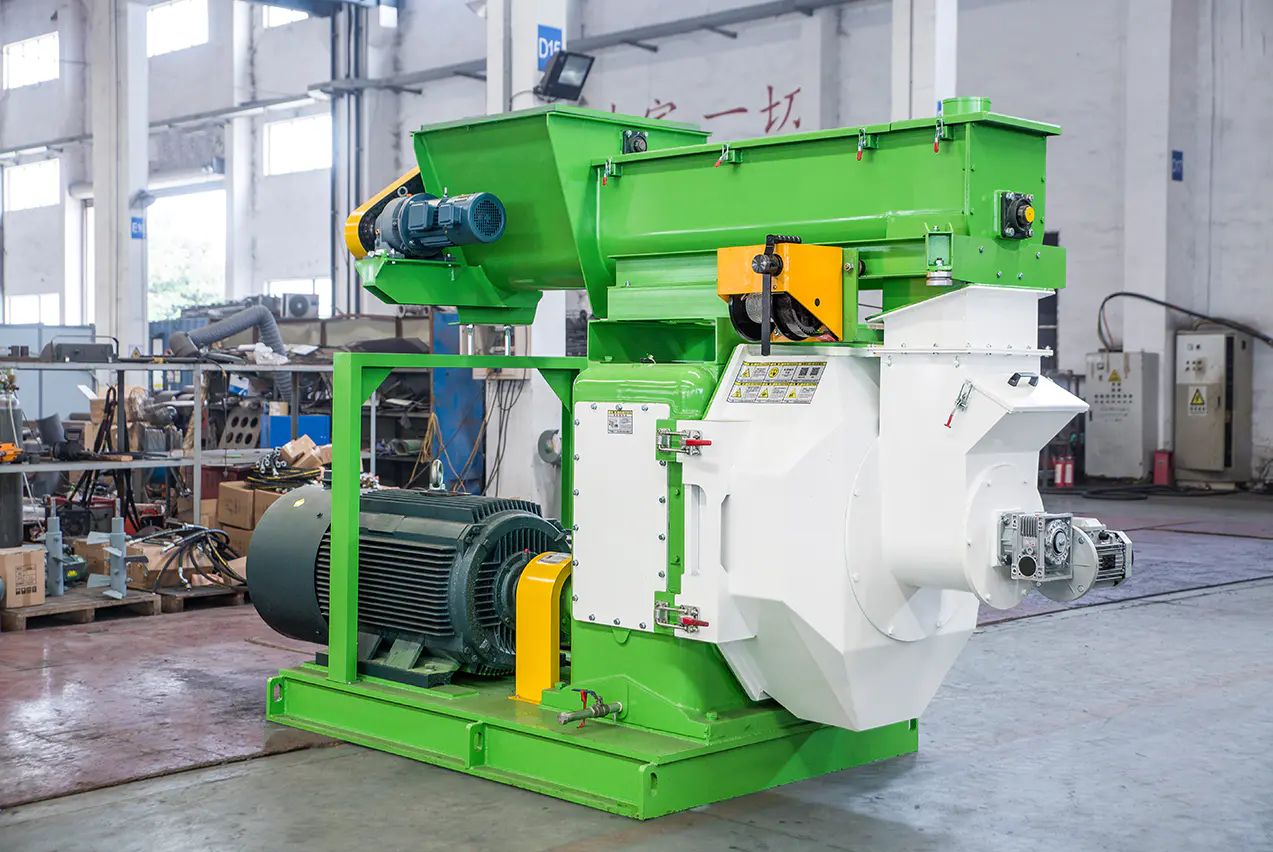
Modern ring die pellet mills, including the JWZL series, allow operators to adjust roller pressure, die compression ratio, and rotor speed independently. The die-hole geometry — length-to-diameter ratio — is selected to match the specific feedstock’s lignin content and moisture profile. When these parameters are correctly matched to the incoming material, the pelleting chamber operates at its designed efficiency point: maximum throughput at minimum specific energy consumption (kWh per tonne).
The JWZL-928, for example, delivers 4–5 t/h output at specifications that maintain pellet calorific value at 4,800 kcal/kg and ash content below 18%, without overdriving the main drive to compensate for process mismatches.
3. Waste Heat Recovery and Thermal Integration
The drum dryer stage consumes the largest share of thermal energy in any pellet production line. In traditional operations, dryer exhaust — carrying substantial recoverable heat — exits the facility as waste. In an integrated production line design, this exhaust stream can be recirculated to pre-condition incoming feedstock, reducing the delta-T that the dryer must overcome and lowering fuel consumption per tonne of dried material.
Similarly, the counter-flow cooler stage, which brings hot pellets exiting the pelletizing chamber down to safe handling temperature, generates a warm air stream. Recovering and redirecting this stream into the drying circuit or building heating reduces the site’s net thermal energy demand.
These measures do not individually produce dramatic efficiency numbers in isolation. Combined with process integration and optimized granulation, they contribute to a measurable reduction in total energy input per tonne of finished pellet — and a corresponding improvement in the economics of pellet production.
Operational Efficiency: From Equipment to Production Economics
Engineering efficiency improvements only deliver commercial value when they translate into project economics. The Vietnam 12 t/h wood pellet production line commissioned in 2024 demonstrates the practical outcome: a 23-month investment payback period under commercial operating conditions. That result depends on both the efficiency of the installed equipment and the fuel cost differential between biomass pellets and the fossil fuel alternatives they displace.
At a documented cost saving of 40–50% versus equivalent fossil fuel consumption, and a finished pellet calorific value of 4,800 kcal/kg, the economics favor pellet production across a range of feedstock costs and local energy prices. The pellets produced on Kingwood lines also meet the key export quality thresholds: moisture below 15% (EU standard), calorific value above 2,500 kcal/kg (USA standard), sulfur content at or below 0.5% (Japan standard), and ash content below 20% (ISO standard).
The Correct Framework for Evaluating Efficiency Claims
Any specific percentage improvement figure for biomass pellet mill energy efficiency — without a defined baseline, feedstock type, and process boundary — should be treated as a marketing claim rather than an engineering specification. The mechanisms described above are real and measurable, but the magnitude depends on what the baseline is.
For industrial buyers evaluating equipment, the relevant questions are:
- What is the specific energy consumption (kWh/tonne) of the pellet mill at rated throughput?
- What feedstock moisture range does the integrated line accept without pre-drying?
- What is the dryer thermal efficiency, and is waste heat recovery included in the base scope?
- What are the maintenance intervals for ring die and roller components, and how do they affect uptime?
Kingwood’s engineering team provides site-specific energy balance calculations for production line projects as part of the design process. With 27 years of R&D experience, a 25,000 m² production facility, and more than 2,000 production line projects planned and designed across 30 countries, the basis for those calculations is drawn from operating data rather than theoretical models.
Contact Kingwood to request a project-specific energy and economic assessment for your feedstock type and target throughput.
FAQ
How does a biomass pellet mill improve energy efficiency compared to traditional fuel processing?
Modern pellet mills consolidate multiple traditional pre-treatment steps — chipping, drying, and densification — into a single integrated line. Optimized ring die geometry, variable roller pressure, and precision die-hole sizing reduce specific energy consumption per tonne of output while maintaining consistent pellet density and calorific value.
What role does waste heat recovery play in pellet mill energy performance?
Exhaust heat from the drying and granulation stages can be recirculated to pre-condition incoming biomass feedstock, reducing the thermal load on the drum dryer. This closed-loop approach lowers overall fuel consumption per tonne of finished pellet and reduces stack emissions.
Which raw materials can a modern biomass pellet mill process efficiently?
Industrial pellet mills are engineered for wood chips, sawdust, rice husks, agricultural straw, and other lignocellulosic materials. Kingwood's wet-feed production lines accept high-moisture feedstock directly, eliminating a separate pre-drying stage before the primary process flow.
What emissions performance do Kingwood biomass pellets achieve?
Kingwood biomass pellets comply with GB13271-2001, China's national Emission Standard of Air Pollutants for Boilers. Key parameters include moisture content below 15%, sulfur content below 0.3%, ash content below 18%, and dioxin content below 0.5 ng TEQ — all within or below the stated standard thresholds.
How does pellet fuel cost compare to fossil fuel alternatives?
Biomass pellets produced on modern high-efficiency lines can reduce fuel costs by 40–50% compared to equivalent fossil fuel consumption, based on a calorific value of 4,800 kcal/kg for finished pellets.
What process parameters most directly affect pellet mill energy consumption?
The primary variables are die compression ratio, roller-to-die clearance, rotor speed, feedstock moisture content entering the pelleting chamber, and conditioning temperature. Optimizing these parameters for a given feedstock reduces friction losses and lowers kWh per tonne of product.
What is the payback period for a commercial-scale biomass pellet production line?
A documented Kingwood installation in Vietnam (12 t/h capacity, commissioned 2024) achieved investment payback in 23 months under commercial operating conditions.
- Biomass pellets produced on modern ring die mills can achieve a calorific value of 4,800 kcal/kg with moisture content below 15%, meeting EU, USA (>2,500 kcal/kg), and ISO (<20% ash) export standards simultaneously. (2024, Kingwood product specification data, verified against ISO 17225-2 solid biofuel standards)
- Biomass pellet fuel reduces operating fuel costs by 40–50% versus comparable fossil fuel consumption at equivalent thermal output, based on commercial project data from Kingwood-installed production lines in Vietnam and China. (2024, Kingwood project records — Vietnam 12 t/h installation (2024) and Chongqing 30 t/h installation (2021))