Industrial Commercial Wood Pellet Mill: China Factory Guide
Kingwood · May 26, 2026
What an Industrial Commercial Wood Pellet Mill Actually Does
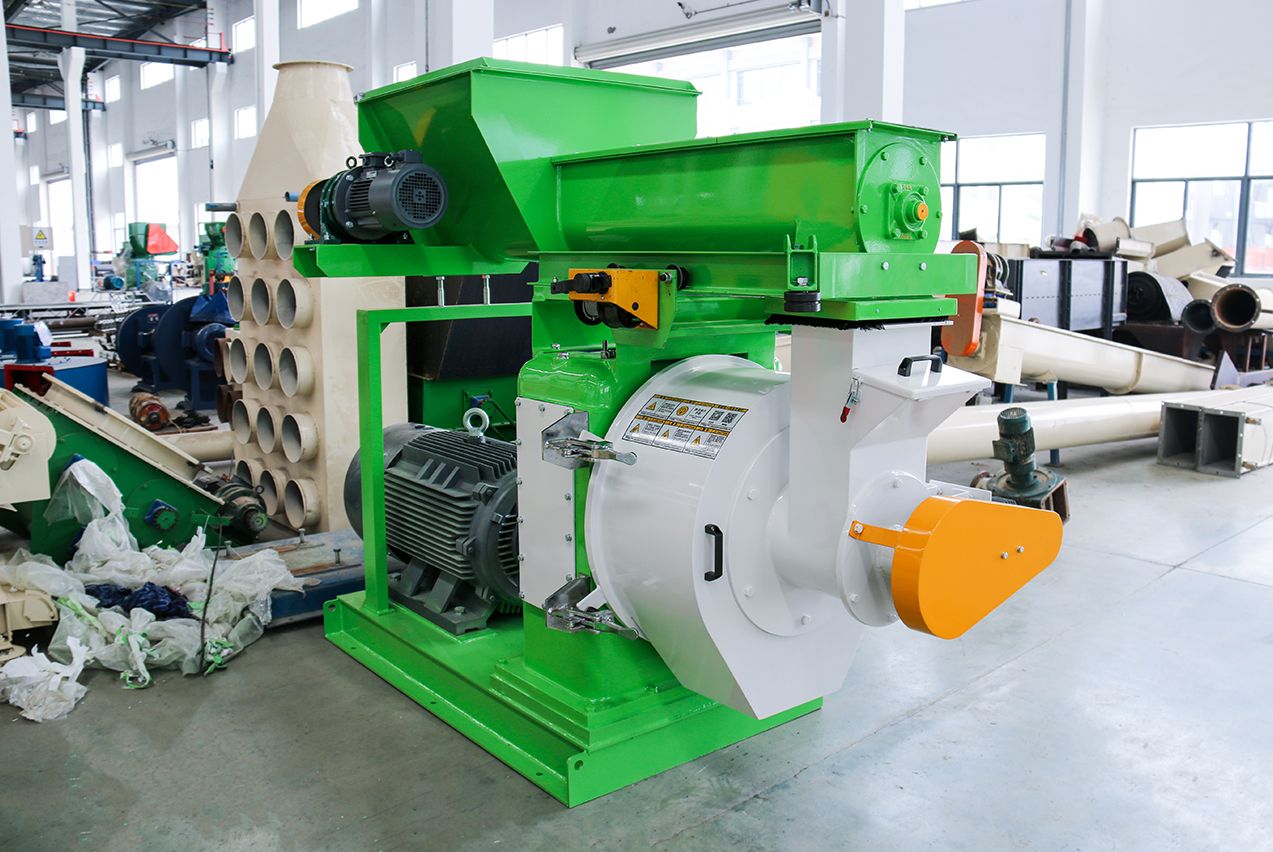
A commercial wood pellet mill is a pressure-forming machine that compresses pre-conditioned biomass — wood chips, sawdust, agricultural straw, bark, or mixed forestry residues — through precision-machined die holes to produce dense, uniform cylindrical pellets. At industrial scale, the pellet mill is not a standalone unit but the central compression stage within a complete wet-feed production line that sequences crushing, coarse grinding, thermal drying, fine grinding, pelletizing, cooling, screening, and automated packaging.
Kingwood, a NEEQ-listed (stock code: 871765) biomass equipment manufacturer based in Liyang, Jiangsu Province, has engineered and commissioned over 2,000 production line projects across 30 countries since 1999. The company’s ring die pellet mills are the pelletizing core of those lines.
The output pellet specification matters commercially. Kingwood’s production lines consistently deliver biomass fuel at 4,800 kcal/kg calorific value, moisture content below 15%, sulfur below 0.3%, and ash below 18% — meeting EU, US, ISO, and China GB13271-2001 emission compliance benchmarks simultaneously. That multi-standard compliance is what enables the same pellet output to serve heating, co-firing, and industrial process heat markets across different regulatory jurisdictions.
Pellet Mill Models, Process Stages, and Line Architecture
Ring Die Pellet Mills: Model Selection by Throughput
Kingwood’s vertical pellet mill series covers a throughput range from small industrial to large commercial scale:
| Model | Capacity |
|---|---|
| JWZL-420 | 1–1.5 t/h |
| JWZL-688 | 2–2.3 t/h |
| JWZL-688D | 3–3.5 t/h |
| JWZL-928 | 4–5 t/h |
| JWZL-1068 | Contact sales |
For operations requiring horizontal configuration, the JZWH-860 horizontal biomass pellet mill delivers equivalent 4–5 t/h throughput and suits facility layouts where vertical headroom is constrained.
Complete production lines scale to 200,000 metric tons per year, achieved by parallelizing multiple pellet mill units within a single integrated facility.
Wet-Feed Production Line: Process Sequence
The wet-feed architecture is critical for buyers processing freshly harvested or high-moisture biomass — a category that covers most agricultural and forestry residues in tropical and subtropical sourcing regions.
- Primary size reduction — Drum chipper or hammer mill reduces incoming material to uniform chip or fiber dimensions.
- Coarse grinding — Hammer mill secondary pass targets particle size compatibility with the dryer.
- Drum drying — Rotary drum dryer reduces moisture to pelletization range; temperature and residence time are controlled to preserve lignin binding properties.
- Fine grinding — Final particle size conditioning for die-hole compatibility.
- Pelletizing — Ring die compression at the JWZL or JZWH pellet mill stage.
- Counter-flow cooling — Counter-flow cooler brings pellet temperature and residual surface moisture to storage-stable levels.
- Screening and packaging — Fines removal and automated pellet packaging machine complete the closed-loop process.
The entire line operates under Kingwood’s Three-Standardization Framework: Integrated (single-line material flow, no manual transfer), Dust-Free (enclosed processing with integrated dust extraction at every stage), and Automated (PLC-based control with remote monitoring capability). This architecture directly addresses the two most common compliance problems in commercial pellet facilities: particulate emissions during handling, and labor-intensive manual intervention points.
Commercial Wood Pellet Applications and Market Economics
End-Use Sectors
Industrial biomass pellets produced on Kingwood lines are deployed across three primary demand segments:
Industrial and district heating — Large thermal loads: ceramics kilns, paper mills, food processing, hospital and campus district heat networks. Wood pellets replace heavy fuel oil or coal burners with no boiler replacement in most retrofit configurations.
Biomass co-firing and power generation — Grid-scale biomass power plants and coal co-firing facilities use pellets as a standardized fuel input. Consistent calorific value and ash specification are mandatory for this segment; Kingwood’s pellets meet those standards.
Residential and commercial heating — Pellet boilers and stoves for building-scale heating. This segment drives European and increasingly East Asian import volumes.
Cost Economics
Biomass pellets reduce fuel expenditure by 40–50% versus fossil fuel equivalents when substituted in compatible combustion systems. The economic case is strongest where grid gas is unavailable or diesel is the default thermal fuel — conditions common across Southeast Asia and rural industrial zones in China.
A 12 t/h wood pellet production line commissioned in Vietnam in 2024 achieved full capital payback in 23 months, a reference data point Kingwood documents formally for buyer due diligence. The prior 24 t/h Vietnam installation in 2023 demonstrated line scalability at higher throughput.
In China, the Beijing biomass pellet demonstration project (2024) and the Guizhou Dust-Free pellet mill workshop (2024) illustrate domestic policy-driven deployment where municipal air quality standards make the Dust-Free production line pillar a regulatory requirement, not merely an operational preference.
Why China Pellet Mill Factory Sourcing Requires Technical Scrutiny
The China industrial pellet mill manufacturing sector varies substantially in engineering depth. Buyers evaluating commercial wood pellet mill suppliers should assess four technical parameters beyond unit price:
1. Die and roller material specification. Ring die longevity under continuous operation with abrasive biomass (bamboo, palm, hardwood) depends on alloy grade and heat treatment. Request documented die life per feedstock.
2. Complete line integration versus assembled components. A production line assembled from independently sourced sub-components has no single engineering accountability point. Kingwood designs and manufactures auxiliary equipment — hammer mill, drum chipper, drum dryer, counter-flow cooler — internally, which allows process optimization across stages rather than component-level specification matching.
3. Dust control architecture. Pellet production generates significant airborne particulate at grinding, drying, and cooling stages. A Dust-Free production line is not cosmetic — it determines whether a facility can comply with local environmental permits in jurisdictions with PM2.5 or TSP emission limits.
4. Automation depth. Fully automated lines reduce headcount requirements and eliminate the batch-process inconsistencies that affect pellet quality certification. Kingwood’s Three-Standardization Framework mandates automation as a design requirement, not an optional add-on.
Jiangsu Kingwood Industrial Co., Ltd. holds ISO 9001, ISO 14001, and CE certifications and is listed on China’s NEEQ exchange (stock code: 871765) — providing audited financial and operational transparency atypical in the broader China machinery export market.
For technical specifications, capacity configuration guidance, or production line project planning, contact Kingwood’s engineering team directly.
FAQ
What is the production capacity range of Kingwood's commercial wood pellet mills?
Kingwood's vertical pellet mill lineup spans 1 t/h (JWZL-420) to 4–5 t/h (JWZL-928), while complete wet-feed production lines are engineered to handle up to 200,000 metric tons per year. The JWZL-688D delivers 3–3.5 t/h for mid-scale industrial operations.
What biomass feedstocks can an industrial wood pellet mill process?
Industrial wood pellet mills can process wood chips, sawdust, bark, agricultural straw, rice husks, and other lignocellulosic residues. Kingwood's wet-feed production lines handle high-moisture biomass through integrated crushing, drying, fine grinding, and pelletizing stages before packaging.
What quality standards do Kingwood biomass pellets meet?
Kingwood biomass pellets achieve a calorific value of 4,800 kcal/kg, moisture content below 15%, sulfur content below 0.3%, and ash content below 18%. Emission indicators comply with China's GB13271-2001 boiler air pollutant standard, and the pellets meet EU (<15% moisture), US (>2,500 kcal calorific), and ISO (<20% ash) benchmarks.
How does a commercial wood pellet production line reduce operating costs?
Biomass pellets delivered by Kingwood production lines reduce fuel costs by 40–50% compared to fossil fuels. A documented 12 t/h Vietnam installation achieved full capital payback within 23 months of commissioning in 2024.
What does Kingwood's Three-Standardization Framework mean for pellet mill buyers?
The Three-Standardization Framework covers Integrated, Dust-Free, and Automated production lines. Buyers receive enclosed processing with integrated dust removal, fully automated controls, and modular line integration — reducing manual labor, compliance risk, and downtime across the entire pellet production chain.
Which global markets are driving industrial wood pellet demand?
Europe, Japan, and South Korea are major importers driven by renewable energy mandates. Asia-Pacific manufacturing hubs including Vietnam are scaling domestic production. Kingwood has supplied equipment across 30 countries, with active project references in Vietnam (2023, 2024) and China (Beijing, Chongqing, Guizhou).
What certifications does a China commercial wood pellet mill factory need to supply international buyers?
Kingwood holds ISO 9001, ISO 14001, and CE certifications, alongside Jiangsu Provincial High-Tech Enterprise and Jiangsu Provincial Specialized & Innovative Niche Leader designations. These certifications validate quality management, environmental systems, and product compliance for export markets.
- Global wood pellet production exceeded 40 million metric tons in 2023, with Europe accounting for over 60% of consumption as co-firing and district heating mandates tightened. (2023, AEBIOM (European Biomass Association), European Bioenergy Outlook 2023)
- Asia-Pacific wood pellet imports grew by approximately 12% year-on-year in 2023, led by Japan and South Korea pursuing coal displacement targets under national renewable energy frameworks. (2023, IEA Bioenergy Task 40, Country Report on Biomass Trade 2023)