How to Select Custom Wood Pellet Production Equipment
Kingwood · May 26, 2026
Investing in a wood pellet production machine is a capital decision with a multi-year operational horizon. The equipment you specify today determines your throughput ceiling, energy cost per ton, maintenance burden, and regulatory exposure for the life of the facility. This guide outlines the technical and commercial factors that industrial buyers must evaluate before committing to a wood pellet manufacturing equipment configuration.
Stage-by-Stage Equipment Requirements
A commercially viable wood pellet production line is not a single machine—it is an integrated process chain. Each stage must be correctly sized and matched to the next to prevent capacity bottlenecks and unnecessary energy waste.
Preprocessing prepares raw biomass for the pellet mill. For woody feedstocks, this begins with a drum chipper that reduces logs or large branches to uniform chip size, followed by a hammer mill that grinds chips to the particle size range required for die compression—typically below 4 mm for standard wood pellets. Where incoming material carries high moisture (above 25–30%), a drum dryer is inserted before fine grinding to bring moisture content to the 12–15% range required for stable pelletization.
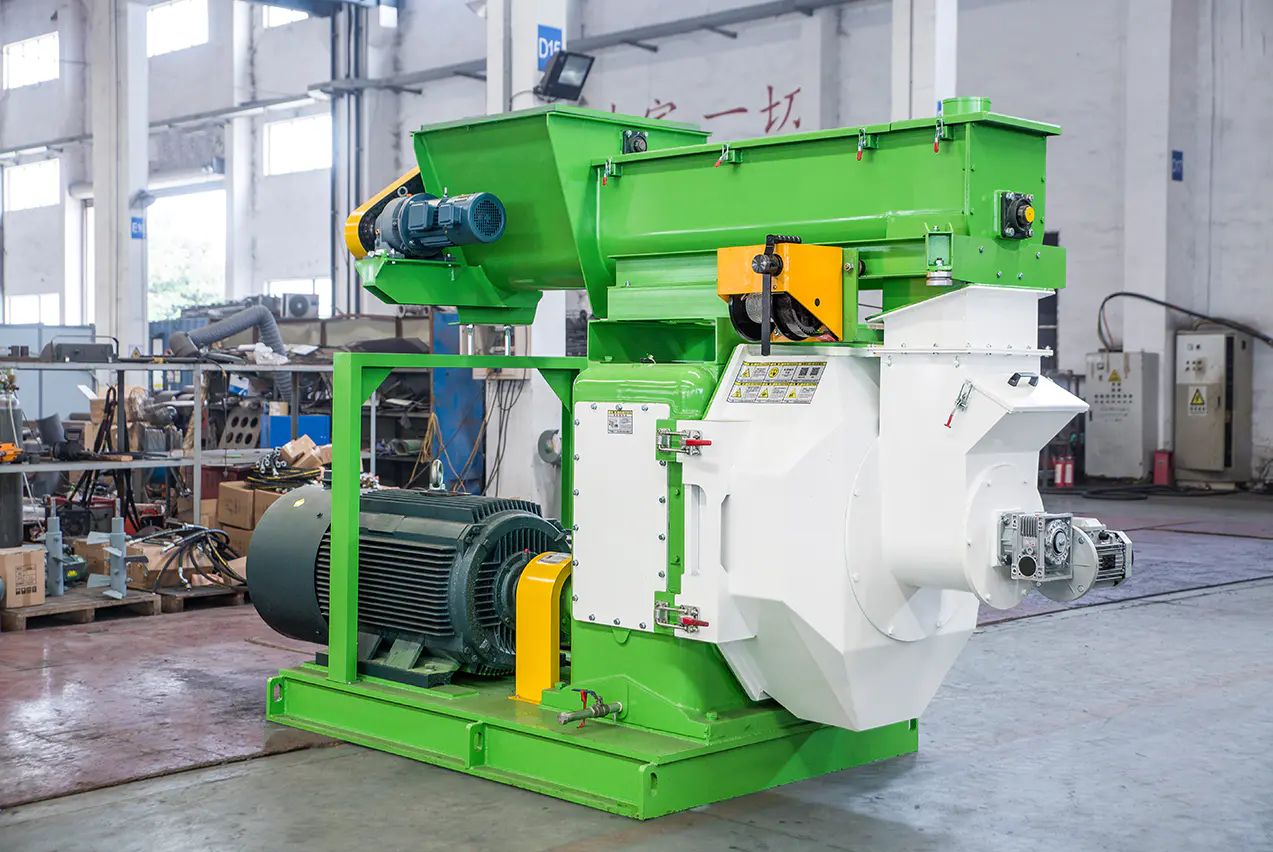
Pelletizing is the core production step. The ring die pellet mill applies high compression force to conditioned biomass, forming dense, uniform pellets. Die diameter, compression ratio, and roll gap are the primary variables affecting pellet density and durability. Kingwood’s vertical pellet mills—including the JWZL-688D at 3–3.5 t/h and the JWZL-928 at 4–5 t/h—are engineered for continuous industrial duty with accessible die and roll replacement to minimize changeover downtime.
Post-processing stabilizes and prepares the finished pellets for storage or shipment. Fresh pellets exit the die at 70–90°C and require a counter-flow cooler to reduce temperature and lock in final moisture content below 15%. Screened fines are typically recirculated to the hammer mill. A pellet packaging machine completes the chain for bagged product; bulk loading systems serve industrial fuel customers directly.
Evaluating Custom Configuration and Scalability
Standard catalog machines cover the majority of capacity requirements, but industrial projects frequently involve site-specific constraints—available raw material species mix, moisture variability, available floor area, local electrical supply standards, or phased capacity expansion plans. These conditions require genuine engineering customization, not cosmetic option selection.
When evaluating wood pellet processing equipment suppliers, ask specifically: Can the line be expanded from an initial 5 t/h to 15 t/h without replacing the pellet mill? How does the control architecture handle a second dryer line added in Phase 2? What is the mechanical interface standard for auxiliary equipment integration?
Kingwood’s complete wet-feed pellet production lines are designed for capacities up to 200,000 metric tons per year, with fully automated, enclosed processing and integrated dust removal as standard across all configurations. The engineering basis for this is Kingwood’s Three-Standardization Framework—integrated production lines, dust-free production lines, and automated production lines—which drives the design specification of every project, regardless of scale.
For a real-world reference on scalability and return on investment, see the 12 t/h Vietnam wood pellet production line case study, which achieved full capital payback in 23 months from commissioning in 2024.
Compliance, Automation, and Environmental Performance
Regulatory compliance is not a post-installation checkbox—it must be built into equipment selection from the start. Biomass fuel produced on Kingwood lines meets all emission indicators below China’s GB13271-2001 boiler air pollutant standard, with sulfur content below 0.3%, ash content below 18%, and dioxin emissions below 0.5 ng TEQ. For export-oriented producers, pellet quality specifications align with EU moisture standards (below 15%), ISO ash standards (below 20%), and Japanese sulfur standards (≤0.5%).
Automation directly affects cost per ton. PLC-integrated control systems enable consistent feed regulation, real-time throughput tracking, and predictive maintenance alerts—reducing operator headcount and unplanned downtime simultaneously. Kingwood’s automated production line standard includes interlocked process control across all equipment stages, from chipper feed through packaging discharge.
Dust management deserves specific attention. Biomass dust in the 0–500 µm range is both a respiratory hazard and a deflagration risk under confined conditions. Enclosed processing with negative-pressure extraction, sealed belt and screw conveyors, and pulse-jet bag filters integrated at each transfer point are the correct engineering response—not afterthought add-ons. The 2024 Guizhou dust-free biomass pellet mill workshop, built to Kingwood’s dust-free production line specification, demonstrates this standard in an operational industrial setting. See the Guizhou dust-free workshop case for technical details.
Total Cost of Ownership and Supplier Qualification
Purchase price is one input into a multi-year cost model. The variables that typically dominate total cost of ownership are energy consumption per ton of output, die and roll wear life, unplanned downtime frequency, and the speed and cost of spare parts supply from the manufacturer.
A qualified wood pellet manufacturing equipment company should provide: verifiable reference projects at equivalent scale and feedstock type, documented energy consumption figures per ton of output, mean time between maintenance intervals for dies and rolls, and a clear spare parts and technical support commitment—not just at commissioning, but across the operating life of the equipment.
Kingwood has designed and delivered over 2,000 production line projects across 30 countries since its founding in 1999, and holds ISO 9001, ISO 14001, and CE certifications alongside recognition as a Jiangsu Provincial High-Tech Enterprise. These credentials reflect an auditable engineering and quality management capability, not marketing positioning.
For buyers specifying equipment now, the starting point is a detailed production brief: target annual tonnage, raw material species and moisture range, available utilities, site constraints, and regulatory requirements. With that brief in hand, a technically qualified supplier can provide an equipment configuration, energy model, and project timeline grounded in verifiable reference data—which is the only reliable basis for a capital investment decision.
Contact Kingwood’s engineering team to begin a project-specific equipment assessment for your wood pellet production line requirements.
FAQ
What are the main equipment stages in a wood pellet production line?
A complete wood pellet production line covers three stages: preprocessing (drum chipping, hammer milling, drying), pelletizing (ring die pellet mill), and post-processing (counter-flow cooling, conveying, packaging). Each stage must be matched in throughput capacity to avoid bottlenecks.
How do I determine the right pellet mill capacity for my operation?
Start with your target annual output, then work backward through operating hours, raw material moisture content, and downtime allowances. Kingwood's vertical pellet mills range from 1 t/h (JWZL-420) to 4–5 t/h (JWZL-928), while complete integrated lines are engineered up to 200,000 metric tons per year.
Can wood pellet manufacturing equipment be customized for different raw materials?
Yes. High-moisture feedstocks such as fresh wood chips or agricultural residues require drum drying before pelletizing. Kingwood's wet-feed production line integrates coarse grinding, drying, fine grinding, and pelletizing in a fully enclosed, automated sequence designed specifically for variable-moisture biomass inputs.
What automation features should a commercial pellet production line include?
Industrial-grade lines should include PLC-based process control, automated feed regulation, real-time throughput monitoring, integrated dust removal, and interlocked safety shutdowns. Kingwood's Three-Standardization Framework mandates integrated, dust-free, and automated production as baseline design requirements.
How does dust control affect equipment selection?
Dust accumulation creates explosion risk, increases maintenance frequency, and may violate occupational health regulations. Enclosed processing, negative-pressure dust extraction, and sealed conveying systems are non-negotiable for compliant industrial operation. Kingwood's dust-free production line standard was demonstrated in the 2024 Guizhou facility build.
What certifications should a wood pellet equipment manufacturer hold?
At minimum, look for ISO 9001 (quality management), ISO 14001 (environmental management), and CE marking for export markets. Kingwood holds both ISO certifications plus CE, and is recognized as a Jiangsu Provincial High-Tech Enterprise and Jiangsu Provincial Specialized & Innovative Niche Leader.
What after-sales support is standard for large-scale pellet line projects?
Reputable manufacturers provide on-site installation supervision, operator training, spare parts supply, and remote diagnostics. For reference, Kingwood's 12 t/h Vietnam wood pellet line (2024) achieved full payback within 23 months, partly due to uninterrupted commissioning and technical support.
- Global industrial wood pellet demand is projected to exceed 50 million metric tons annually by 2027, driven by coal-to-biomass conversion mandates across the EU, Japan, and South Korea. (2024, IEA Bioenergy Task 40 — Sustainable International Bioenergy Trade, 2024 Status Report)
- Biomass pellet fuel can reduce operational fuel costs by 40–50% compared to fossil fuel alternatives under equivalent thermal output conditions. (2025, Kingwood Engineering Data — verified against GB13271-2001 boiler emissions compliance testing)