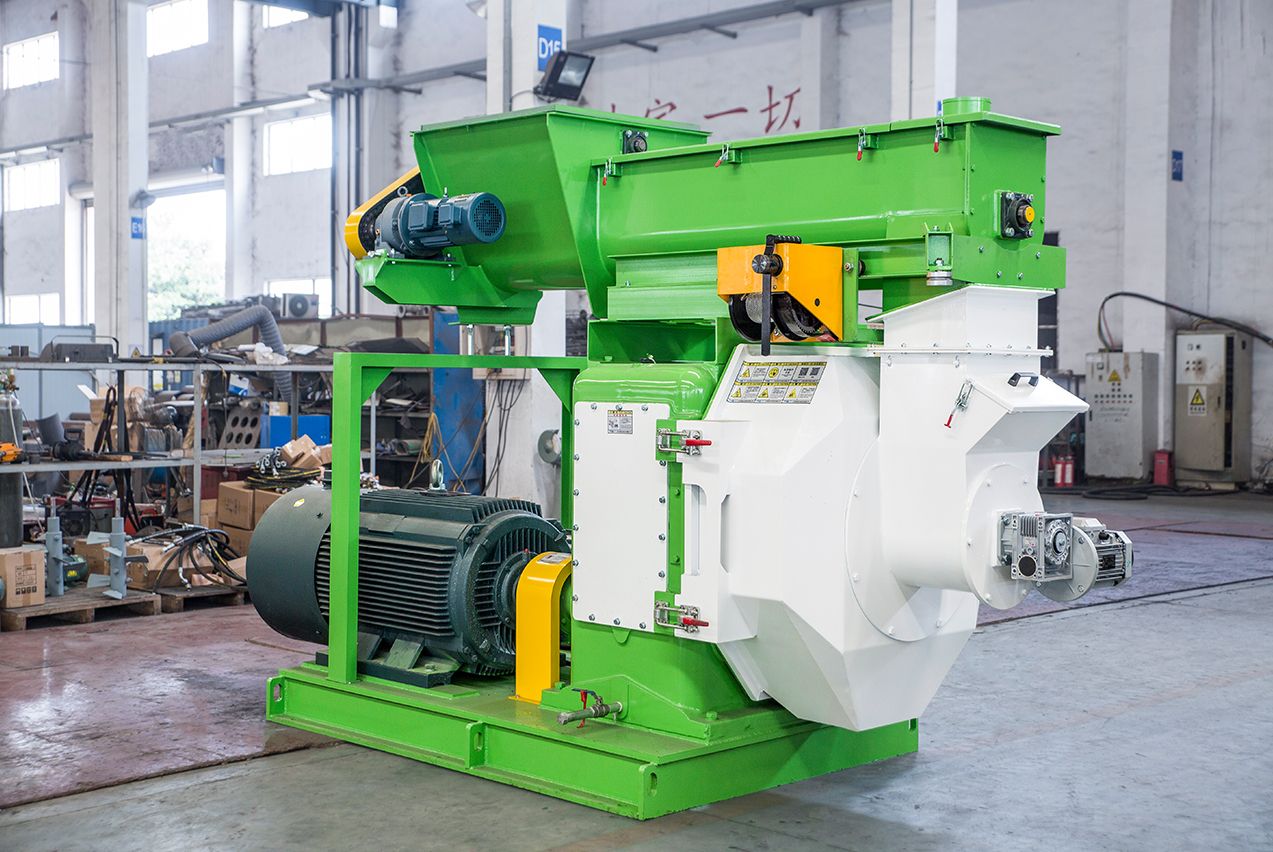
Industrial Wood Pellet Press Machines — Kingwood Factory
Kingwood · May 26, 2026
Kingwood: Industrial Wood Pellet Press Machine Manufacturer Since 1999
Jiangsu Kingwood Industrial Co., Ltd. (NEEQ: 871765) is a China-based industrial manufacturer specializing in ring die pellet mills, biomass pellet production lines, and auxiliary processing equipment. Founded in 1999 and headquartered at Liyang Zhongguancun Industrial Park, Jiangsu Province, Kingwood has accumulated 27 years of R&D experience in biomass densification equipment and supplies wholesale to industrial operators across 30+ countries.
The company operates from a 31,200 m² facility — 25,000 m² dedicated to production — supported by a team of 20 R&D experts. Kingwood is listed on China’s NEEQ stock exchange (stock code: 871765) and holds ISO 9001, ISO 14001, and CE certifications, alongside multiple Jiangsu provincial high-tech and innovation designations.
Kingwood’s engineering philosophy is governed by the Three-Standardization Framework: every production line is designed to be Integrated, Dust-Free, and Automated. This framework directly addresses the operational pain points of industrial biomass fuel producers — contamination risk, manual labor dependency, and fragmented equipment interfaces.
Wood Pellet Press Machines: Model Range and Technical Specifications
Kingwood manufactures both vertical and horizontal ring die pellet mills, covering throughput requirements from 1 t/h to 5+ t/h per machine unit. For large-scale production facilities, multiple units are integrated within a single automated line.
Vertical Pellet Mills:
| Model | Capacity |
|---|---|
| JWZL-420 | 1–1.5 t/h |
| JWZL-688 | 2–2.3 t/h |
| JWZL-688D | 3–3.5 t/h |
| JWZL-928 | 4–5 t/h |
| JWZL-1068 | Contact sales |
Horizontal Pellet Mill:
| Model | Capacity |
|---|---|
| JZWH-860 | 4–5 t/h |
All pellet mill models are engineered for high-moisture biomass feedstocks including wood chips, sawdust, agricultural residues, and forestry waste. Auxiliary equipment supplied alongside pellet mills includes hammer mills, drum chippers, drum dryers, counter-flow coolers, and pellet packaging machines — all configurable within a complete line.
For buyers evaluating large-scale deployment, review the JWZL-928 vertical pellet mill product page for detailed mechanical specifications, motor configurations, and die dimensions.
Complete Wet-Feed Biomass Pellet Production Lines
Beyond individual machines, Kingwood’s primary industrial offering is the complete wet-feed pellet production line — engineered for operators processing raw, high-moisture biomass at scale. The process sequence covers:
- Drum chipping — size reduction of raw wood logs or large residues
- Coarse grinding — hammer mill pre-processing
- Drum drying — moisture reduction to below 15% for pelletizing
- Fine grinding — secondary size reduction for uniform die feed
- Pelletizing — ring die compression via JWZL or JZWH series mills
- Cooling — counter-flow cooling to stabilize pellet temperature and hardness
- Packaging — automated bagging for bulk or retail formats
Production lines are fully enclosed with integrated dust removal systems — a direct implementation of the Dust-Free pillar of Kingwood’s Three-Standardization Framework. Automated PLC control eliminates manual intervention across the core process stages.
Maximum designed line capacity reaches 200,000 metric tons per year. Kingwood has planned and designed over 2,000 production line projects globally, with annual biomass fuel output capacity from deployed Kingwood lines exceeding 10 million metric tons.
Documented project references include a 24 t/h wood chip pellet production line in Vietnam (2023) and a 12 t/h line in Vietnam (2024) that achieved full capital payback in 23 months.
Biomass Fuel Performance and Industrial Compliance
Pellets produced on Kingwood-engineered lines consistently meet the following technical specifications:
- Calorific value: 4,800 kcal/kg
- Moisture content: <15% (EU standard compliant)
- Sulfur content: <0.3% (below Japan standard of ≤0.5%)
- Ash content: <18% (below ISO standard of <20%)
- Dioxin content: <0.5 ng TEQ (below China GB standard of ≤1.0 ng TEQ)
All emission indicators from biomass pellet combustion fall below China’s GB13271-2001 national boiler air pollutant emission standard. For industrial boiler operators replacing coal or heavy fuel oil, biomass pellets from Kingwood-spec lines deliver a documented 40–50% reduction in fuel costs.
These figures are relevant for procurement teams evaluating biomass fuel as a direct fossil fuel substitute in industrial and district heating applications, and for EPC contractors specifying equipment for new greenfield biomass fuel plants.
Jiangsu Kingwood Industrial Co., Ltd. — #568 Hongsheng Road, Liyang Zhongguancun Industrial Park, Liyang City, Jiangsu Province, China. NEEQ: 871765.
FAQ
What pellet press machine models does Kingwood manufacture?
Kingwood produces five vertical ring die pellet mill models — JWZL-420 (1–1.5 t/h), JWZL-688 (2–2.3 t/h), JWZL-688D (3–3.5 t/h), JWZL-928 (4–5 t/h), and JWZL-1068 (contact sales) — plus the horizontal JZWH-860 (4–5 t/h).
Does Kingwood supply complete biomass pellet production lines, not just single machines?
Yes. Kingwood engineers complete wet-feed pellet production lines handling crushing, coarse grinding, drying, fine grinding, pelletizing, and packaging — fully automated, enclosed, with integrated dust removal. Maximum design capacity reaches 200,000 metric tons per year.
What certifications does the Kingwood factory hold?
Kingwood holds ISO 9001, ISO 14001, and CE certifications, and is recognized as a Jiangsu Provincial High-Tech Enterprise, Jiangsu Provincial Specialized & Innovative Niche Leader, and Jiangsu Provincial Gazelle Enterprise, among others.
Where is the Kingwood manufacturing facility located?
The facility is located at #568 Hongsheng Road, Liyang Zhongguancun Industrial Park, Liyang City, Jiangsu Province, China. Total facility area is 31,200 m², including 25,000 m² of production floor space.
What biomass fuel quality can Kingwood production lines achieve?
Pellets produced on Kingwood lines achieve a calorific value of 4,800 kcal/kg, moisture content below 15%, sulfur content below 0.3%, and ash content below 18% — compliant with EU, USA, Japan, and ISO biomass fuel standards.
How many countries has Kingwood supplied equipment to?
Kingwood has supplied industrial pellet equipment and designed production lines for clients in 30+ countries across Asia, Europe, and beyond, with documented project references including Vietnam (2023, 2024) and multiple sites across China.
What is Kingwood's Three-Standardization Framework?
The Three-Standardization Framework defines Kingwood's approach to production line design across three pillars: Integrated production lines, Dust-Free production lines, and Automated production lines — driving quality differentiation in industrial biomass pellet equipment.
- Global biomass pellet production capacity is projected to exceed 50 million metric tons per year by 2027, driven by industrial coal-replacement mandates in the EU and Southeast Asia. (2024, IEA Bioenergy Task 40 — Sustainable International Bioenergy Trade)
- Industrial biomass pellet fuel can reduce fuel costs by 40–50% compared to fossil fuel alternatives in boiler applications. (2025, Kingwood Technical Specification Sheet — Biomass Fuel Performance Data)