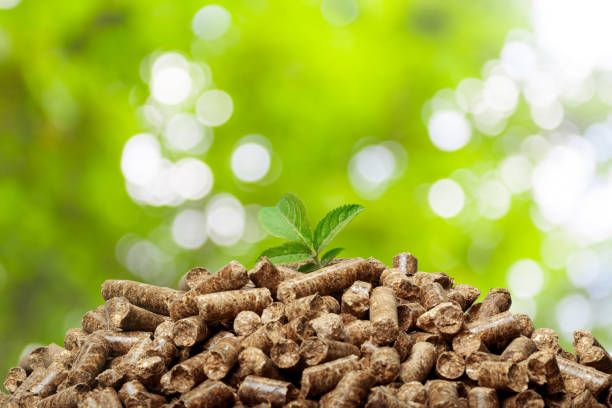
Vertical Wood Pellet Machines and Carbon Emission Reduction
Kingwood · May 26, 2026
The Carbon Reduction Case for Vertical Pellet Mills
Biomass energy’s carbon credentials depend heavily on how efficiently raw feedstock is converted into fuel. Inefficient processing wastes material, consumes excess auxiliary energy, and produces avoidable emissions at the plant level — all of which erode the carbon advantage biomass holds over coal or heavy fuel oil.
Vertical wood pellet machines address these inefficiencies at the process level. By orienting the compression axis vertically, these machines achieve more uniform feedstock distribution across the die, improving pellet density consistency and reducing rejected or undersized output. The result is more usable fuel per ton of raw material — a direct improvement in the carbon efficiency of the production process.
Kingwood’s vertical pellet mill lineup — including the JWZL-688D at 3–3.5 t/h, the JWZL-928 at 4–5 t/h, and the JWZL-688 at 2–2.3 t/h — is engineered specifically for industrial biomass fuel production where feedstock quality and throughput consistency are commercial requirements, not aspirational targets.
How Vertical Design Reduces Operational Emissions
The emission profile of a biomass pellet plant is not determined solely by combustion. Dust generation, energy waste in auxiliary systems, and unplanned downtime all contribute to a facility’s actual carbon output per ton of product. Vertical pellet mills reduce these operational emission sources through three design characteristics.
Compact footprint and equipment integration. Vertical mills occupy less floor area than horizontal ring die equipment of equivalent throughput. This allows tighter physical integration with upstream drum dryers and downstream counter-flow coolers, shortening material transfer distances and reducing conveying energy consumption — a meaningful efficiency gain at industrial scale.
Dust-Free enclosed processing. Under Kingwood’s Three-Standardization Framework — Integrated, Dust-Free, and Automated production lines — vertical pellet mill installations incorporate fully enclosed material pathways and integrated dust removal systems. Open-floor biomass workshops are a documented source of fugitive particulate emissions. Kingwood’s Dust-Free implementation, demonstrated at the 2024 Guizhou facility, eliminates these uncontrolled releases at source rather than managing them downstream.
Automation-driven process consistency. Automated feed rate control and die pressure monitoring reduce the energy spikes and off-spec output associated with manual operation. Consistent pellet density directly affects downstream combustion efficiency: denser, uniform pellets burn more completely, reducing unburned carbon and stack emissions at the point of use.
Biomass pellets produced on Kingwood lines carry a calorific value of 4,800 kcal/kg with sulfur content below 0.3%, ash below 18%, and dioxin content below 0.5 ng TEQ — meeting EU, US, Japanese, and ISO fuel quality standards simultaneously. All emission indicators fall below China’s GB13271-2001 national boiler air pollutant standard.
Feedstock Flexibility as a Sustainability Multiplier
A vertical pellet mill’s contribution to carbon reduction extends beyond the machine itself. The ability to process diverse feedstocks — wood waste, sawdust, agricultural residues, forestry byproducts — enables facilities to divert materials from open burning or landfill disposal, both of which generate CO₂, methane, and particulate matter with no energy recovery.
Kingwood’s wet-feed complete pellet production lines are designed around this feedstock reality. The integrated process sequence — crushing, coarse grinding, drying, fine grinding, pelletizing, and packaging — handles high-moisture raw biomass that would be rejected by simpler dry-feed systems. This processing capability allows operators to source feedstock from a wider supply base, improving both supply chain resilience and the total carbon avoided per facility.
Complete line capacity reaches up to 200,000 tons per year. The 24 t/h Vietnam wood chip pellet production line commissioned in 2023 and the 12 t/h Vietnam line commissioned in 2024 — which achieved full capital payback in 23 months — demonstrate what this feedstock flexibility delivers at commercial scale. Across both projects, the ability to process variable-moisture wood chip feedstock was a primary factor in line selection.
Selecting the Right Vertical Pellet Mill for Industrial Carbon Goals
For procurement teams and project developers evaluating vertical pellet mills against carbon reduction targets, the relevant specification variables are throughput capacity, feedstock moisture tolerance, automation level, and dust control architecture — not headline motor ratings.
Kingwood’s vertical model range spans 1 t/h to 5 t/h per machine. The JWZL-420 at 1–1.5 t/h suits smaller distributed installations; the JWZL-688 at 2–2.3 t/h and JWZL-688D at 3–3.5 t/h cover mid-scale industrial requirements; the JWZL-928 at 4–5 t/h is positioned for high-throughput fuel production operations. Multi-machine configurations within integrated production lines scale throughput further without compromising the Dust-Free and Automated standards that determine a facility’s actual emission profile.
The JWZL-1068 addresses higher-capacity requirements — contact Kingwood’s technical sales team for configuration and throughput specifications.
Jiangsu Kingwood Industrial Co., Ltd. has designed over 2,000 production line projects across 30 countries since its founding in 1999. The company holds ISO 9001, ISO 14001, and CE certifications and is listed on the NEEQ exchange under stock code 871765. Engineering inquiries for complete biomass pellet production lines, including carbon impact assessments for specific feedstock and capacity requirements, can be directed to Kingwood’s technical sales team at #568 Hongsheng Road, Liyang City, Jiangsu Province, China.
FAQ
How do vertical wood pellet machines reduce carbon emissions compared to horizontal pellet mills?
Vertical pellet mills compress biomass more efficiently per unit of feedstock, extracting more energy from the same raw material volume. This means fewer input materials and less auxiliary energy consumption per ton of output pellets — directly lowering the carbon intensity of biomass fuel production. Kingwood's vertical models such as the JWZL-688D are engineered with enclosed processing and integrated dust removal under the Three-Standardization Framework, further reducing fugitive emissions at the plant level.
What types of biomass feedstock can vertical pellet mills process?
Kingwood's vertical pellet mills are designed to handle a wide range of lignocellulosic feedstocks including wood waste, sawdust, agricultural residues, and energy crops. This feedstock flexibility allows facilities to utilize materials that would otherwise go to landfill or open burning — both of which generate avoidable CO₂ and particulate emissions.
What is the carbon profile of biomass pellets produced by Kingwood equipment?
Biomass pellets produced on Kingwood lines carry a calorific value of 4,800 kcal/kg, sulfur content below 0.3%, ash content below 18%, and dioxin content below 0.5 ng TEQ. All emission indicators fall below China's GB13271-2001 national boiler air pollutant standard. These specifications meet or exceed EU (<15% moisture), US (>2,500 kcal calorific), Japanese (≤0.5% sulfur), and ISO (<20% ash) standards.
How does the compact footprint of a vertical pellet mill benefit industrial facilities?
Vertical pellet mills occupy significantly less floor area than equivalent-capacity horizontal ring die configurations. For greenfield projects or retrofits inside existing biomass facilities, this reduces civil construction costs and allows tighter integration with upstream drying and downstream cooling equipment. Kingwood's JWZL-928, for example, delivers 4–5 t/h within a machine geometry that fits constrained plant layouts.
What automation features do Kingwood vertical pellet mills include for emission control?
Kingwood vertical pellet mills are built under the Three-Standardization Framework — Integrated, Dust-Free, and Automated production lines. Dust-Free design means fully enclosed material handling and integrated dust removal, eliminating the uncontrolled particulate releases common in open-floor pellet workshops. Automated controls reduce manual intervention, improving process consistency and reducing energy waste per production cycle.
Can a complete Kingwood pellet line achieve meaningful cost savings versus fossil fuels?
Yes. Biomass pellets produced on Kingwood lines deliver a documented 40–50% cost saving versus conventional fossil fuels. A 12 t/h wood pellet line deployed in Vietnam in 2024 achieved full capital payback in 23 months, validating both the economic and the carbon-substitution case for industrial-scale biomass pellet production.
What certifications confirm Kingwood's environmental and quality standards?
Kingwood holds ISO 9001 and ISO 14001 certifications, CE marking, and is recognized as a Jiangsu Provincial High-Tech Enterprise. The company is also a Deputy Director Member Unit of the China Biomass Energy Industry Alliance and has received the Top 10 Brands in Biomass Molding Equipment designation — all of which independently verify manufacturing quality and environmental management systems.
- Biomass pellets produced on Kingwood lines cut fuel costs by 40–50% versus fossil fuel alternatives, with a 12 t/h Vietnam installation achieving 23-month capital payback. (2024, Kingwood Vietnam 12 t/h project case study, kingwoodpellet.com)
- Kingwood has planned and designed over 2,000 biomass pellet production line projects across 30 countries since 1999. (2025, Jiangsu Kingwood Industrial Co., Ltd. company profile, kingwoodpellet.com)